A Giant Deep-Sea Scavenger Sat Unnamed in a German Collection for Decades

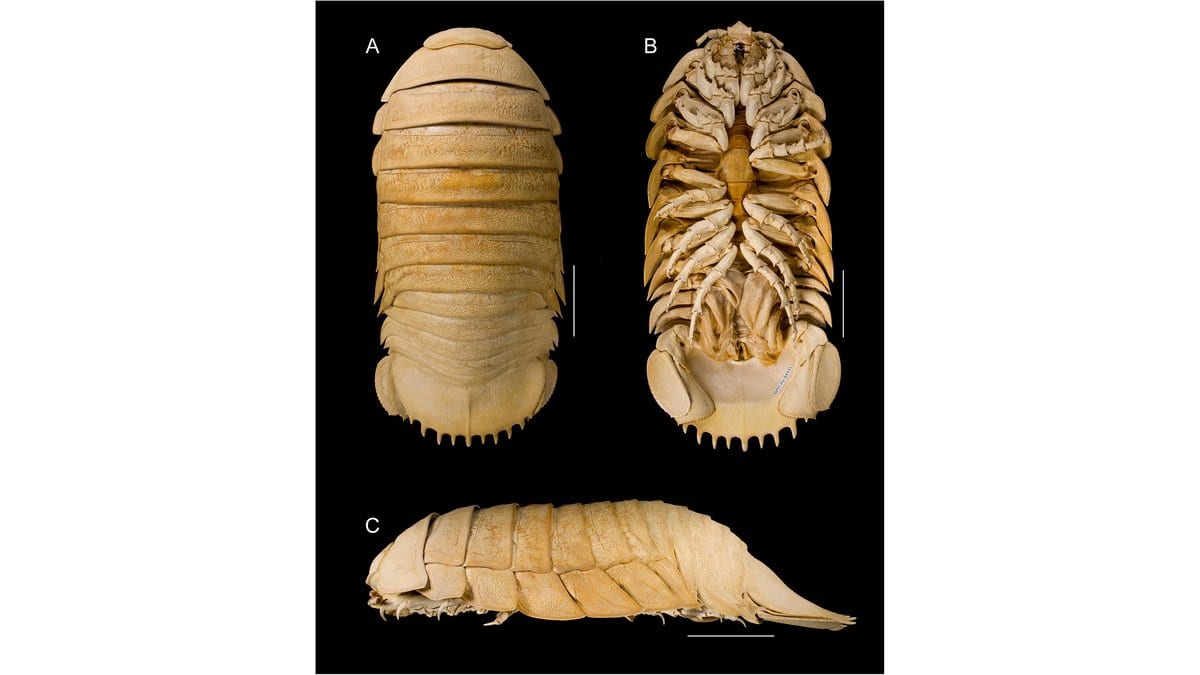
The animal is 322 millimeters long, dried to a yellow-beige, and it has sat in a cabinet in southern Germany since the late 1980s. For most of that time it carried a name: Bathynomus giganteus, the giant isopod of the western Atlantic. That is what something this size would be expected to be, trapped off Puerto Rico. It was even a central exhibit in a special show at the State Museum of Natural History in Stuttgart. What had not been done was a close look at its mouthparts, which descriptions in this group often skip.
Ingmar Werneburg and Benedikt Kästle, both at the Senckenberg Centre for Human Evolution and Palaeoenvironment and the geosciences department at the University of Tübingen, took the specimen out. They photographed it, put it through an X-ray scanner and drew what the scan showed. Writing in Scientific Reports on Oct. 8, 2026, they describe it as a species nobody had named. Bathynomus tuebingoborikensis takes its name from Boríken, the Taíno word for Puerto Rico, and from Tübingen, the city where it had been sitting.
Giant isopods are deep-sea scavengers, built like the woodlice under a flowerpot and scaled up to the length of a forearm; the largest grow to about 50 centimeters. They eat what sinks, including the carcasses of fish, squid and whales. This one came up in a trap on the seabed 500 meters down. It was acquired at a marine research station in Puerto Rico by the late Tübingen paleontologist Adolf Seilacher, known for reading ancient environments out of the tracks and burrows animals leave.
The holotype is the single specimen a new species is pinned to. This one differs from its nearest relatives in a list of small things: the shape of the plate over its mouth, the number of stout bristles on its jaw appendages, how far the tail fan reaches. The authors add that one feature turns up in no other member of the genus: a row of curved, comb-like bristles along the last pair of legs, possibly used to groom the swimming limbs. They note that it may also simply have been overlooked in earlier descriptions. The species rests on this one dried female, its antenna tips missing and its swimming limbs distorted by drying.
The other half of the paper is the ambitious half. Werneburg and Kästle scored 23 living species and four fossil ones on characters of body shape, the first family tree of the genus built from anatomy rather than genes, and that tree puts the root of the group in the Caribbean. It cuts against the molecular work, which has often placed an East Asian species near the root and suggested an Asian origin. The gene fragments usually used for that work are short stretches of DNA, which they argue cannot resolve relationships inside a genus. They call the analyses preliminary in the abstract, in the methods and in the discussion.
On a map of the world as it looked about 14 million years ago, they sketch up to ten waves of spreading out of that Caribbean beginning: south along Brazil, west through the still open gap at Panama and on to Japan. From there the tree runs through a long spell of new species in the Australasian seas, west again to Madagascar and the Mediterranean, and back to the Americas two or three separate times. Those routes are read off the shape of the tree rather than from dated fossils at each step, a scenario rather than a chronology.
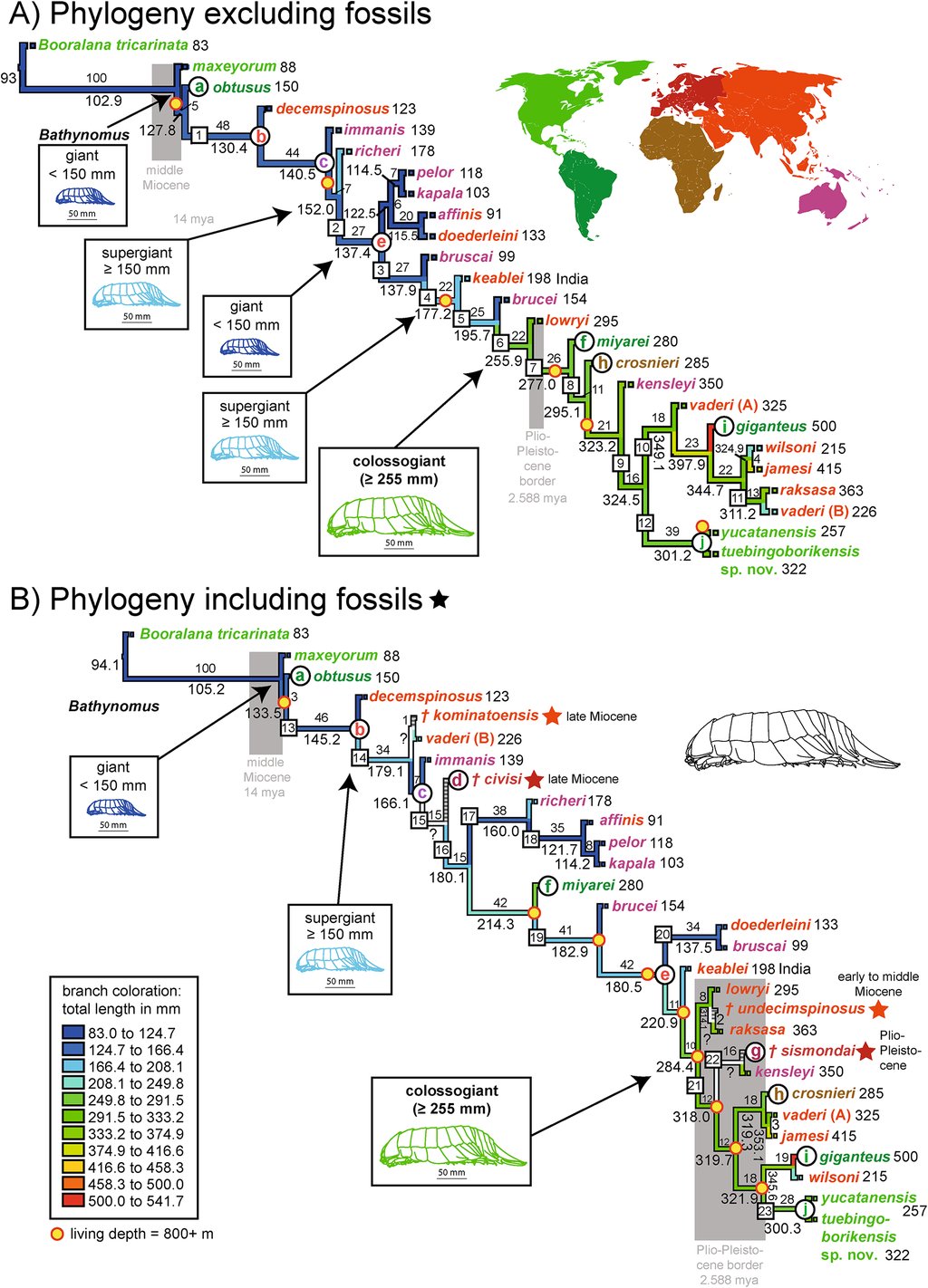
The size result is the one most likely to be mangled in the retelling. Giant and supergiant were already in use for this genus, and Werneburg and Kästle add a third label, colossogiant, for species reaching 255 millimeters or more. They reconstruct a single jump of about 30% in body length at the point where that group appears. That jump sits far from the Caribbean root, in a more advanced part of the tree they place in the Australasian seas, and inside the colossogiant group several species became smaller again. They tie the increase to a cooling ocean late in the Pliocene, just before the ice ages, and suggest the physiology for being that large appeared only once, at the origin of the genus.
The result they flag as unexpected is what size does not track. Across the same set of species, body size showed no relationship with the depths at which they have been recorded living, which the authors read as a sign that very deep water does not by itself favor growing big. Those depths come out of the literature, often a single record per species, and gaps in the table were filled in with the average for that measurement. The authors expect these animals are flexible about depth.
What the authors want read off all this is a point about collections. They write that misidentified specimens are a recurring problem in the genus, usually defaulting to B. giganteus, which has hidden how many species there are. More species have been described from the Indo-Pacific than from the Americas, a gap of sampling effort rather than of animals. The holotype photographs, the X-ray renderings of the mouthparts and the migration map are published under a Creative Commons license, free to reuse with credit, and the scan data is available from the authors on request. Their own new species spent decades in a drawer under the wrong name, in a collection that had it out on public display.
Sources
- Scientific ReportsPeer-reviewed