Two Enzymes Must Act in Sequence Before the Toxoplasma Parasite Can Invade a Cell

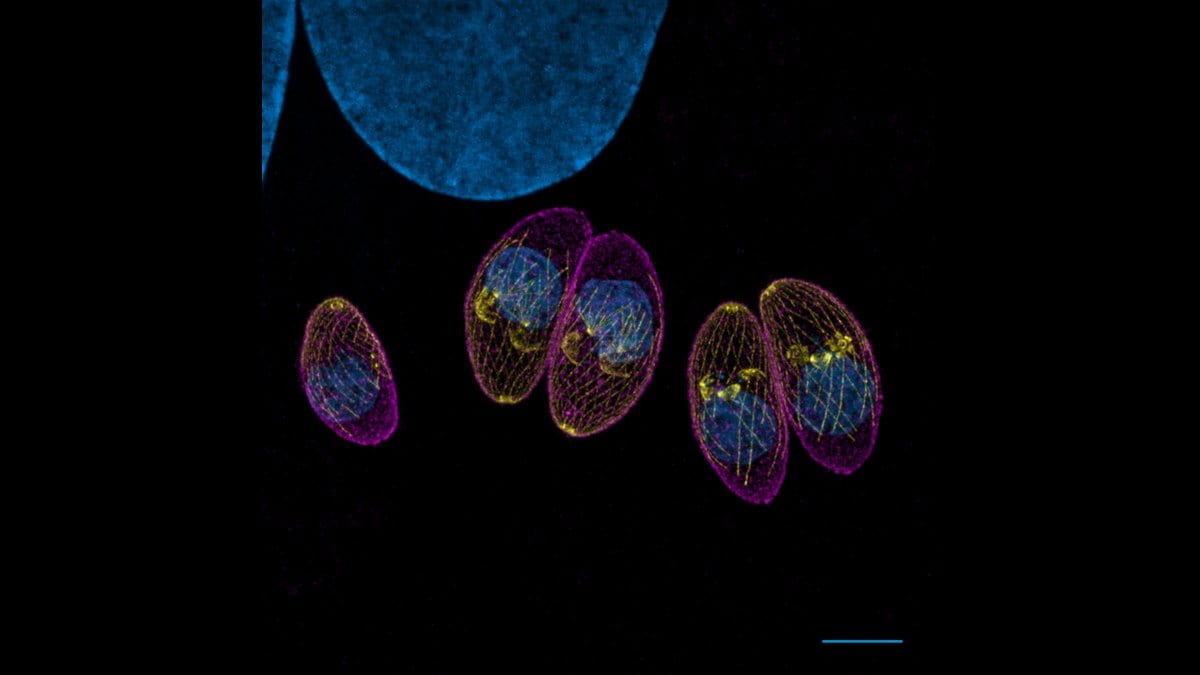
Most parasites that end up inside a human cell get there by being swallowed. Toxoplasma gondii does not wait for the invitation. It sets its narrow end against the membrane of a cell and drives itself through, and it leaves the same way, breaking out to find the next one. The engine is a layer of actin filaments built at the parasite's front tip and clipped to gripping proteins on its surface, so that assembling the filaments pulls the whole parasite forward.
Cell biologists have had the parts list for years. What has been harder to see is what has to happen before any of it runs. Peipei Qin, Elena Jimenez-Ruiz and colleagues at LMU Munich's Faculty of Veterinary Medicine report that two enzymes have to act at the tip first, one after the other, and that the chemistry they use is borrowed from somewhere unexpected.
Both are lysine methyltransferases: enzymes that fasten a small methyl group onto a protein, changing how it behaves or what it sticks to. That chemistry is best known from the cell nucleus, where methyl marks on the proteins packaging DNA help decide which genes are read. The newly described enzyme, which the team calls TgPCKMT, works nowhere near the nucleus. It sits in a ring of protein at the extreme tip of the parasite, just above the conoid, a small cone of fibers that Toxoplasma pushes out like a piston in the moment before it moves. The work appeared in Nature Communications on August 26, 2026.
"What surprised us is that the methylation here is not happening in the cell nucleus, where it is best studied, but directly on the parasite's locomotor apparatus," said Jimenez-Ruiz, who led the group, in the university's announcement, published in German. "These two enzymes appear to manage the transition from a parasite that is ready to move to one that can actually generate force."
Take the enzyme away and the parasite stays put
To find out what TgPCKMT does, the team built parasites in which the gene could be cut out on command, then watched what broke. Inside a host cell, the parasites went on dividing normally. They simply could not get out. Even when the researchers forced the exit signal with a calcium ionophore, the parasites tore open the compartment they were sitting in and then stalled; the actin that should have gathered at their back end never arrived. Their ability to invade a fresh cell fell to the level seen when actin itself is removed, and on a lawn of human cells they cleared no plaques at all after a week.
None of that came from a broken tip. Cryo-electron tomography showed the conoid still fully built. What had gone missing was a single protein: Formin-1, the nucleator that starts new actin filaments. It normally waits at the tip and, without TgPCKMT, is not there at all. The dependency runs one way. Strip out Formin-1 and TgPCKMT stays where it is.
Changing one amino acid in the enzyme's catalytic site was almost as damaging as deleting the whole gene. Parasites carrying only the inactive version recovered some invasion and some gliding, but still could not escape a host cell, and Formin-1 was again largely absent from mature parasites. The authors are careful about what that means: the enzyme's activity, and "to a certain extent its structural presence", are both needed, which they describe as a dual role, part scaffold and part enzyme. It is not a clean chemical trigger.
The second enzyme cannot leave until the first has acted
The second enzyme, TgAKMT, is not new. It has been on the list of Toxoplasma motility regulators since 2011. It sits at the conoid in a resting parasite, lets go the moment motion begins, and travels to the back of the cell with the connector that couples actin filaments to the surface grips. What this paper adds is where it falls in the queue. Without TgPCKMT, TgAKMT stayed at the tip and did not move. Without Formin-1, the same. Block actin assembly with cytochalasin D, and again it stayed. The sequence the authors draw runs: TgPCKMT, then Formin-1, then actin, then TgAKMT and the connector, with the two enzymes holding their own positions independently of one another.
Every one of those results comes from taking a part away. That is the work the authors' own verb is doing when they write that TgPCKMT "licenses" Formin-1-dependent motility: the step has to be in place before the parasite can move, which is not the same as showing the step is enough on its own to set it moving.
There is a hole in the middle of this, and the authors put it in their own discussion. A methyltransferase works by methylating something, and nobody yet knows what these two are methylating. Defining the exact sites and the direct substrates, they write, "lies beyond the scope of the present study". Actin itself is probably not one of them: it did not turn up in either the methylation survey or the proximity-labeling experiment, so whatever these enzymes do to actin dynamics they most likely do at one remove. Formin-1 is the obvious candidate, and it is the only protein besides TgPCKMT to appear across all four of their proteomic datasets, but appearing near an enzyme is not the same as being modified by it.
The malaria arm is one enzyme, not two
Toxoplasma is a convenient laboratory organism; the reason a result like this travels is Plasmodium falciparum, the parasite that causes the deadliest form of malaria and invades red blood cells with a version of the same apparatus. The team tested one enzyme there, PfSET9, the counterpart of TgPCKMT, previously known only for a role in the parasite's sexual stage. It shows up as a single bright dot at the front of a merozoite, close to that species' Formin-1. With PfSET9 depleted, the Formin-1 signal looked reduced or partly misplaced, and the parasites did not make the next generation: schizonts accumulated on schedule while new ring stages collapsed, which the authors read as a failure to invade, and possibly to get out.
That is one enzyme, not two. TgAKMT's Plasmodium counterpart was not touched, and the authors say so themselves in a sentence worth reading in full: a detailed mechanistic investigation of PfSET9, comparable to the one they performed in Toxoplasma, "remains the subject of ongoing work".
LMU's announcement goes one step further than the paper does, noting that because these methyltransferases are specific to apicomplexan parasites, compounds that block them could interfere with movement and invasion without hitting an equivalent enzyme in human cells. The paper makes no therapeutic claim and tests no compound.
What the group says it wants next is the ookinete, the motile form Plasmodium takes inside a mosquito, which keeps a fuller conoid than the blood stages do and lives by moving. If the ordering holds anywhere outside Toxoplasma, that is where it should show.
Sources
- doi.orgPeer-reviewed
- idw-online.de