Scientists Catch a Stretch of Ocean Crust Being Born, as It Happens

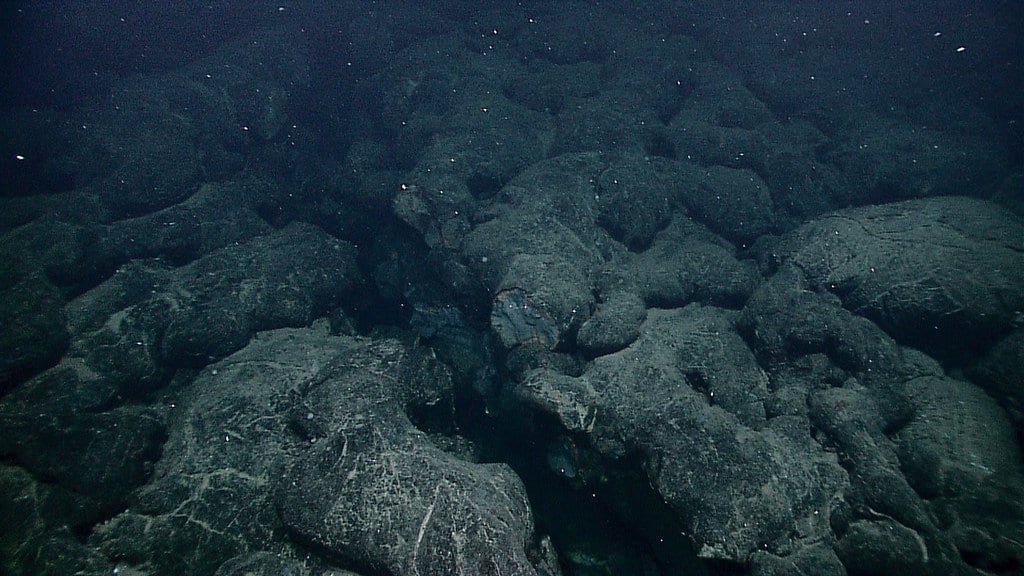
The place where most of Earth's surface is made lies kilometres underwater, in near-total darkness, along a seam that winds around the planet like the stitching on a baseball. Mid-ocean ridges are where two tectonic plates pull apart and molten rock rises to fill the gap, cooling into fresh oceanic crust. Over geological time, this factory has paved two-thirds of the planet. And until now, no one had ever caught it in the act.
A team reporting in Nature has recorded a seafloor-spreading event in real time, using an array of instruments planted directly on the Southeast Indian Ridge, near the remote Amsterdam Island in the southern Indian Ocean (Nature, 10.1038/s41586-026-10785-0). Beginning around 26 April 2024, the seafloor beneath the sensors dropped by about 4 metres and stretched apart by more than a metre, over a span of days, as magma welled up into the widening crack. It is the first in-situ recording of the fundamental process that builds ocean floor.
That "in situ" is the whole point. Geologists have long inferred how spreading works: from the striped magnetic patterns frozen into the seabed, from earthquakes picked up by distant networks, from surveys of ridges long after the fact. But those are all read from the aftermath, like reconstructing a car crash from skid marks. What the ocean-floor record has lacked is a front-row seat: instruments sitting on the ridge itself while it tears open.
The technique that delivered it is called seismogeodesy, a marriage of two kinds of measurement. Seismometers on the seabed listen for the small earthquakes that accompany rock fracturing and magma moving. Geodetic sensors, meanwhile, track the slow, silent deformation of the ground itself: how far the seafloor sinks, and how much it slides apart. Combine the two, and you can watch both the sudden cracks and the steady stretch that ordinary earthquake catalogs miss entirely. Together they turned a single spreading pulse into a continuous, quantified record.
The numbers tell a story of a segment giving way. The roughly 4 metres of subsidence marks the valley floor dropping as the crust beneath it split and magma redistributed underground; the extension (more than a metre of the seafloor pulling apart) is the spreading itself, the plates edging away from each other in a burst rather than a smooth creep. Events like this, punctuated and fast on human timescales, are thought to be how ridges do much of their work, in fits separated by long quiet intervals.
This is not a surprise overturning textbooks. Coverage of the find has been broad since early July, and the basic picture of how crust forms at ridges is well established. The advance is one of resolution: a direct, multi-instrument recording of an event that theory and inference had only ever described secondhand. It gives modelers real measurements (how much, how fast, and in what sequence) to test their pictures of magma supply and plate motion against, rather than assumptions.
The work is peer-reviewed, published in Nature alongside an accompanying News & Views commentary. Its lasting value may be as a template. If a single well-placed observatory can capture one spreading event in this detail, then the tens of thousands of kilometres of ridge circling the globe become, in principle, watchable: a planet-scale process finally observable in real time, one pulse at a time, from the seabed where it happens.
Sources
- NaturePeer-reviewed
- www.nature.com