A Network Built for Speech Is Being Asked to Finish Earthquake Simulations

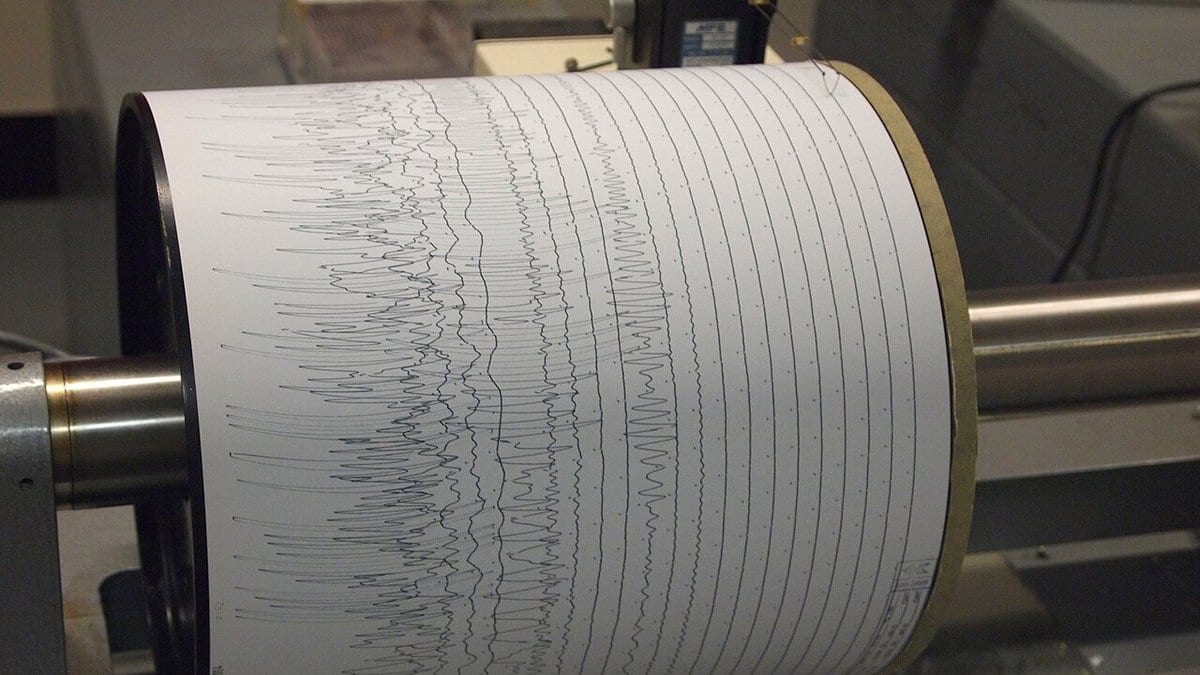
Run a physics-based earthquake simulation and what comes back is oddly incomplete. The mechanics are sound (a fault ruptures, waves spread through layered rock, all of it solved from first principles), and up to a few cycles per second the result tracks what seismometers record. Above that, in the fast, jagged part of the ground motion that cracks walls and trips machinery, the simulation goes quiet. Nobody knows the fine structure of the crust well enough to model it, and the computation would be unaffordable if they did.
That band is exactly the one earthquake engineering needs. Buildings, pipes and equipment respond to the fast wiggles, not the slow ones. The latest attempt to supply them comes from Gottfried Jacquet, Filippo Gatti and Didier Clouteau at the Laboratoire de Mécanique Paris-Saclay, and its central move is to stop computing the missing frequencies and generate them instead.
Their system is called SeismoALICE, and it is the laboratory's own; Gatti and Clouteau proposed the first version in 2020. It is a generative network trained adversarially (one part produces candidate signals, another tries to tell them from real recordings), and it is fed the low-frequency physics simulation as a condition, so what it invents has to stay consistent with the physics rather than float free. The output, described in a paper published in the open-access journal Seismica, is a broadband accelerogram covering 0 to 20 hertz at a single station.
What is new is the machinery in the middle. The authors rebuilt the encoder, decoder and discriminators around Conformer attention, an architecture developed for speech recognition, where the problem has a similar shape: a model must hold a long stretch of waveform in view while resolving detail milliseconds wide. Adversarial training of this kind is notoriously prone to collapse, and the authors report that the new architecture stabilized it. They also added similarity measures that score how closely a synthetic signal matches a real one in time and in frequency.
One limit is written into the paper's own title, and it governs what the method can be used for: the acceleration is normalized. The model reconstructs the shape and frequency content of the shaking, not how strong it was. There is no absolute amplitude in its output to set against a building code, a design basis or anything else, and the paper reaches no conclusion about the safety of any site.
On the Stanford Earthquake Dataset, a large public catalog of recorded waveforms, the authors report that the Conformer version recovers fine detail better than their previous approaches. That comparison is chiefly against their own earlier work, and no group outside the laboratory has evaluated the model. This is the awkward part of putting a learned component inside a physical simulation, which is easier to demonstrate than to check.
The showcase is the Le Teil earthquake. On Nov. 11, 2019, a magnitude 4.9 quake struck the lower Rhône valley near Montélimar and behaved nothing like its size. Jean-François Ritz and colleagues traced surface rupture along about five kilometers of the La Rouvière fault, an Oligocene structure France's active-fault database did not list, and placed the hypocenter roughly a kilometer down, extraordinarily shallow for a continental earthquake. Hundreds of buildings in Le Teil were badly damaged.
Because nothing was recording close to the fault, Mathieu Causse and colleagues had to reconstruct the near-field shaking from distant stations and from what the quake moved on the ground, including toppled funeral slabs and displaced rocks. Their estimate is that acceleration in the immediate fault vicinity locally exceeded gravity, which is what an event of that magnitude should not do, and what makes it worth reconstructing at all.
The Cruas nuclear plant sits about 12 kilometers north of the epicenter, and it is where Jacquet and colleagues point the synthesizer, predicting the seismic response at the site. Their own framing of the exercise is a showcase, one that provides "insightful perspective for future large-scale applications." The paper claims no engineering, qualification or regulatory use.
The code is archived and openly licensed (SeismoALICE-v2 on Zenodo, under CC BY), so another group can run it rather than take the comparison on trust, and Seismica publishes its referee reports alongside the article. Both are unusual, and both matter here, because nobody outside the group has yet run the model against their own data.
What the work delivers is a synthesizer and a single demonstration of it: one event, one site, signals with their amplitude divided out. The next question is whether the fine detail the network invents is the fine detail an instrument would record, and answering it will take groups other than the one that built it.