Astronomers Watch a Giant Star's Wind Fall Onto the Tiny Star Beside It
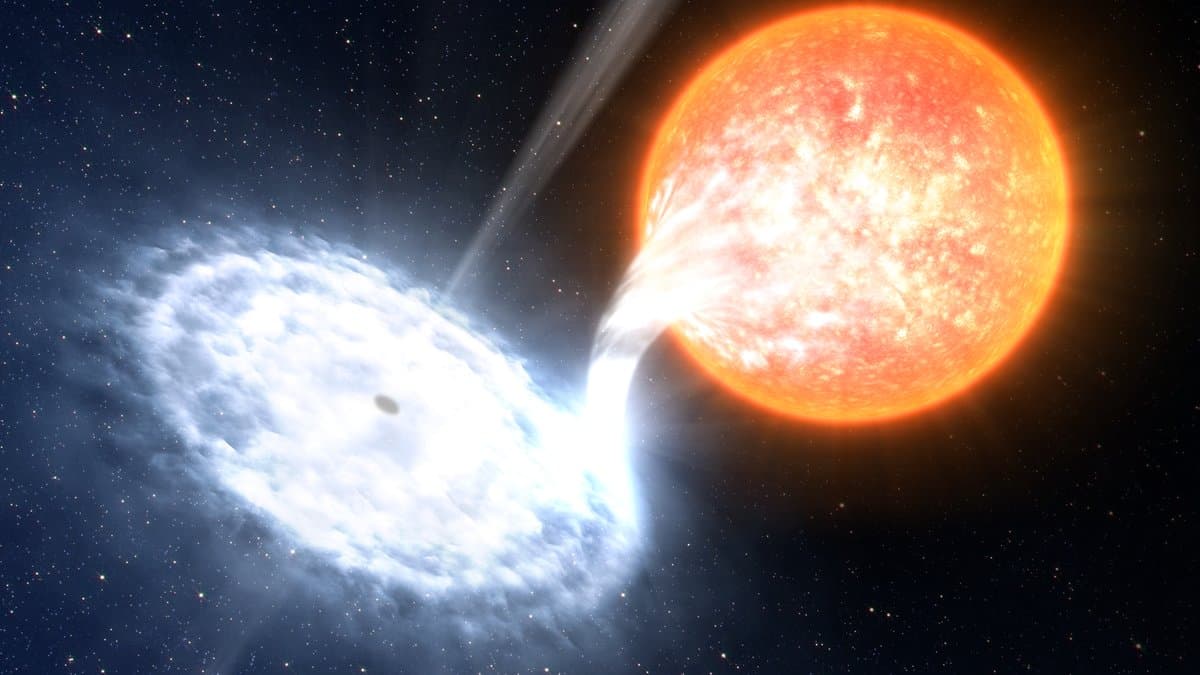
Astronomers using the NASA and JAXA observatory XRISM have measured gas pouring off a giant star and falling onto the small, collapsed star that orbits it, at about 335,000 miles per hour. The team, led from the University of Maryland, Baltimore County and NASA's Goddard Space Flight Center, says that falling gas is what powers the system's bursts of X-rays.
Their paper appeared Sept. 18 in Science Advances. "We've never before seen clear indications of wind plasma falling onto a compact object," said Roi Rahin, who led the work. "We can now test our understanding of these processes in much greater detail."
The system is BP Crucis, about 13,000 light-years away in the southern constellation Crux. Its bright member, Wray 977, is a blue hypergiant roughly 40 times the Sun's mass, hot enough that gas streams off it continuously. Its companion, GX 301-2, is a neutron star: the crushed core left by a supernova, holding more than the Sun's mass in a ball about 12 miles across. It spins fast enough to sweep a beam of X-rays past Earth, which makes it a pulsar.
The researchers pointed XRISM at the pair on Feb. 1, 2025, near the end of one of the system's flares. The observatory's Resolve spectrometer, built jointly by the two agencies, recorded absorption lines from iron sitting at lower energies than they would in a laboratory. That shift, a redshift, means the gas is moving away from Earth and toward the pulsar, and its size gave the speed.
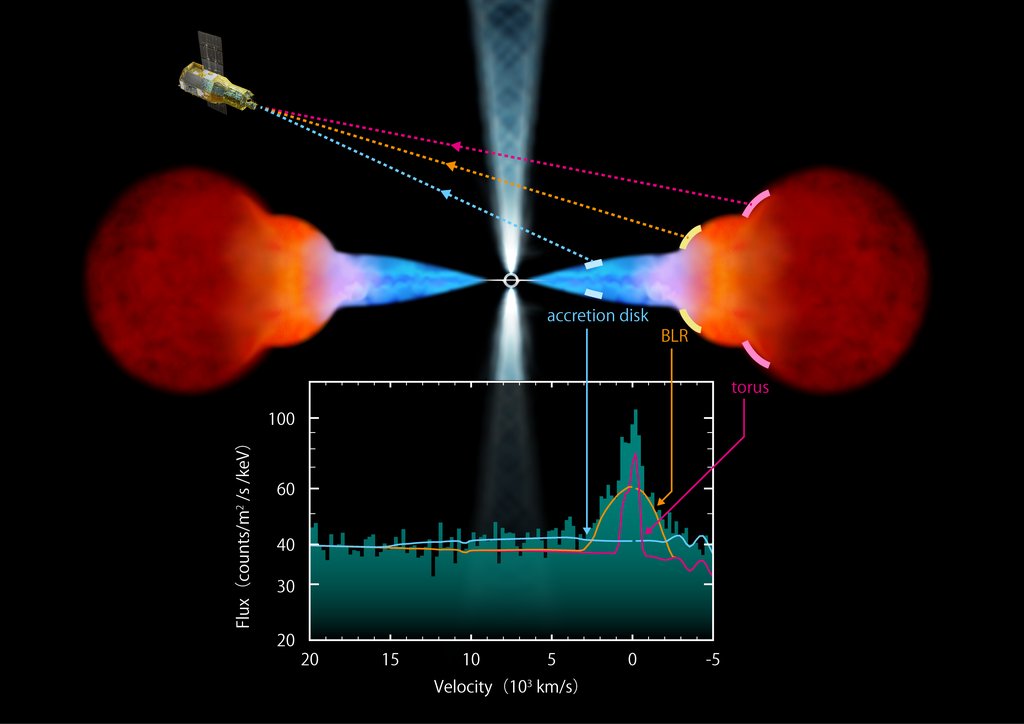
In the team's account, the pulsar sweeps the gas into a turbulent disk, which spirals inward, heats up and radiates the X-rays. Farther into the stream, the disk falls apart and plasma drops straight onto the neutron star, the phase XRISM caught. The crossing takes about four days.
Flares like it recur twice in every 41.5-day orbit, NASA says, near the pulsar's closest and farthest approaches, and the strongest come when it passes nearest the star.