Hidden Behind Our Galaxy, a Radio 'Treble Clef' Turns out to Be Two Clusters Colliding
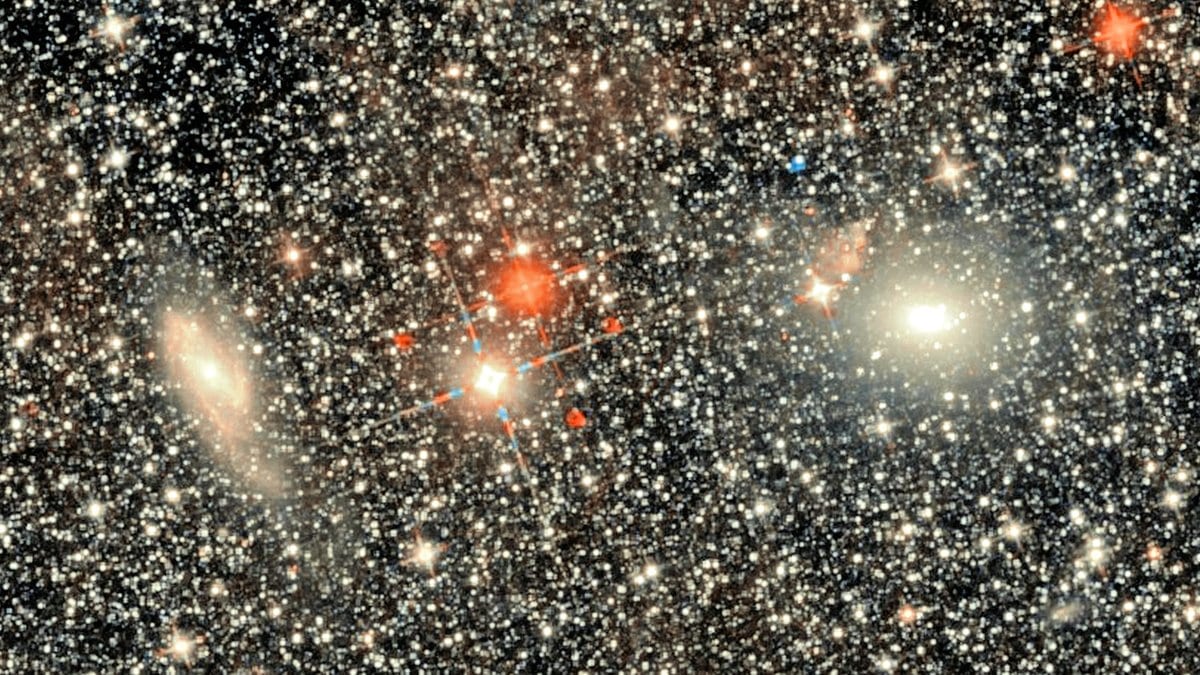
Astronomers have traced a bright, curling radio source nicknamed the "Treble Clef" to a massive galaxy cluster hidden behind the plane of the Milky Way, and identified the source itself as a radio phoenix: old charged particles from a black-hole outburst, relit by a collision between two clusters.
Andrea Botteon of Italy's National Institute for Astrophysics (INAF) and 17 colleagues report in Astronomy & Astrophysics that they have measured the host cluster's properties for the first time, among them its distance, mass, temperature and whether it is settled or disturbed. The paper was published online Oct. 9, 2026.
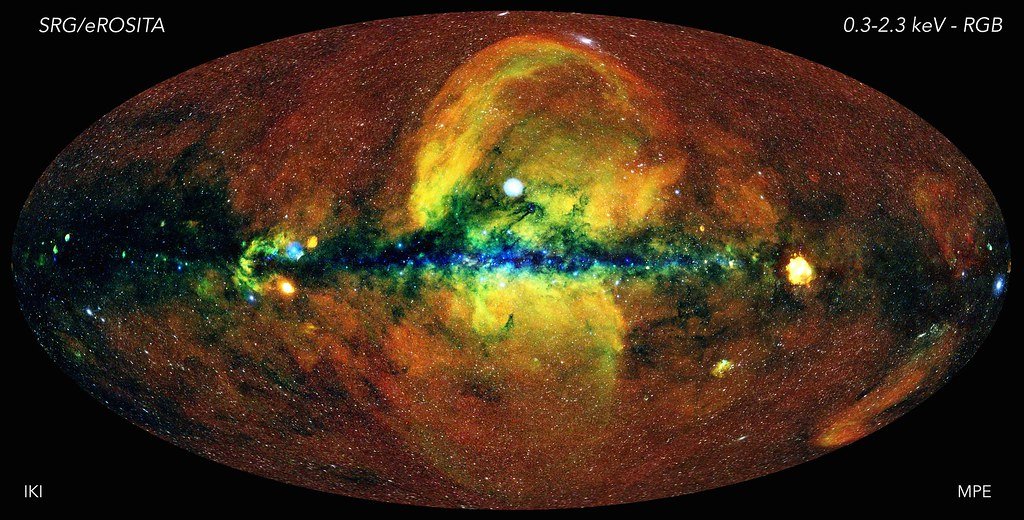
NASA says an explanation had been hard to find because the formation sits in the zone of avoidance, the part of the sky that our own galaxy's stars, gas and dust block from view. NASA's Chandra X-ray Observatory and the German eROSITA telescope saw through that material and found hot, diffuse gas at the source's position, showing that a galaxy cluster sits there and is really two clusters merging.
NASA says the authors traced the collision by fitting a symmetrical oval to the cluster's hot gas and subtracting it from the X-ray image. What was left is brightest to the left and right of the center, implying a collision along that direction. The researchers put it a few hundred million years ago and say the clusters are now moving apart.
The authors' explanation has two stages. A supermassive black hole at the cluster's center first drove clouds of charged particles and magnetic fields outward at close to the speed of light, and the radio waves they produced faded as the particles lost energy. The merger then compressed and reenergized that cloud, brightening it again. The authors put the source's tangled shape down to gas motions during the merger, which they describe as speculation.
The signal fades unusually fast toward higher frequencies, steepening to a spectral index above 4 between 400 and 650 MHz. On that basis the authors call it a good target for the next version of the LOFAR radio array, which observes at very low frequencies.
Sources
- science.nasa.gov
- Astronomy & AstrophysicsPeer-reviewed