Solar Orbiter Traces a Kink in the Solar Wind Back to the Sun's Surface
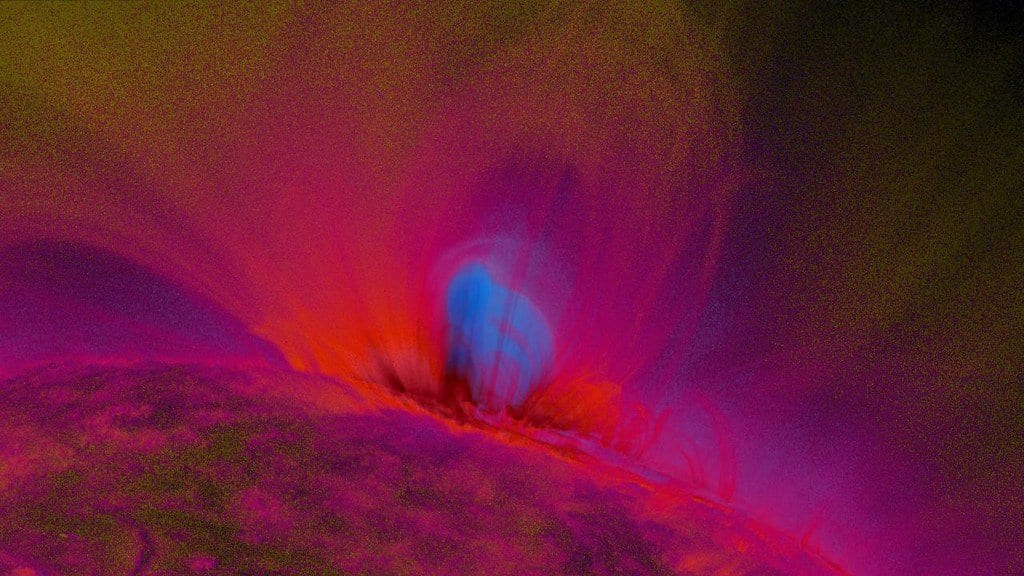
The European Space Agency reported Oct. 8, 2026, that its Solar Orbiter spacecraft has traced one of the solar wind's magnetic kinks back to its birthplace on the Sun. The spacecraft flew through a large S-shaped fold in the field, called a switchback, and sampled the particles inside it. According to ESA, the mix of charged oxygen and carbon it found could only have formed within hot magnetic field loops at the surface of the Sun.
Beyond the kink itself, ESA says the result shows how the Sun heats its atmosphere and accelerates solar wind particles into space. ESA also says the Sun's atmosphere stamps its signature onto those particles, which could let researchers read the history of solar plasma far from the star.
The sample was taken by Solar Orbiter's Solar Wind Analyser, roughly halfway between Earth and the Sun. "Solar Orbiter flew through a very large switchback," said Jesse Coburn of CNRS/LPP in France, lead author of the paper, published Oct. 8, 2026, in Nature Astronomy. "Because of this, we were able to sample rarely observed particles there that have tell-tale fingerprints of their origin."
How switchbacks form has been argued over for years, with two main candidates. ESA's release says the particle mix points to interchange reconnection, which happens where open and closed regions of the Sun's magnetic field meet, snap and rejoin, letting trapped plasma escape. The team also sees signs of the rival explanation, waves and turbulence, but likely only once the switchback is on its way out. "Our finding reconciles the two, showing that they simply operate at different stages in a switchback's lifetime," said co-author Stephanie Yardley of Northumbria University in the UK.
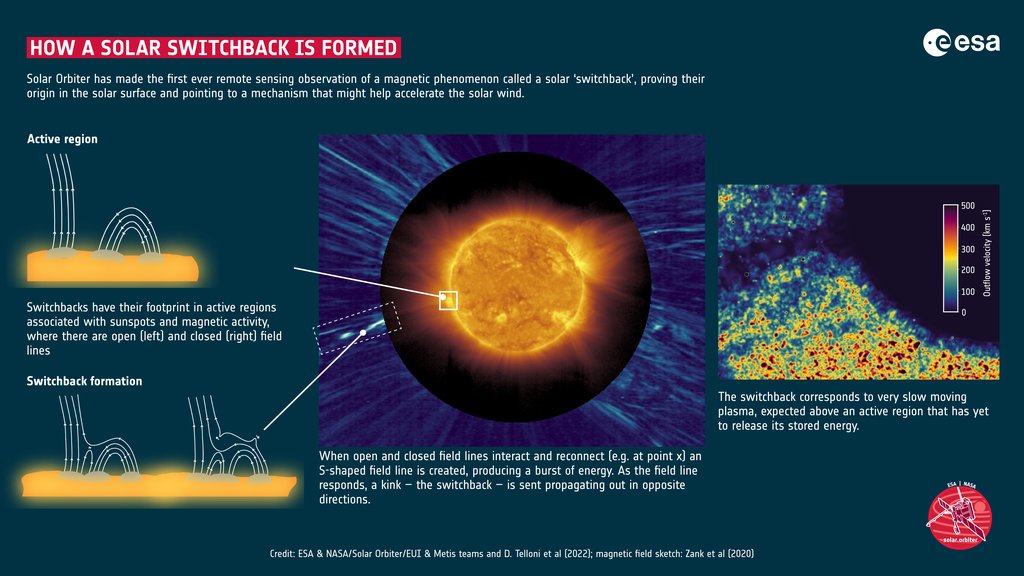
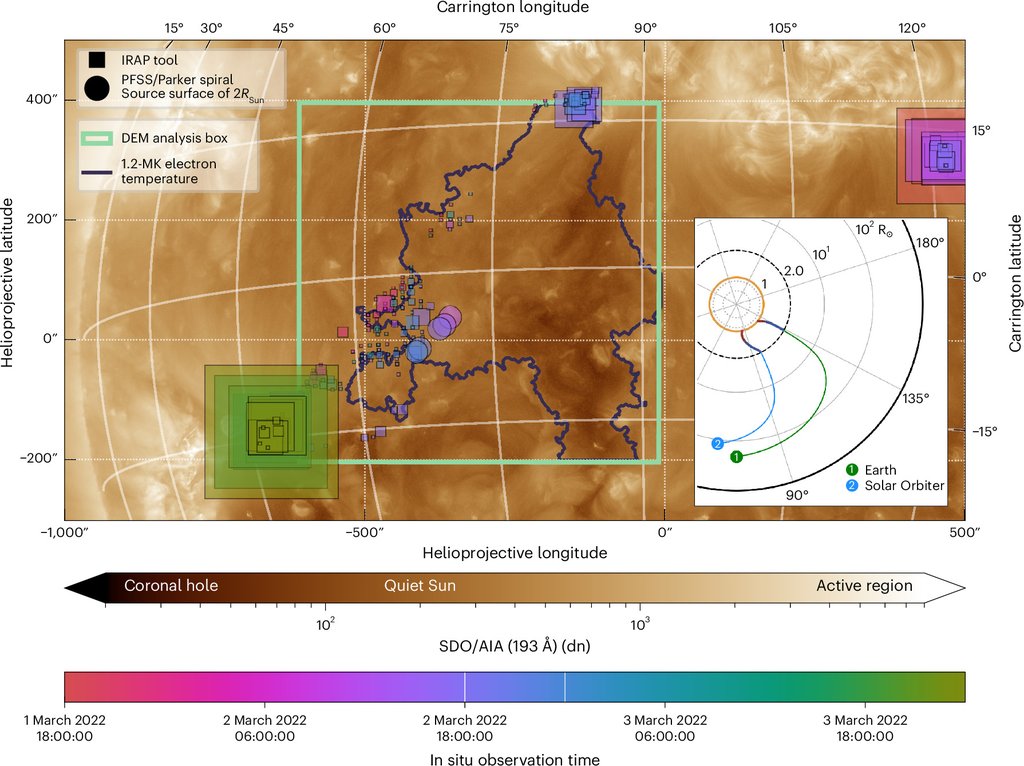
Solar Orbiter's earlier encounter with a switchback, reported by ESA in 2022, confirmed the S-shape that scientists had predicted but never seen directly. For the new work, the researchers combined the spacecraft's on-the-spot particle measurements with images of the Sun and magnetic field models, then used a new model to link them to data from NASA's Solar Dynamics Observatory and locate the source region.