Hubble Spots a Ten-Sided Wave Circling Saturn's South Pole
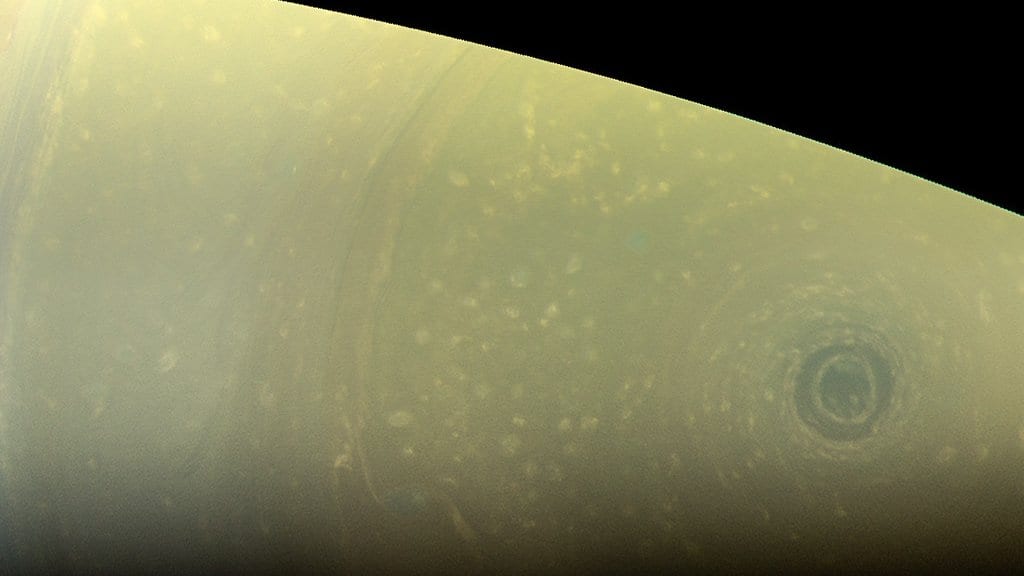
A ten-sided atmospheric wave is circling Saturn's south pole, according to a paper published Sept. 2 in Science Advances by Agustín Sánchez-Lavega of the University of the Basque Country and co-authors at NASA's Goddard Space Flight Center, the University of California, Berkeley, and the University of Leicester.
The paper places the decagon at planetographic latitudes of about 58 to 63 degrees south, in ground-based and Hubble Space Telescope images taken in 2025. Hubble images from 2023 and 2024 show the same vertices and straight sides at weaker albedo contrast, which the authors say implies an evolving feature rather than a long-standing one.
The paper measures the pattern drifting eastward at 2.5 meters per second, far slower than the 116-meter-per-second jet at 60.5 degrees south. The longitudes of its vertices oscillate over a period of 32 days, with amplitudes of 4.6 to 8.4 degrees.
Saturn has a long-lived, nearly stationary hexagonal wave near its north pole, coupled to an intense eastward jet. No similar wave had been reported in the southern hemisphere or elsewhere on Saturn.
What produces the decagon is not settled. From its properties it "could be" a large-scale meandering wave trapped vertically and confined by the curvature of the dominant jet. Shallow-water model simulations, they write, suggest it "may have originated" from a spatially periodic disturbance in the jet peak, or may have been driven by a dark anticyclonic vortex immediately to the north.
In a release accompanying the paper, NASA said that Saturn's changing seasons brought the south pole back into view from Earth, and that Sánchez-Lavega and two amateur astronomers first noticed an undulating band there in ground-based images in 2024. Amy Simon, a co-author at Goddard, said in the release, "The northern hexagon has been there every time we've looked for more than 40 years."
The Hubble images come from the telescope's Outer Planet Atmospheres Legacy program, which NASA says has photographed the outer planets annually for more than a decade.
Sources
- doi.orgPeer-reviewed