India's Chandrayaan-3 Orbiter Is Watching Earth Like a Distant Exoplanet
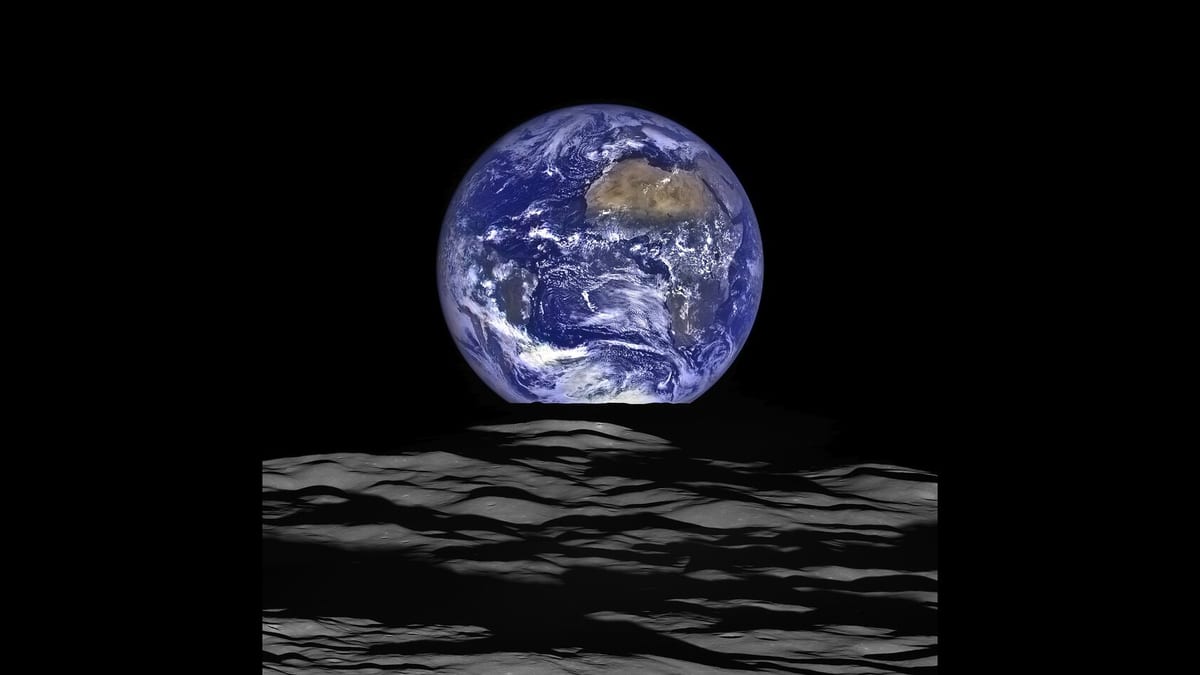
An ISRO-led team has published the design, ground testing, and in-orbit performance of SHAPE, an instrument on the Propulsion Module of India's Chandrayaan-3 Moon mission that observes the whole Earth at once as a stand-in for a distant planet. The paper, with 36 authors and led by Anuj Nandi and Swapnil Singh, was posted to arXiv on Aug. 19 and has been accepted for publication in the journal Advances in Space Research.
SHAPE measures both the colors of infrared light coming off the planet and how that light is polarized. Its filter is a crystal that passes one narrow band of wavelengths at a time and is tuned by a radio signal, which the paper says is generated by an in-house source running at 80 to 135 megahertz. The filter covers the near-infrared range from 1.0 to 1.7 microns and splits the light into two beams polarized at right angles to each other, focused onto indium-gallium-arsenide detectors. The paper reports a spectral resolution of 2 to 4 nanometers and a field of view of about 2.6 degrees.
That field is deliberate: seen from lunar orbit, Earth covers roughly 2 degrees of sky, so the instrument takes in the entire disc and little else. Exoplanets are observed the same way, as a single unresolved point.
The paper's Figure 22 shows three Earth spectra: one taken from lunar orbit on Oct. 3, 2023, one from a highly elliptical Earth orbit of 180,000 by 380,000 kilometers on Apr. 17, 2025, and one from an orbit of 409,000 by 727,000 kilometers on Feb. 10, 2026. The caption marks absorption bands of oxygen, water, and carbon dioxide.
In the authors' words, the current configuration provides "a test bed for characterizing Earth-like exoplanets and benchmarking future exoplanet observations." That is the team's own account of what the instrument is for.
SHAPE was first operated on Aug. 20, 2023, after the Chandrayaan-3 lander separated from the Propulsion Module. The lander touched down on the Moon three days later.
Sources
- arXivPreprint