Skip to content
See the World Through ScienceA project of ALLATRA
Source: Peer-reviewedScience Advances1 source

Mantis Shrimp Eyes Reach Into the Deep Red, Lab Tests Show
Science

Republish this story

Our work is licensed under Creative Commons BY-NC 4.0. You may republish this piece for free — with credit to ALLATRA Media and a link to the original, unedited beyond length trims, and not for commercial use.

Read the full license

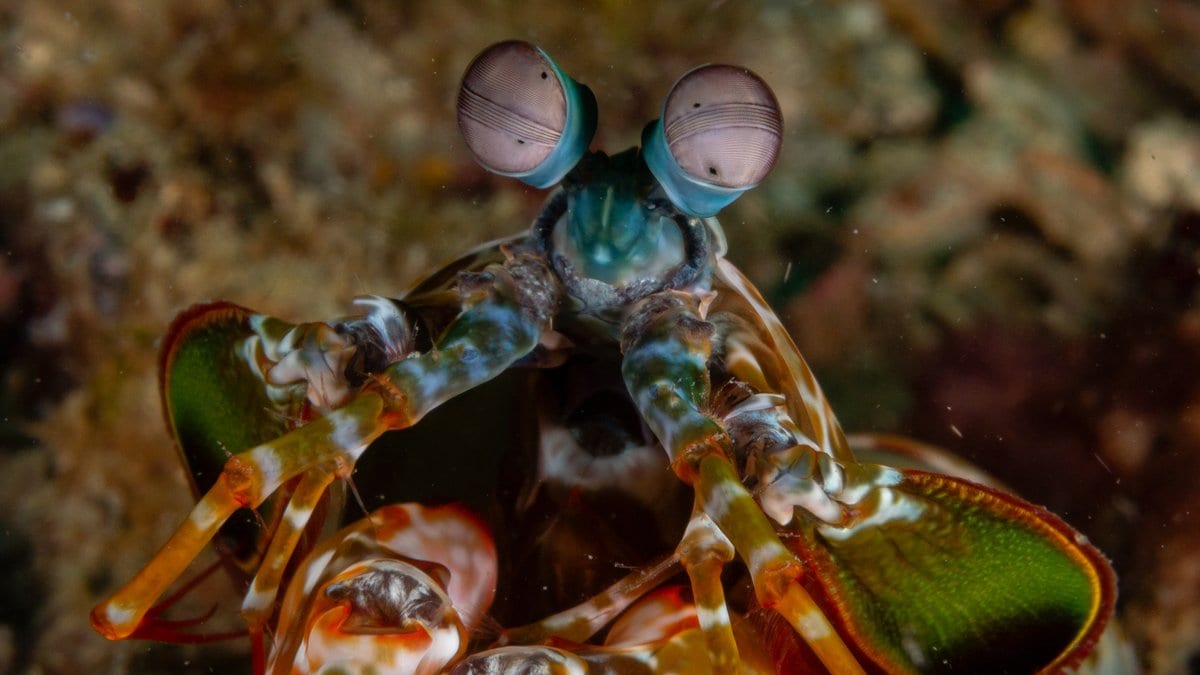
A mantis shrimp faces the camera with two stalked compound eyes raised above its carapace.
A mantis shrimp lifts its two stalked compound eyes, which move independently of each other (illustrative; the study measured pigments from Neogonodactylus oerstedii)."Mantis-Shrimp-Eyes" by Daniel Sasse, via Wikimedia, CC BY 4.0

A research group has measured mantis shrimp visual pigments one at a time and reports that three of them respond to light beyond 600 nanometers, well into the red end of the spectrum. The work appeared Oct. 14, 2026, in Science Advances.

The authors say that mantis shrimp eyes hold an unmatched variety of visual pigments, and that whether the animals can use them for broad color detection had remained unclear. The paper reports that 17 of these pigments, called rhodopsins, take part in color sensing, most of them in a narrow band of rows across the middle of the eye.

Camille Brouillon and Peter Hegemann of Humboldt University of Berlin and colleagues produced each pigment separately and measured which wavelengths it absorbed. The authors report that two mid-wavelength pigments take up blue light most readily and that most of the long-wavelength ones absorb in the green range.
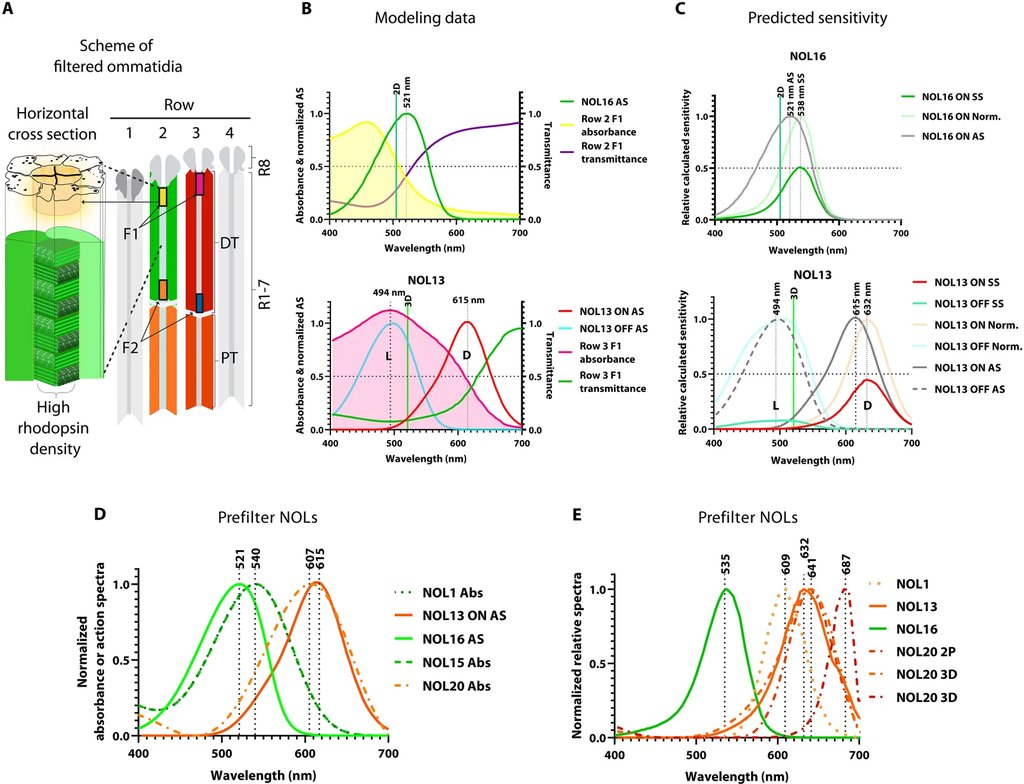
Scientific figure with a cross section diagram of filtered ommatidia and absorbance curves plotted from 400 to 700 nanometers.
Filters inside midband rows 2 and 3 shift the long wavelength pigments NOL16 and NOL13 toward the far red, beyond 600 nanometers. Fig. 4 from Camille Brouillon, Alina Pushkarev, Marjorie A. Liénard, Songhwan Hwang, Arno Munhoven, Richard McDowell, Robert J. Lucas, Megan Porter, Han Sun, Peter Hegemann (2026), "Spectral tuning and signaling of diverse and far red–sensitive rhodopsins in mantis shrimp eyes", Science Advances — CC BY

The authors also report that several of the blue and red pigments switch back and forth under light, with the blue ones shifting in the opposite direction to the red. They attribute that to how retinal, the light-absorbing molecule each pigment carries, binds inside the protein, and describe the switching as a flexibility not previously recognized in these eyes.

The paper concludes that each row of the eye gets its own color sensitivity from colored filters combined with the separately tuned pigments behind them, which extends the animals' vision into the far red.

The work was done at Humboldt University of Berlin, the University of Liège, the University of Manchester, the University of Hawai'i at Mānoa and the Leibniz-Forschungsinstitut für Molekulare Pharmakologie in Berlin.

Sources

Spot an error?

Spot an error?

Report an error

Spotted a mistake on this page? Tell us what's wrong and our editors will take a look.

What kind of problem?

Only if you'd like us to be able to follow up. We won't use it for anything else.

We correct mistakes openly. Select any text to flag it. Fixes are logged under our Corrections Policy.

Report an error

Reporting on

Mantis Shrimp Eyes Reach Into the Deep Red, Lab Tests Show

What kind of problem?

Only if you'd like us to be able to follow up. We won't use it for anything else.

We read every report. Corrections are logged publicly.