Skip to content
See the World Through ScienceA project of ALLATRA

Sakurai's Object Is Now a Wolf-Rayet Star. Astronomers Watched It Happen
Space

Republish this story

Our work is licensed under Creative Commons BY-NC 4.0. You may republish this piece for free — with credit to ALLATRA Media and a link to the original, unedited beyond length trims, and not for commercial use.

Read the full license

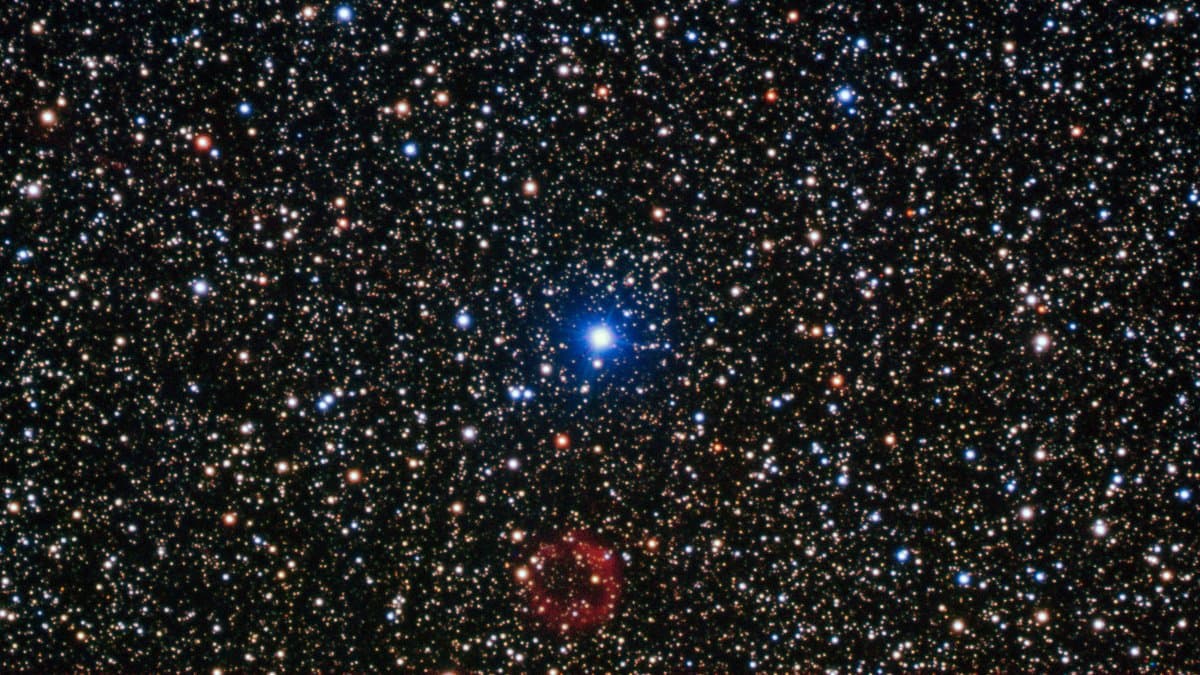
A dense field of stars in Sagittarius, with a faint red ring of gas around Sakurai's Object near the bottom center of the frame.
The faint red ring near the bottom center is the shell of gas and dust thrown off by Sakurai's Object; the bright star at the center of the frame is an unrelated foreground star. Imaged with the FORS instrument on the Very Large Telescope and published August 3, 2015."Sakurai's Object" by ESO, via wikimedia, CC-BY-4.0 · CC-BY-4.0

A white dwarf that abruptly reignited in 1996 has now been confirmed as a Wolf-Rayet-type star, with new spectroscopy from the Very Large Telescope providing the first direct measurement of its surface temperature and stellar wind, according to a letter published Sept. 16 in Monthly Notices of the Royal Astronomical Society.

W. Marcolino of the Universidade Federal do Rio de Janeiro and colleagues used the VLT's FORS2 instrument along with non-local thermodynamic equilibrium atmosphere models to establish that Sakurai's Object has developed a [WC]-type stellar wind, a class of star defined by strong carbon emission lines driven by intense outflows. The strongest spectral features the paper identifies are due to carbon (C ii-iii) and helium (He i).

Stellar evolution normally unfolds over millions of years, on timescales no single observer follows. Sakurai's Object underwent a Very Late Thermal Pulse, a helium-shell ignition in a white dwarf that had already stopped fusing, and was first detected in that "born-again" state in 1996. Spectroscopic monitoring over the roughly 30 years since has now captured the full transition to a Wolf-Rayet object within a single scientific career.
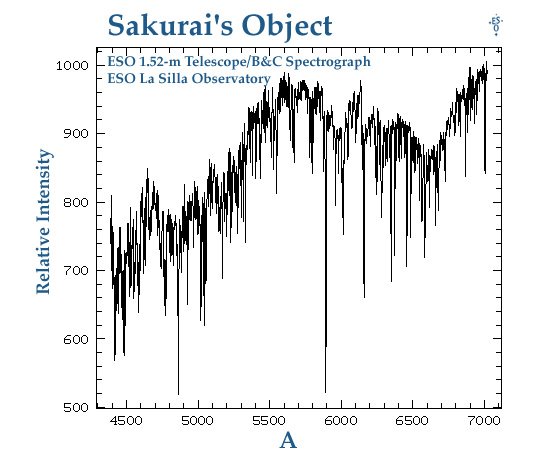
A line chart titled Sakurai's Object plotting relative intensity against wavelength from about 4400 to 7000 angstroms, with many narrow absorption dips.
The spectrum of Sakurai's Object recorded on February 24, 1996, a few months after the star brightened. The narrow dips are absorption lines of helium, carbon, nitrogen and oxygen, with hydrogen barely present. — "The spectrum of Sakurai's Object (eso9619b)" by ESO, via wikimedia, CC-BY-4.0

The paper reports an effective temperature of about 30,500 K, which is substantially cooler than V605 Aquilae, the only other known born-again star with a comparably measured temperature (~95,000 K). V605 Aql erupted about 80 years before Sakurai's Object. The temperature is lower than models predict when convective mixing is suppressed during the thermal pulse, but is consistent with calculations for remnants of slightly lower mass (below roughly 0.6 solar masses).

Continued spectroscopic monitoring will be needed to trace how the star reheats over coming decades.

Sources

Spot an error?

Spot an error?

Report an error

Spotted a mistake on this page? Tell us what's wrong and our editors will take a look.

What kind of problem?

Only if you'd like us to be able to follow up. We won't use it for anything else.

We correct mistakes openly. Select any text to flag it. Fixes are logged under our Corrections Policy.

Report an error

Reporting on

Sakurai's Object Is Now a Wolf-Rayet Star. Astronomers Watched It Happen

What kind of problem?

Only if you'd like us to be able to follow up. We won't use it for anything else.

We read every report. Corrections are logged publicly.