Skip to content
See the World Through ScienceA project of ALLATRA
Source: PreprintarXiv1 source

Bennu's Sample Meets NASA's Own Test for a Clean Sample, With One Exception
Space

Republish this story

Our work is licensed under Creative Commons BY-NC 4.0. You may republish this piece for free — with credit to ALLATRA Media and a link to the original, unedited beyond length trims, and not for commercial use.

Read the full license

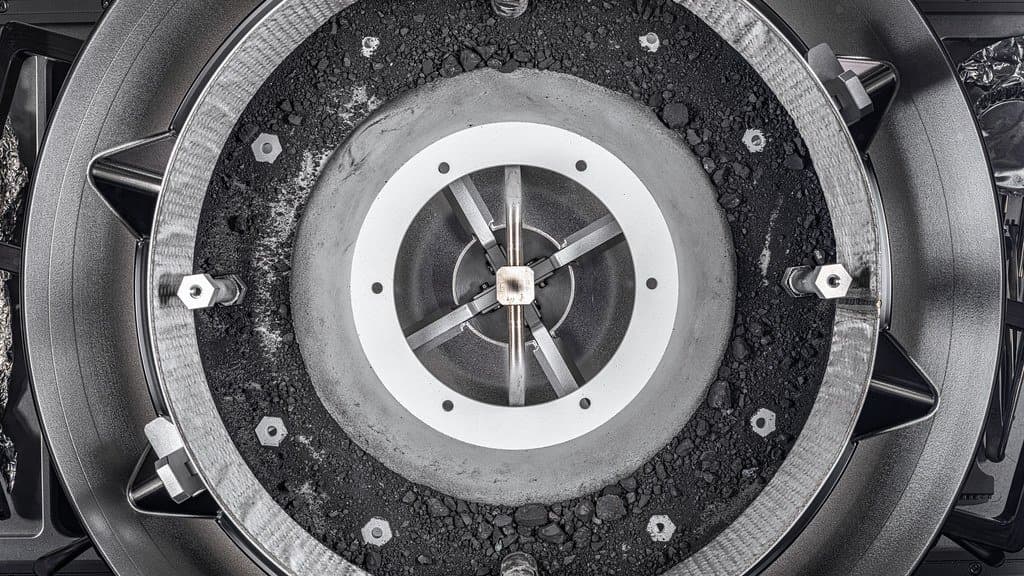
A circular sampler head seen from above, its inner ring packed with black asteroid dust and small rock fragments around a central collector.
The OSIRIS-REx sampler head opened in the curation laboratory, with dark Bennu regolith packed around the collector."NASA’S OSIRIS-REx Curation Team Reveals Remaining Asteroid Sample" by NASA's Marshall Space Flight Center, via nasa, BY-NC · CC-BY-NC-2.0

The team that analyzed NASA's OSIRIS-REx asteroid sample reports that the material returned from Bennu meets the mission's definition of a clean sample, apart from an isolated 1.24% by mass that escaped the sample container and picked up particles shed by the spacecraft.

The mission's own standard is material free of foreign matter that could affect measurements; that is the sense in which the paper uses the word "pristine." Tracing each suspected contaminant back to its origin is what kept real asteroid material from being written off: several particles that had been under suspicion, among them phosphate and sodium fluoride, were identified as native to Bennu.
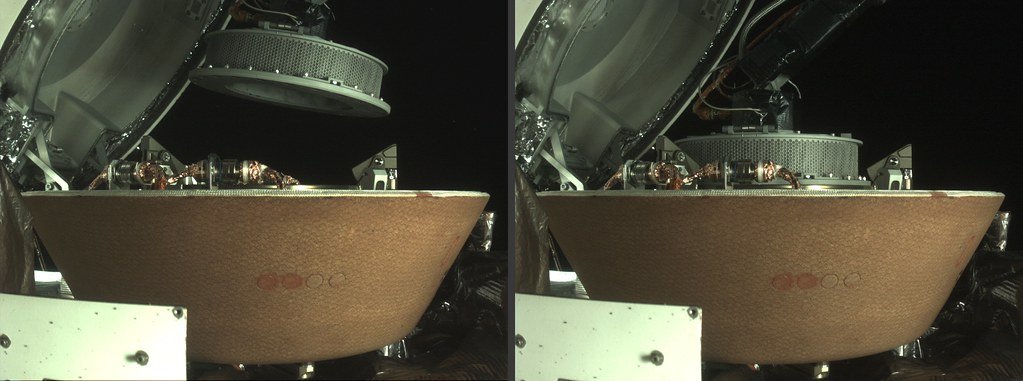
Two side-by-side frames from a spacecraft camera showing the sampler head being lowered onto the return capsule.
Two frames from the spacecraft's own camera as the sampler head is lowered into the return capsule for stowage. — "OSIRIS-REx In the Midst of Sample Stowage" by NASA's Marshall Space Flight Center, via nasa, BY-NC

OSIRIS-REx delivered 121.6 grams of regolith, the loose rock and dust on an asteroid's surface, in September 2023. In a preprint posted to arXiv on Sept. 10 and not yet peer-reviewed, Jason P. Dworkin and 83 colleagues go through every suspected contaminant encountered during the sample analysis phase. Most came from neither the spacecraft nor the handling of the sample on the ground. Some were introduced later, during laboratory analysis itself.

That last group carries the practical lesson the authors draw. Laboratories measuring different things need procedural blanks (control runs containing no sample), and the material has to be shared among them with that in mind, or the analysis starts adding what it is looking for.

The paper sets out the mission's contamination control and knowledge program as a template for future sample-return missions.

Sources

Spot an error?

Spot an error?

Report an error

Spotted a mistake on this page? Tell us what's wrong and our editors will take a look.

What kind of problem?

Only if you'd like us to be able to follow up. We won't use it for anything else.

We correct mistakes openly. Select any text to flag it. Fixes are logged under our Corrections Policy.

Report an error

Reporting on

Bennu's Sample Meets NASA's Own Test for a Clean Sample, With One Exception

What kind of problem?

Only if you'd like us to be able to follow up. We won't use it for anything else.

We read every report. Corrections are logged publicly.