Astronomers Map the Earliest Known Cluster of Galaxy Clusters
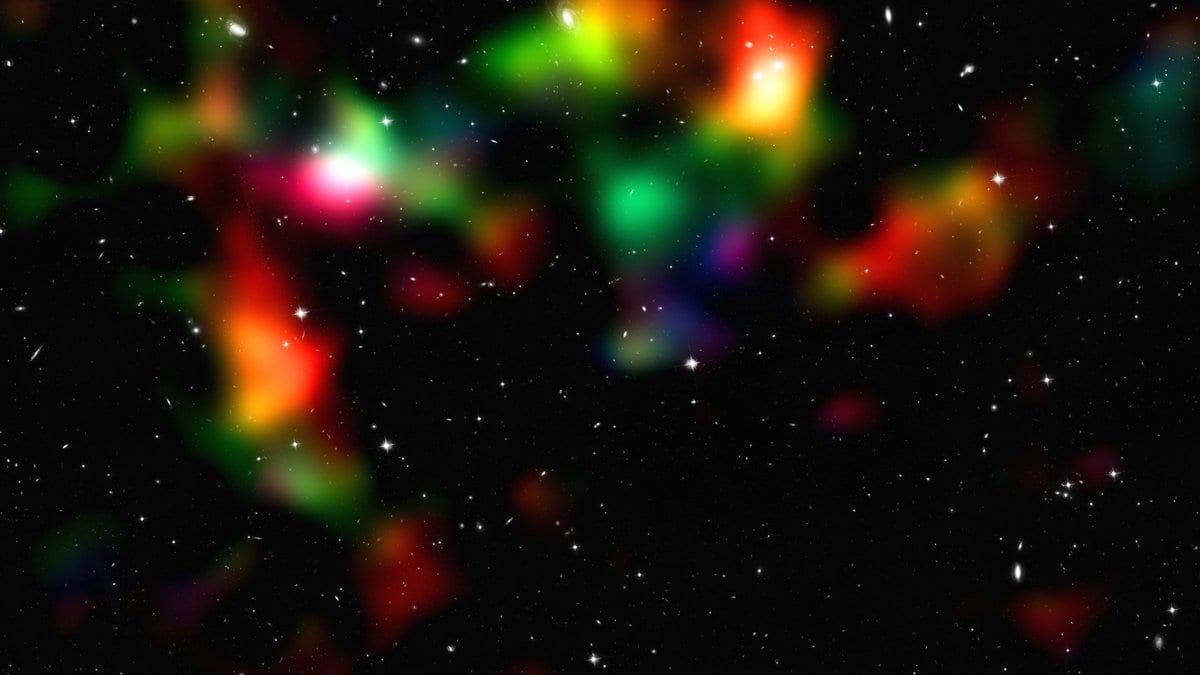
Astronomers have mapped, in three dimensions, the earliest and most distant forerunner of a galaxy supercluster yet found, NSF NOIRLab said on Sept. 8. The clump, designated COSMOS-z3.1-A, is seen as it looked when the Universe was 2.1 billion years old.
Lead author Vandana Ramakrishnan, then a graduate student at Purdue University, said the team hopes "to understand the growth of massive structures in the Universe and how they influence the evolution of galaxies within them." The team also wants to know how protoclusters (loose collections of galaxies still merging, not yet settled into a stable cluster) connect to the cosmic web, the network of filaments along which galaxies gather.
The work draws on the ODIN survey, run with the Dark Energy Camera on the NSF Víctor M. Blanco telescope in Chile. NOIRLab said the survey found 150 protoclusters that formed when the Universe was 1–3 billion years old. The team picked the two most crowded, then worked out how far away each of their galaxies lies, using instruments on the Mayall telescope in Arizona, Gemini South in Chile and Keck II in Hawaii. The maps are published in The Astrophysical Journal.
COSMOS-z3.1-A carries a mass 5,000 times that of the Milky Way, enough to make it a proto-supercluster: the ancestor of a cluster of clusters. "We think there should be fewer than one such object for every 10,000 galaxy clusters!" Ramakrishnan said. The release adds that another proto-supercluster, Hyperion, has been identified in other studies at a later point in cosmic time.
Both structures are clumpy and irregular and sit where several filaments of the cosmic web cross, which, NOIRLab said, is the first direct look at such features in the distant Universe. The team reads that as a sign of growth from the bottom up, as small pieces merge into larger ones. From the maps, it predicts both will become more massive than the Coma Cluster, the largest cluster known nearby.