One Giant Wind Loop May Explain Why Mars's Air Never Evens Out
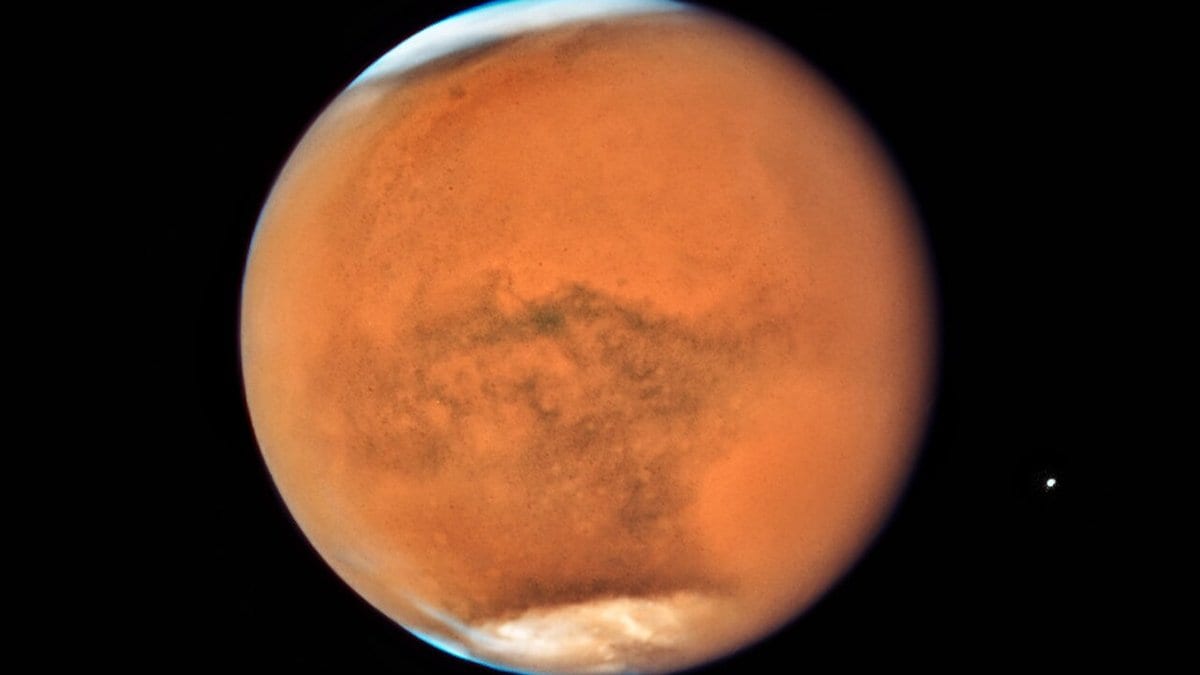
Mars's atmosphere is stirred by a single planet-wide loop of circulation, and a new analysis reports that the loop's own structure keeps dust and gas from mixing across its edge while carrying material from one pole to the other. Chen-Shuo Fan and five co-authors published the result on Aug. 31 in Nature Geoscience.
The work is based on modeling rather than on new observations. The team tracked particles through Martian atmospheric reanalysis, a reconstructed record of past atmospheric states, using a Lagrangian method. That method follows parcels of air as they travel, rather than sampling fixed points.
The paper takes aim at a long-standing puzzle. Dust and the gases water vapor, carbon monoxide and argon are found at markedly different concentrations from one region of Mars to another, even though planet-scale circulation is generally expected to smooth such differences out. The mechanism behind that patchiness, the authors write, "has been difficult to define."
In their results, the coherent structure of Mars's single-cell Hadley circulation produces what the paper calls dynamical barriers: not physical walls, but zones where the flow itself suppresses exchange. Those barriers prevent material from mixing between the inside and the outside of the cell, the authors report, while the same circulation allows a pole-to-pole teleconnection linking the planet's two polar regions.
A dimensional analysis in the paper attributes the pattern to the combined effect of Mars's rapid rotation and its thin atmosphere, with the mean circulation outweighing transport by smaller eddies. The authors describe the resulting transport regime as "fundamentally distinct from those on Earth and Venus," and say the finding "challenges the conventional view of material mixing from planetary-scale circulations," suggesting instead that atmospheric dynamics can confine material and restrict its redistribution.
The Mars reanalysis the team used, EMARS, is publicly available, and the paper lists its particle-tracking code and a minimum demonstration dataset on Zenodo.
Sources
- www.nature.comPeer-reviewed