A Desktop Experiment Reaches the Turbulence Predicted Inside Planets and Stars
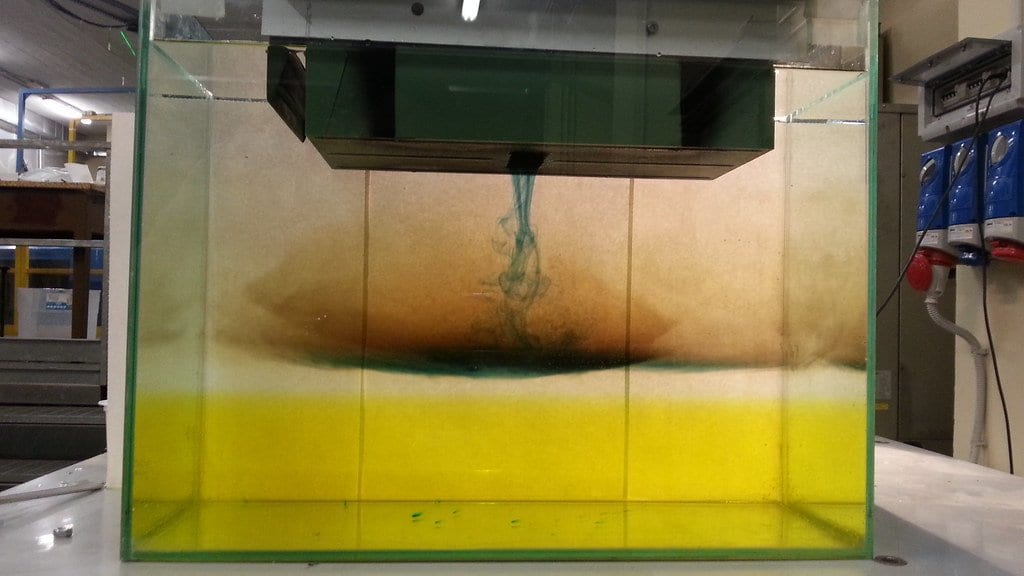
A laboratory experiment with rotating liquid metal has reached a state of turbulent convection that theory predicts for the interiors of planets and stars and that laboratories have struggled to produce. The work was published Aug. 24 in Physical Review Letters by Jewel A. Abbate and Jonathan M. Aurnou of the University of California with colleagues at Princeton University, the Helmholtz-Zentrum Dresden-Rossendorf, Coventry University, and the University of Colorado.
The abstract calls the target the "ultimate regime": rapidly rotating turbulence in which the flow is unaffected by viscosity and by thermal diffusion, the two properties that spread motion and heat through a fluid. Convection in planets and stars is predicted to work this way. In a laboratory vessel, it has been out of reach, because diffusion in the layer of fluid next to the walls "has historically hindered experimental access to this regime," the paper says.
The route around that, according to the authors, is a particular oscillating mode of rotating convection that is driven by the temperature gradient in the bulk of the fluid rather than at its edges, and so does not depend on what happens at the boundary. The abstract reports that this mode arises in rotating liquid metals, which it classes as low-Prandtl-number fluids, meaning heat spreads through them faster than motion does. The experiments were accompanied by direct numerical simulations.
The team writes that it verifies the regime three ways: through the efficiency of heat transport, through the speed of the flow, and through temperature fluctuations inside the fluid, each expressed as a dimensionless number, and each in quantitative agreement with reduced theoretical models.
This is a laboratory analogue rather than an observation of any planet or star, and the extrapolation is what the authors say it buys. Reaching the predicted scaling in desktop-sized experiments, the abstract concludes, "provides the validation necessary to extrapolate and predict the convective flows in remote geophysical and astrophysical systems."
Sources
- Physical Review LettersPeer-reviewed