A Comet From Another Star Changed Chemistry Unlike Anything in Lowell's Records
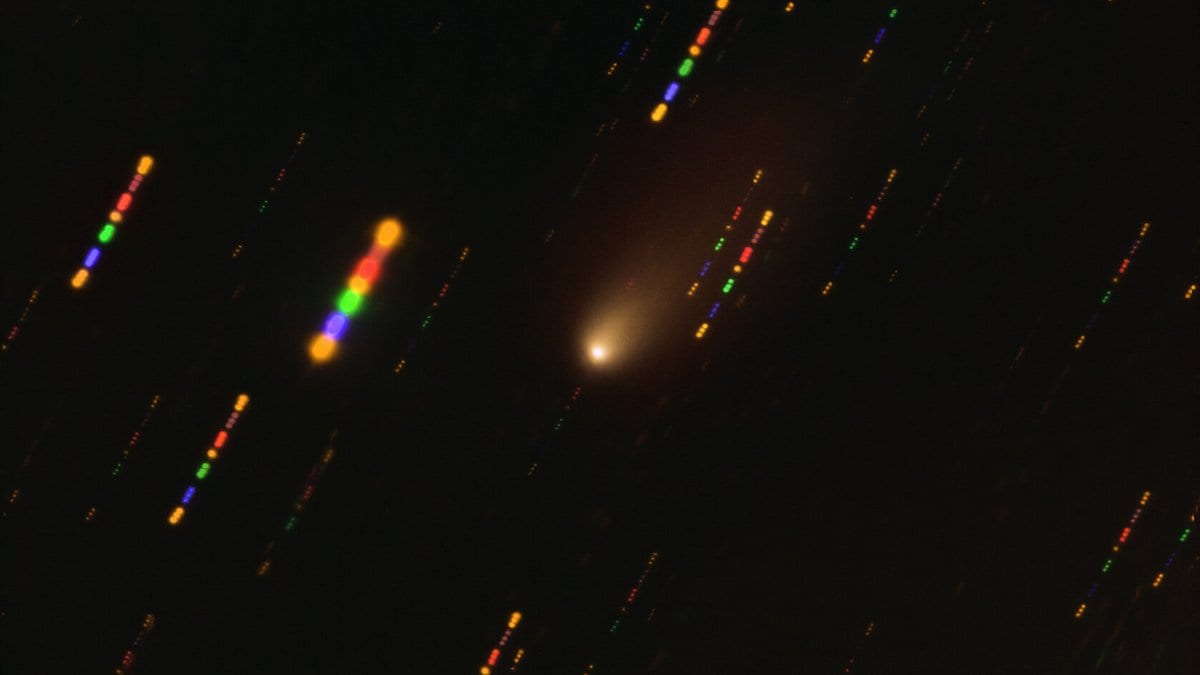
Astronomers at Lowell Observatory report that two carbon gases released by the interstellar comet 2I/Borisov rose sharply against a third as the comet neared the Sun in 2019, a change the team calls unprecedented in the observatory's own comet database. The paper, led by Allison N. Bair, has been accepted for publication in the Planetary Science Journal and was posted to arXiv on Aug. 24.
The group measured the comet's composition on four nights before its closest approach to the Sun, from Oct. 4 to Nov. 25, 2019, at 2.466 to 2.028 astronomical units. CN, a carbon-nitrogen molecule, was detected on all four nights. The Oct. 27 data are the earliest reported detections of C2 and C3, two simple carbon molecules, at the comet; their log production-rate ratios against CN stood at -0.7 and -1.3. By Nov. 25 both had climbed by nearly a factor of four, to -0.3 and -0.9.
The authors call that "an extremely large increase with heliocentric distance that is unprecedented in the Lowell Observatory comet database."
From OH and NH measured on Nov. 25, the paper derives a water production rate of 4.5x10^26 molecules per second, with log ratios the authors call very high: -2.0 for CN to OH and -1.7 for NH to OH.
Broadband monitoring between Sept. 13 and Dec. 16, 2019, puts the peak of the comet's dust production around Oct. 19, 50 days before its Dec. 8 closest approach. Narrowband images from Oct. 4 and 27 show a nearly symmetric distribution of CN in the surrounding gas cloud, which the authors read as activity across the whole sunward hemisphere and possibly the entire nucleus.
2I/Borisov, found in 2019, was the second interstellar object identified in the Solar System, after 1I/'Oumuamua in 2017. Combined with other teams' results, the authors write, their measurements reveal "a chemical composition and behavior with heliocentric distance unlike any other comet we have observed."
Sources
- arXivPreprint