Why a Moderate Solar Storm Can Still Light up Mid-Latitude Skies
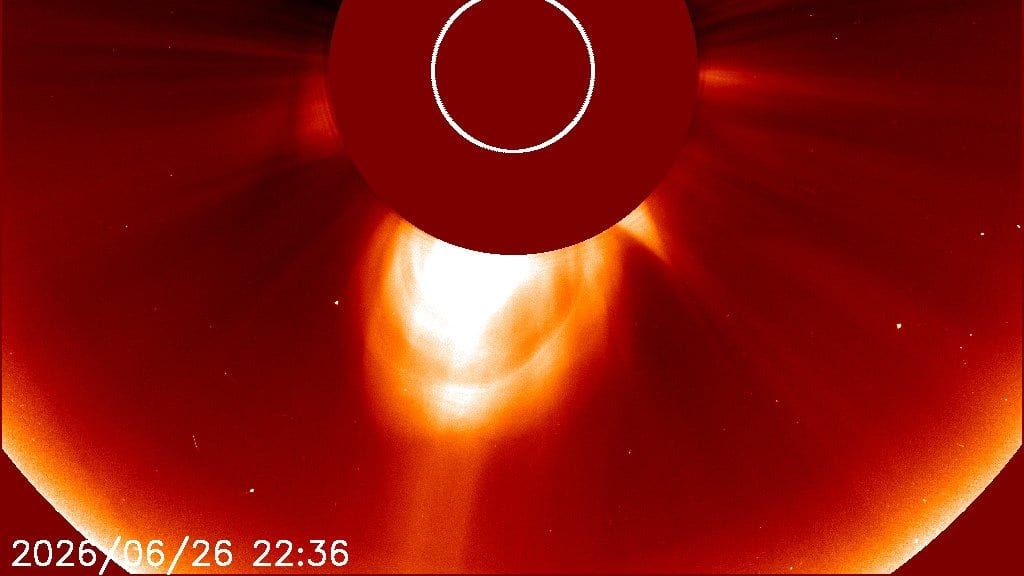
NOAA's Space Weather Prediction Center (SWPC) has flagged a G2, or moderate, geomagnetic storm for roughly July 3, after two coronal mass ejections (vast clouds of solar plasma and magnetic field) blew off the Sun on June 26 and 27 and headed our way. On NOAA's five-step scale, G2 sits near the low end, well short of the severe (G4) and extreme (G5) storms that grab headlines. Yet even a moderate storm can do the one thing skywatchers care about: push the northern lights far enough south to be seen from mid-latitudes.
The reason has less to do with a storm's raw power than with geometry and timing. A coronal mass ejection is a sprawling cloud, not a beam, and what matters most when it reaches Earth is the direction its embedded magnetic field is pointing. If that field is tilted southward, opposite to Earth's own, the two can link up and pry open the door, letting solar particles pour into the upper atmosphere. When that coupling is efficient, even a modest CME can drive a livelier storm than its size alone would suggest.
That energy drives charged particles along Earth's magnetic field lines toward the poles. The particles slam into the thin upper atmosphere, where they excite atoms of oxygen and nitrogen. These atoms shed that energy as light: the greens and reds of the aurora. In a stronger storm, this glowing oval of activity swells and slides toward the equator. That is why a "moderate" G2 can carry the aurora out of its usual polar haunts and into the skies over places that rarely see it, given dark, clear conditions and a viewer looking poleward.
The same energy has quieter, less photogenic effects. A geomagnetic storm heats and puffs up the outermost atmosphere, increasing the drag on satellites in low Earth orbit and subtly shifting their paths (a real, if routine, headache for operators tracking thousands of spacecraft). Storms can also degrade high-frequency radio and add noise to precision GPS. At G2 strength these impacts are minor and familiar, the sort of thing space-weather forecasters manage as a matter of course.
The forecast is a preliminary estimate. The arrival time and final strength of a CME are notoriously hard to pin down until the cloud sweeps past sensors parked between the Sun and Earth, about an hour upstream. Storms routinely arrive early or late, over- or under-perform, or fizzle when their magnetic field turns out to point the wrong way. Aurora, in other words, is never guaranteed. For the latest official outlook, the place to check is NOAA's live alerts, watches and warnings feed, which updates as the CMEs close the last stretch to Earth.