Euclid Turns Its Eye on the Milky Way's Crowded Heart, a Hunting Ground for Planets
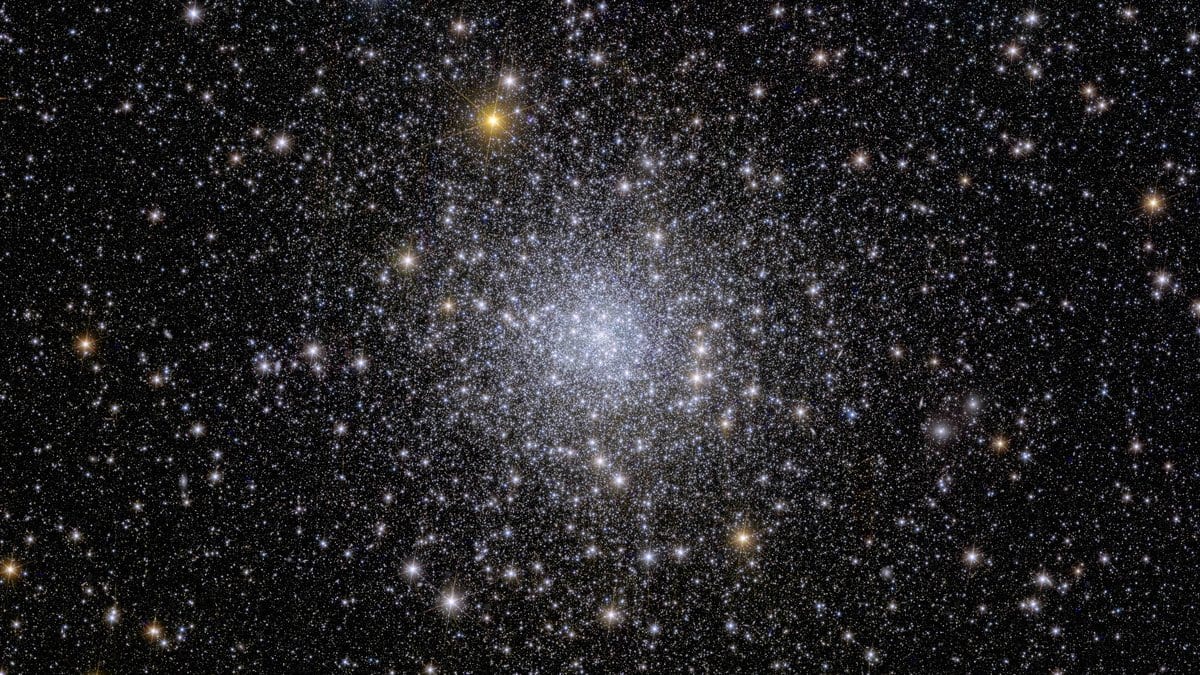
Point a camera at the heart of our galaxy and you get chaos: stars stacked thousands deep along the line of sight, glittering across the central bulge. ESA's Euclid telescope has now turned that chaos into the largest, most detailed visible-light mosaic of the region ever made: about 60 million stars, stitched from nine pointings, each covering a patch of sky larger than the full Moon. The whole thing was captured in roughly 26 hours on 23 March 2025; ESA has now released it to the public.
The striking part is what the crowd is good for. Euclid was built to survey billions of distant galaxies, not the stars of our own. This bulge image came from a special request by astronomers who wanted its sharp, wide-field eye for a different job: finding planets by gravitational microlensing. When one star drifts almost exactly in front of a more distant one, its gravity bends and briefly magnifies the background star's light, like a lens passing across the sky. If the foreground star has a planet, the planet adds its own small blip to that brightening, betraying its presence. A field as dense as the bulge offers the most chances for those rare alignments.
A single day's image can't catch a microlensing event, which plays out over weeks. What it provides is a reference frame: a precise snapshot of where the stars sit and how they move, so that when future alignments occur, astronomers can pin down a planet's mass. The mosaic already contains 51 known planetary systems.
This is an image and data release rather than a new discovery, and it arrives alongside wide coverage. Its value is as a foundation: a baseline map of a crowded sky that turns the galaxy's busiest region into a place to go planet-hunting.