Skip to content
See the World Through ScienceA project of ALLATRA
Source: Peer-reviewedProceedings of the National Academy of Sciences2 sources

Sand Grains Record the Wind That Built Their Dune, a Global Study Finds
Space

Republish this story

Our work is licensed under Creative Commons BY-NC 4.0. You may republish this piece for free — with credit to ALLATRA Media and a link to the original, unedited beyond length trims, and not for commercial use.

Read the full license

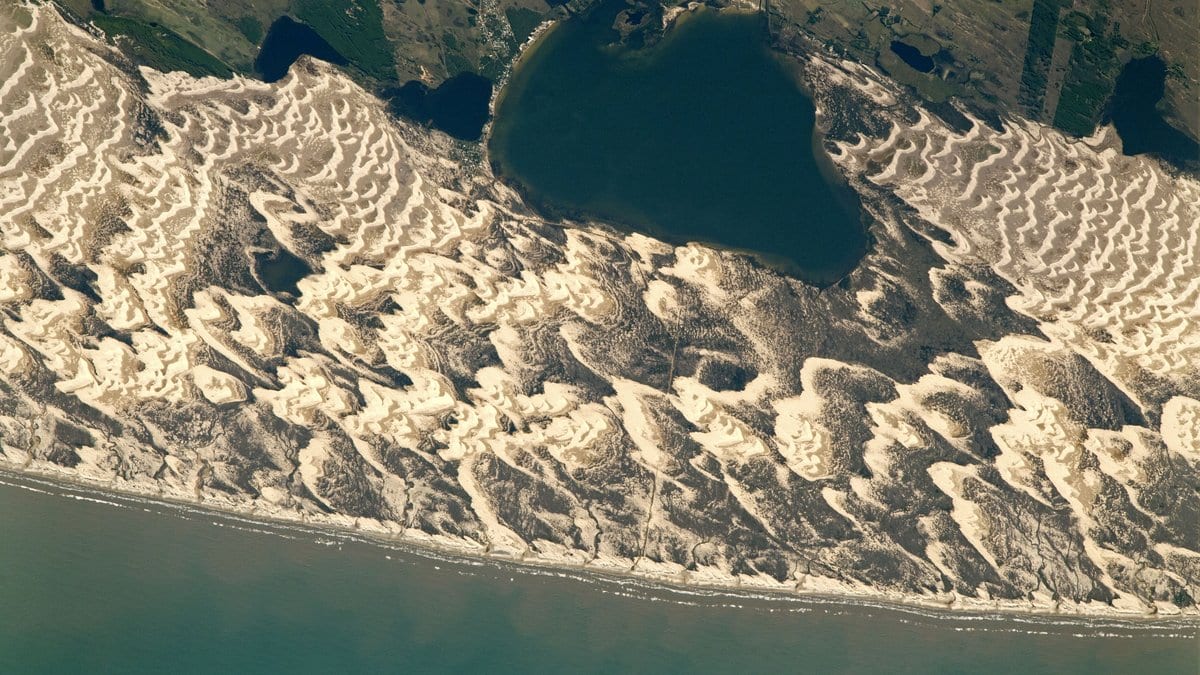
Crescent-shaped sand dunes and dark coastal lagoons along an ocean shoreline, seen from orbit.
Crescent dunes and lagoons on the Atlantic shore of Rio Grande do Sul, photographed from the International Space Station July 9, 2017. Fields like this one are what the study compared worldwide."ISS-52 Barchan Dunes and Lagoons, Southern Brazil" by NASA Astronaut photograph from ISS, via Wikimedia Commons, Public domain

The winds that build sand dunes blow barely hard enough to move sand at all. A study published Nov. 20, 2026, in the Proceedings of the National Academy of Sciences finds that dune-building winds only just exceed the speed at which grains begin to hop along the ground. Geologists call that hopping saltation, and the paper reports that dune fields worldwide sit just above its threshold.
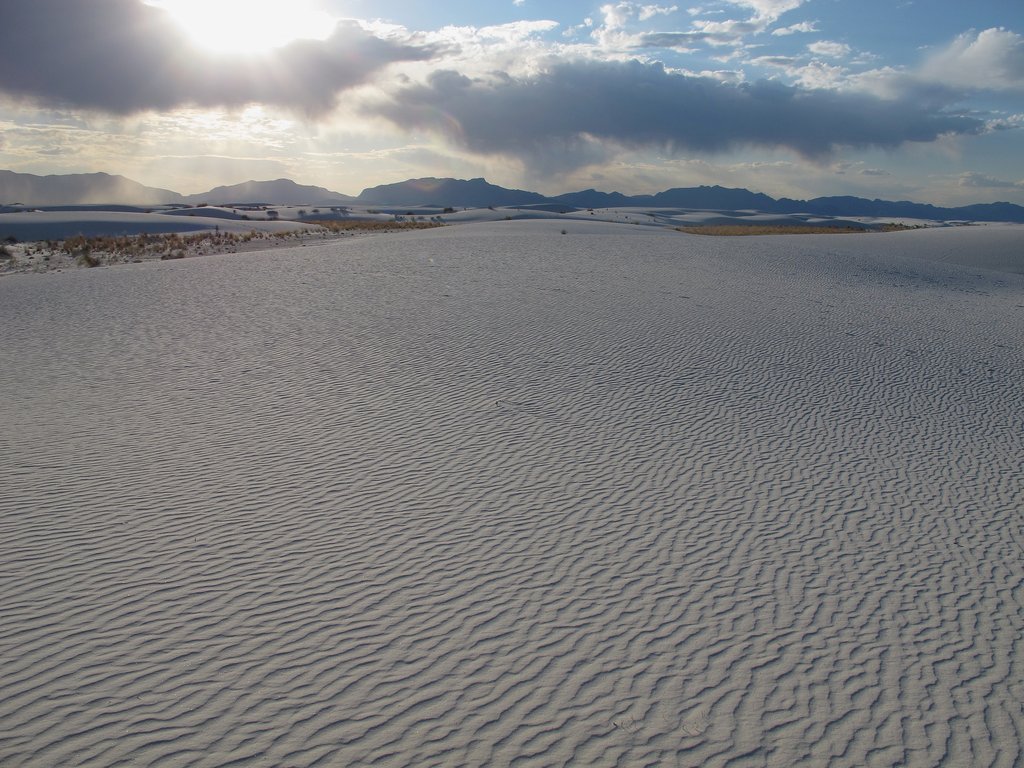
Fine wind-made corrugations across a pale gypsum dune surface, with mountains on the horizon.
Wind-combed gypsum at White Sands National Park in New Mexico, photographed Sept. 26, 2011 (illustrative). The fine corrugations form where grains hop along the surface, the motion that builds a dune. "Ripples in the sand" by NPS Photo, via Wikimedia Commons, Public domain

The authors report that this makes grain size a record of the wind: a dune field built by winds that only just move its sand carries their speed in the size of its grains. The paper states that wind speeds can be estimated this way from wind-laid sandstones and from dune deposits on other planets, which the authors offer as a way to reconstruct past climates on Earth and beyond.

The paper says a near-threshold state had been proposed from selected observations on Earth; what the authors add is that it holds globally. They report that dune fields are born in that state rather than evolving into it, because the frequency of winds drops steeply as wind speed rises — the strongest winds blow least often. Riverbeds reach a similar state along a different route, by reshaping their channels.
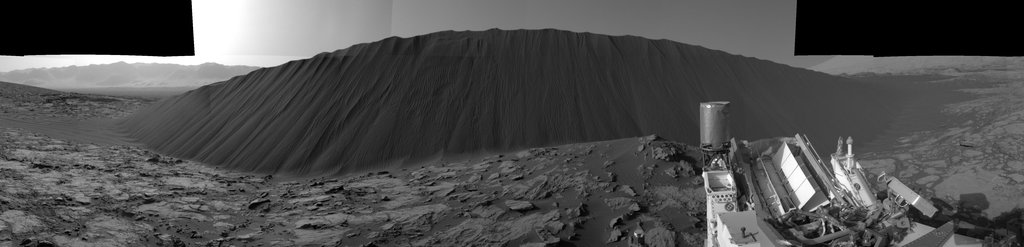
A rover-deck view of the steep, smooth downwind face of a dark dune on Mars, with rocky ground in front of it.
The steep lee slope of a dark dune in Gale Crater on Mars, seen from the deck of NASA's Curiosity rover (illustrative). Grains blown over the crest avalanche down it, which is how a dune advances. "PIA20281 Slip Face on Downwind Side of Namib Sand Dune" by NASA JPL, via Wikimedia Commons, Public domain

The paper notes that windblown dunes occur throughout the Solar System wherever a gas flow has loose sediment to move, from the sluggish winds of Venus to sublimation flows on comets that run at the speed of sound. Its argument is that winds in all of those places reach speeds just right to start and keep sand hopping, despite wide variation in gravity and in the grains and gas involved.

The work is by M. Colin Marvin and Mathieu G. A. Lapôtre of Stanford University's Department of Earth and Planetary Sciences, with colleagues at Stanford and the Institut de Physique du Globe de Paris. The journal's record credits the National Science Foundation with funding the work and lists the article in a Dec. 8, 2026, print issue.

Sources

Spot an error?

Spot an error?

Report an error

Spotted a mistake on this page? Tell us what's wrong and our editors will take a look.

What kind of problem?

Only if you'd like us to be able to follow up. We won't use it for anything else.

We correct mistakes openly. Select any text to flag it. Fixes are logged under our Corrections Policy.

Report an error

Reporting on

Sand Grains Record the Wind That Built Their Dune, a Global Study Finds

What kind of problem?

Only if you'd like us to be able to follow up. We won't use it for anything else.

We read every report. Corrections are logged publicly.