Skip to content
See the World Through Science

A Korean Orbiter Photographed the Moon's Newest Crater, Left by a SpaceX Rocket
Space

Republish this story

Our work is licensed under Creative Commons BY-NC 4.0. You may republish this piece for free — with credit to ALLATRA Media and a link to the original, unedited beyond length trims, and not for commercial use.

Read the full license

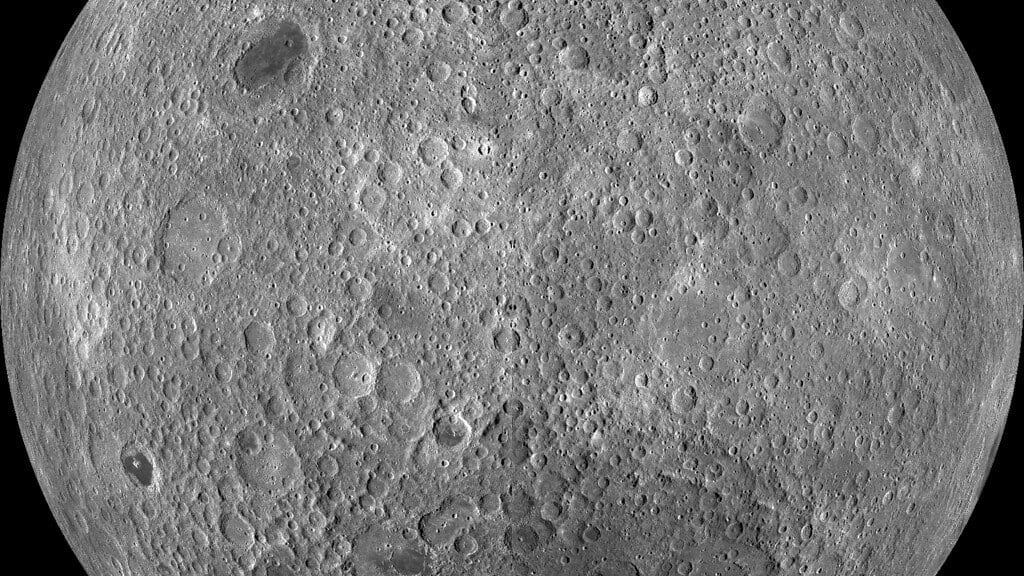
The Moon's far side seen from lunar orbit: a grey hemisphere covered edge to edge with overlapping impact craters and no dark volcanic plains.
The Moon's far side, mapped from lunar orbit by the Lunar Reconnaissance Orbiter Camera on NASA's LRO - the cratered highland hemisphere where the derelict Falcon 9 upper stage came down near Einstein crater on 5 August. Illustrative: this mosaic was assembled from LRO images taken years earlier, and is not Danuri's before-and-after imagery."The Far Side of the Moon -- And All the Way Around" by NASA Goddard Photo and Video, via nasa, CC-BY-2.0 · CC-BY-2.0

The Associated Press reports that South Korea's Danuri orbiter has photographed the patch of the Moon where a derelict SpaceX Falcon 9 upper stage crashed on 5 August, returning images of the same ground before and after the impact.

Danuri flew over the site soon after the stage hit and made multiple passes from lunar orbit. The terrain is noticeably darker where the rocket struck and threw out dust and rock. The images were released by the Korean space agency on Aug. 6.

The Korea Herald, reporting the Korea AeroSpace Administration's release, says the stage hit the far side of the Moon near Einstein Crater at 3:34 p.m. Korean time on 5 August, and that Danuri imaged the area eight times, starting about half an hour before the impact, with its Lunar Terrain Imager at a resolution of about five metres per pixel. Reference pictures of the site were taken the previous month.

The stage was travelling at 5,400 mph (8,700 kph) and was put on a collision course by solar activity and gravity, according to SpaceX. It came from the launch that sent a pair of private lunar landers to the Moon last year.

NASA's Lunar Reconnaissance Orbiter is scheduled to fly over the crash site to provide a second, independent set of images. Current releases do not specify a size for the new crater.

SpaceX launched Danuri itself from Cape Canaveral in 2022.

Sources

Spot an error?

Spot an error?

Report an error

Spotted a mistake on this page? Tell us what's wrong and our editors will take a look.

What kind of problem?

Only if you'd like us to be able to follow up. We won't use it for anything else.

We correct mistakes openly. Select any text to flag it. Fixes are logged under our Corrections Policy.

Report an error

Reporting on

A Korean Orbiter Photographed the Moon's Newest Crater, Left by a SpaceX Rocket

What kind of problem?

Only if you'd like us to be able to follow up. We won't use it for anything else.

We read every report. Corrections are logged publicly.