Skip to content
See the World Through ScienceA project of ALLATRA

One Jet Rule for All Black Holes, From the Smallest to the Largest
Space

Republish this story

Our work is licensed under Creative Commons BY-NC 4.0. You may republish this piece for free — with credit to ALLATRA Media and a link to the original, unedited beyond length trims, and not for commercial use.

Read the full license

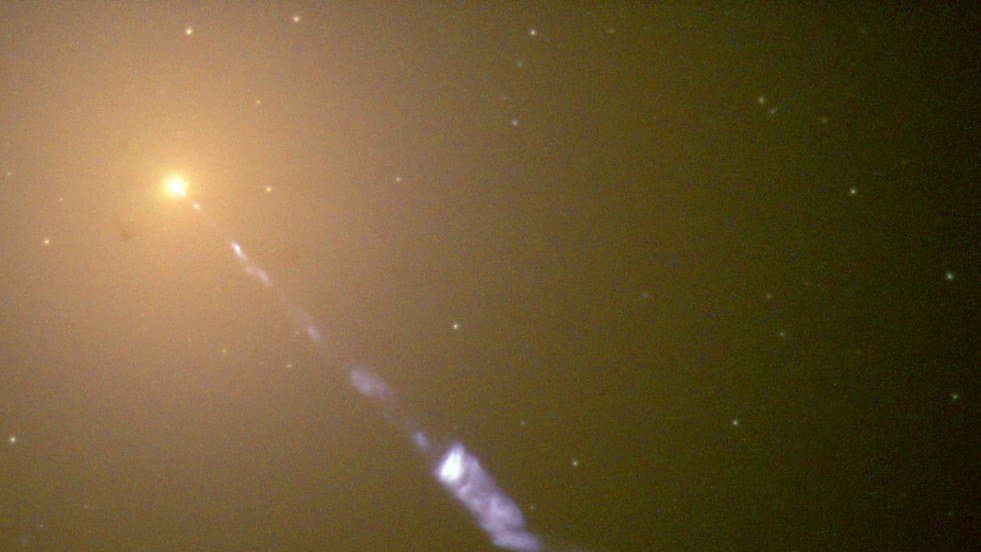
A bright galactic nucleus at upper left with a narrow blue jet of glowing knots streaming diagonally away from it.
The jet from the supermassive black hole at the center of the galaxy M87, imaged by the Hubble Space Telescope. The new study puts the switch-on point for jets near 2% of a black hole's Eddington limit at every mass."Black Hole-Powered Jet Streams from Center of Galaxy M87" by NASA Hubble, via flickr, CC-BY-2.0 · CC-BY-2.0

Astronomers studying stars torn apart by supermassive black holes have found that the trigger for jet formation is the same fraction of a black hole's maximum feeding rate, about 2%, regardless of how massive the black hole is. The result, published Sept. 17 in Nature Astronomy, supports the idea that a single physical process governs jet launching across all black holes.

Adelle J. Goodwin and Andrew Mummery used tidal disruption events (TDEs), episodes in which a star strays too close to a galactic center and is consumed, as a tool for tracking how supermassive black hole accretion flows change over time. Such events evolve over years, making them the only practical window onto the same kind of accretion state transitions that are well studied in stellar-mass black holes, which cycle through states in weeks.
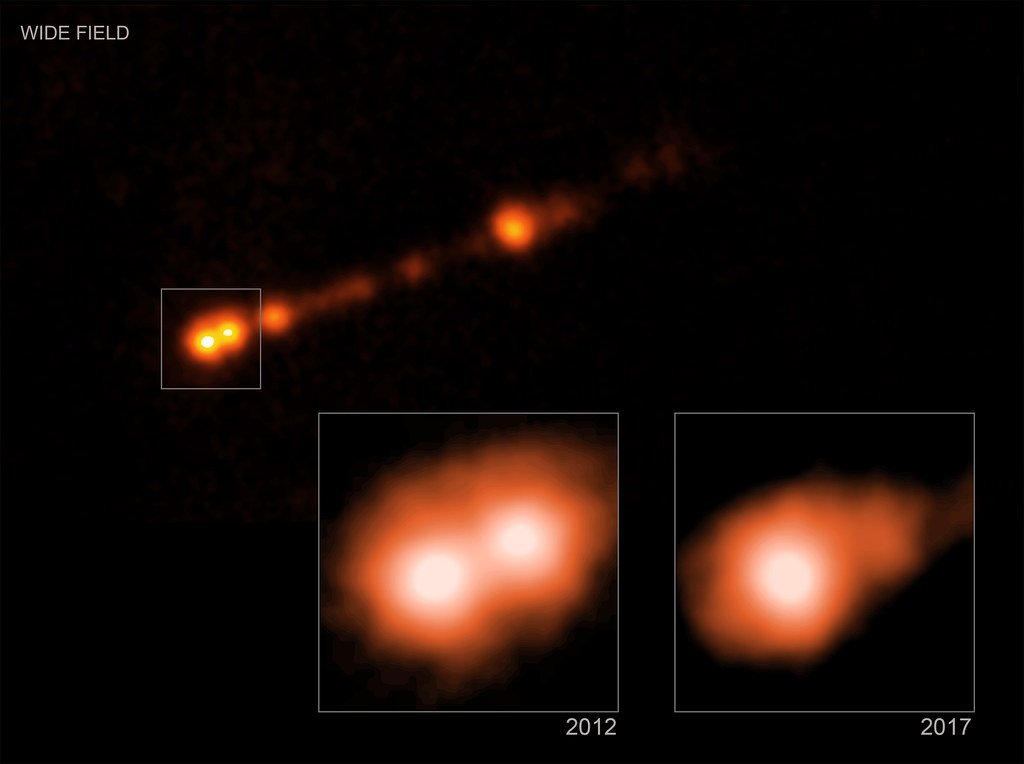
An X-ray image of the M87 jet as a chain of bright orange knots, with two labeled close-up panels from 2012 and 2017 showing the same region of the jet.
The M87 jet in X-rays, with close-ups of the same region in 2012 and 2017. Tracking knots like these is how the speed of a jet is measured. — "Famous Black Hole Has Jet Pushing Cosmic Speed Limit" by NASA's Marshall Space Flight Center, via nasa, BY-NC

The paper reports that TDEs produce a second, physically distinct outflow when the accretion rate falls to roughly 2% of the Eddington limit, the rate at which radiation pressure balances gravity. That threshold matches the critical accretion rate at which accreting stellar-mass black holes switch between jet-producing and non-jet-producing states, as observed in X-ray binary systems. The agreement holds across roughly ten orders of magnitude in black hole mass.

Goodwin and Mummery write that the match across such different mass scales "strongly indicates that a single, scale-invariant physical process governs jet launching in all black holes." The paper also provides a framework for predicting which black holes will launch jets and when: a practical tool for planning multi-wavelength follow-up of future TDE detections.

Sources

Spot an error?

Spot an error?

Report an error

Spotted a mistake on this page? Tell us what's wrong and our editors will take a look.

What kind of problem?

Only if you'd like us to be able to follow up. We won't use it for anything else.

We correct mistakes openly. Select any text to flag it. Fixes are logged under our Corrections Policy.

Report an error

Reporting on

One Jet Rule for All Black Holes, From the Smallest to the Largest

What kind of problem?

Only if you'd like us to be able to follow up. We won't use it for anything else.

We read every report. Corrections are logged publicly.