Skip to content
See the World Through ScienceA project of ALLATRA

Mercury Has Visitors Again, Eight Years After They Left Earth
Space

Republish this story

Our work is licensed under Creative Commons BY-NC 4.0. You may republish this piece for free — with credit to ALLATRA Media and a link to the original, unedited beyond length trims, and not for commercial use.

Read the full license

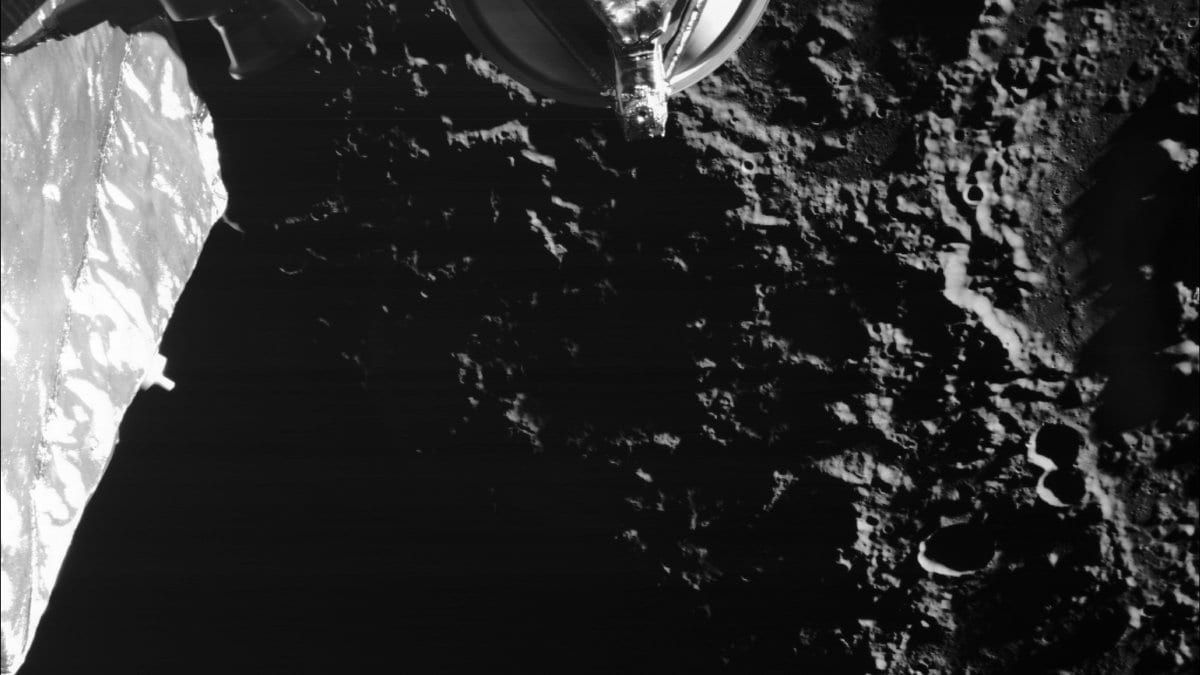
Black-and-white view of a gray, heavily cratered surface lit from the right and falling into deep shadow, with a sunlit foil-covered spacecraft panel down the left edge and the rim of an antenna dish at the top of the frame.
Craters and long shadows on the planet the two spacecraft now circle, seen from one of the mission monitoring cameras during a flyby on Sept. 4, 2024 (illustrative)."BepiColombo snaps a close-up of Mercury ESA501141" by European Space Agency, via Wikimedia Commons, CC BY-SA 3.0 igo

The Associated Press reported via ABC News that a pair of linked spacecraft, one European and one Japanese, entered orbit around Mercury on Nov. 21, 2026, eight years after leaving Earth — the planet's first visitors in more than a decade. The European Space Agency announced the arrival of the mission, known jointly as BepiColombo, on social media.
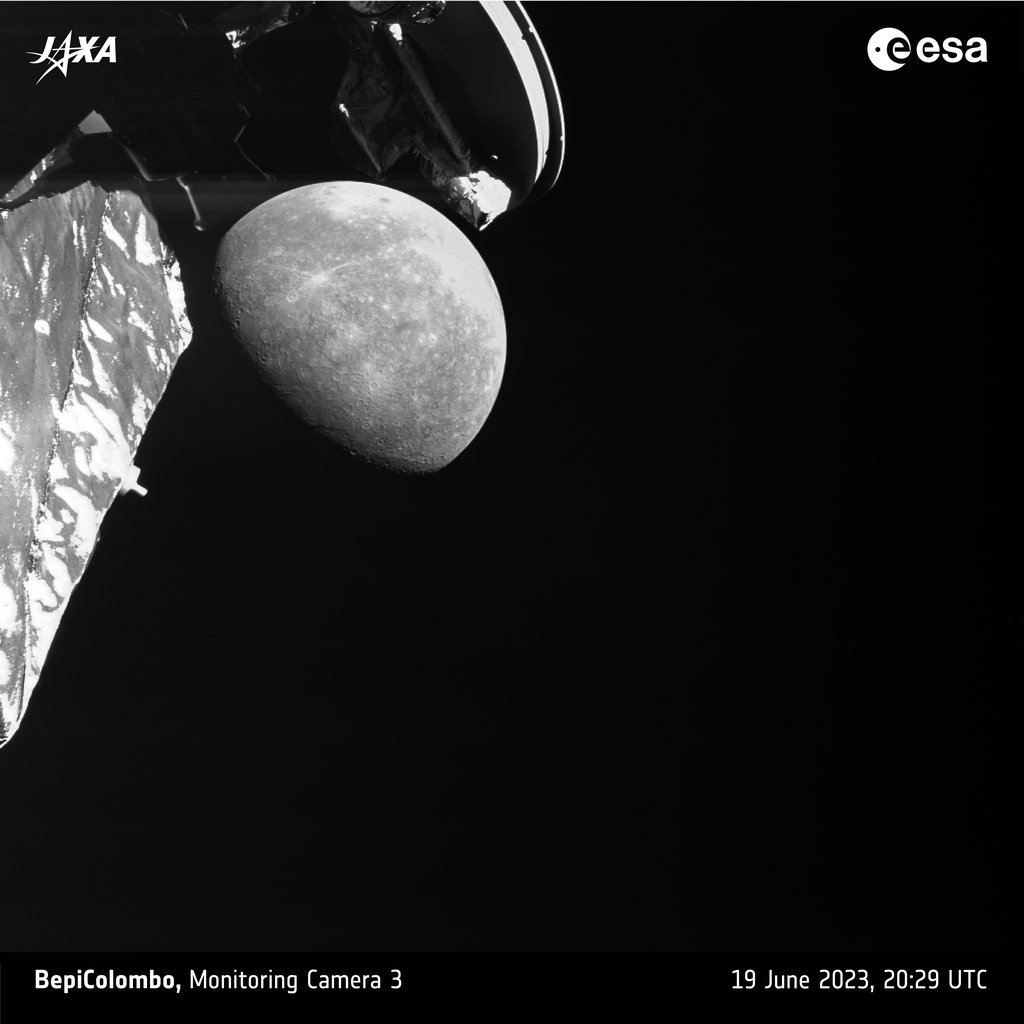
The lit disk of Mercury beside the foil-covered edge of a spacecraft, in a black-and-white frame carrying agency logos at the top and a bar naming the monitoring camera and the date along the bottom.
Mercury close beside the spacecraft structure during an earlier pass, on June 19, 2023 (illustrative). "BepiColombo hugs Mercury ESA24939504" by ESA/BepiColombo/MTM, via Wikimedia Commons, CC BY-SA 3.0 igo

Once the two orbiters separate, ESA's Mercury Planetary Orbiter and the Japan Aerospace Exploration Agency's smaller Mio craft will study Mercury's dense interior and outer magnetic field from different altitudes, along with the impact craters, volcanic plains and mountain ridges in between. ESA's mission page calls BepiColombo the first mission to orbit Mercury with two spacecraft at once, and sets the separation for Dec. 9–10, 2026, with the science phase beginning in April 2027.

According to AP, a series of thruster firings slowed the spacecraft enough for Mercury's weak gravity to capture them. Flight controllers in Germany, 94 million miles away, needed several hours to confirm that BepiColombo had reached orbit; teams were working through the data streaming back, and additional information was not immediately available.

BepiColombo is only the third spacecraft to visit Mercury, the closest planet to the sun and barely bigger than the moon. NASA's Messenger was the last, orbiting until it ran out of fuel and crashed into the planet in 2015. The mission is named for the late Italian mathematician Giuseppe "Bepi" Colombo, who was on the team behind NASA's Mariner 10 flybys of the planet.
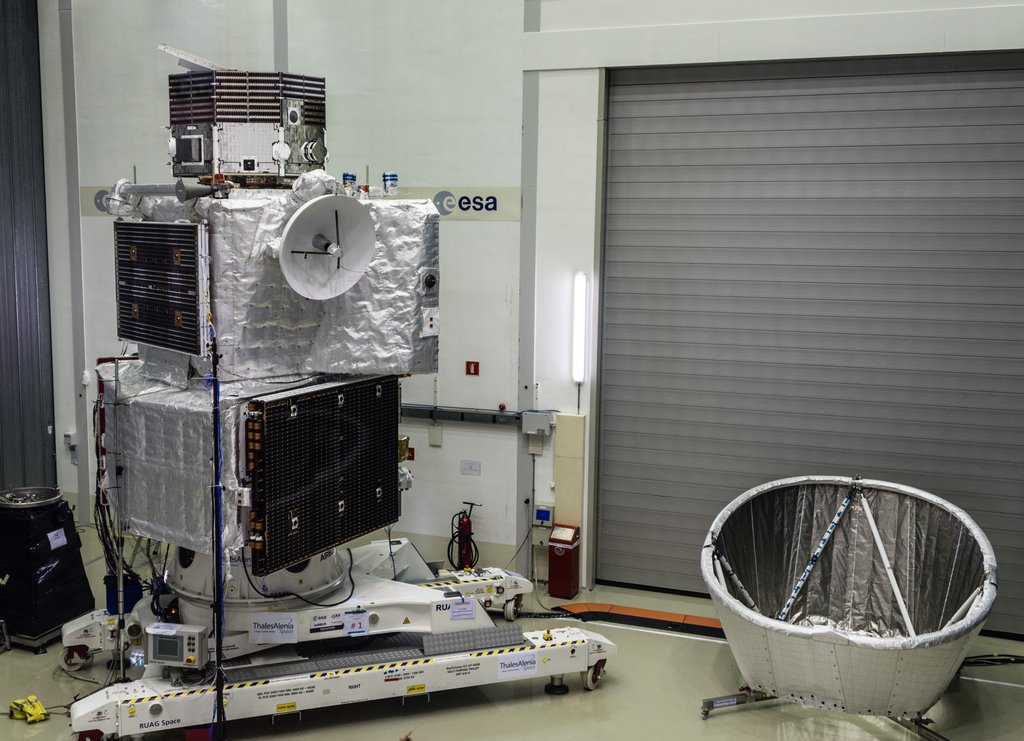
A tall stack of spacecraft modules wrapped in silver foil, with solar panels and a dish antenna, standing on a transport frame in a clean room beside a large conical foil structure.
The two orbiters and the module that carried them, stacked for testing in July 2017, before the mission left Earth. "BepiColombo spacecraft stack ESA380846" by European Space Agency, via Wikimedia Commons, CC BY-SA 3.0 igo

The $2 billion mission reached Mercury by a roundabout route, swinging past Earth, Venus and Mercury itself for gravity assists, and shed its transfer module in September 2026, the step ESA counts as the start of the mission's arrival phase.

Temperatures at Mercury can top 800 degrees Fahrenheit and add strain to electronic and engineering systems, AP reported. Lead project scientist Geraint Jones said in an email: "The spacecraft and its instruments need to be kept as cool as possible, which is a huge technical challenge in itself."

Sources

Spot an error?

Spot an error?

Report an error

Spotted a mistake on this page? Tell us what's wrong and our editors will take a look.

What kind of problem?

Only if you'd like us to be able to follow up. We won't use it for anything else.

We correct mistakes openly. Select any text to flag it. Fixes are logged under our Corrections Policy.

Report an error

Reporting on

Mercury Has Visitors Again, Eight Years After They Left Earth

What kind of problem?

Only if you'd like us to be able to follow up. We won't use it for anything else.

We read every report. Corrections are logged publicly.