BepiColombo Starts Its Mercury Arrival, With Orbit Still Weeks Away
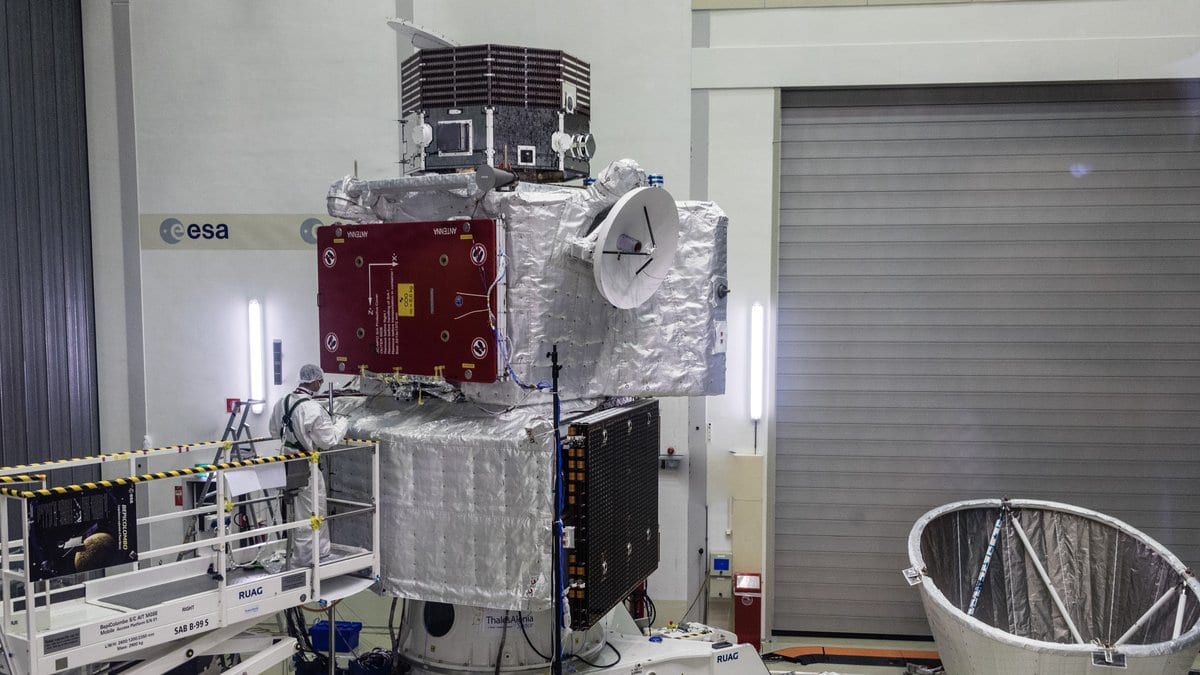
The European Space Agency said BepiColombo separated its Mercury Transfer Module from the rest of the spacecraft on Sept. 3. The maneuver is the first step in an arrival sequence that will place the mission in orbit around Mercury on Nov. 21.
ESA's live-updates page for the mission records the confirmation in two stages. At 13:41 BST, the agency reported a preliminary Doppler signal, a variation in the radio frequency between Earth and the spacecraft caused by a change in the spacecraft's velocity, and said it was consistent with the planned separation sequence. At 14:52 BST, two Estrack deep-space antennas at Cebreros in Spain and Malargüe in Argentina acquired the spacecraft's signal, confirming that the module had separated. Telemetry indicated "all systems are nominal," according to the same page, with the Mercury Planetary Orbiter's solar panels charging the spacecraft's batteries.
The separation was executed more than 200 million kilometers from Earth, with no opportunity for real-time intervention from the ground.
For nearly eight years, the transfer module had carried the spacecraft stack through the inner Solar System. The two science orbiters, ESA's Mercury Planetary Orbiter and JAXA's Mio, remain joined and are heading for orbit insertion around Mercury on Nov. 21. ESA's timeline has MPO powering the stack until Mio separates on Dec. 9-10, with the science phase beginning in April 2027.
BepiColombo is led by ESA in close collaboration with the Japan Aerospace Exploration Agency. It will be the first mission to orbit Mercury with two spacecraft at the same time.