Interstellar Comet 3I/ATLAS Is Richer in Nitrogen Than Comets Born Here
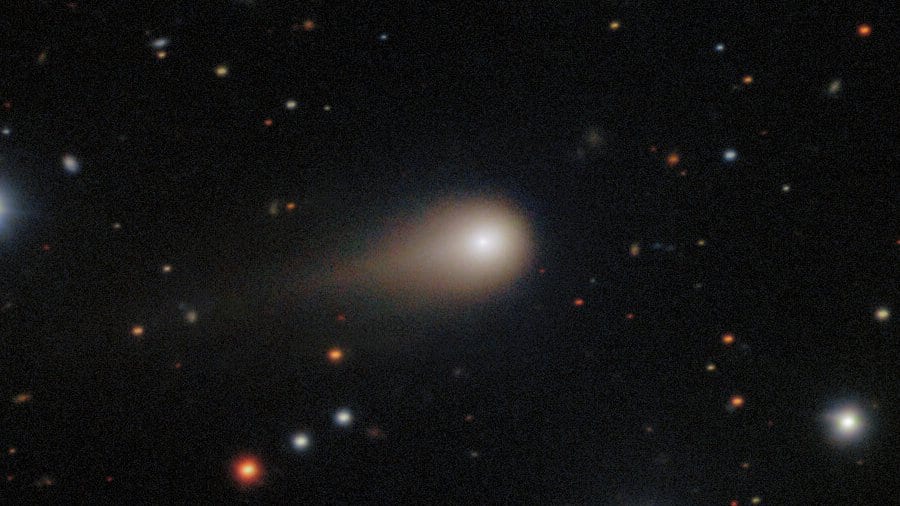
Astronomers have detected five kinds of electrically charged molecules at once in the tail of 3I/ATLAS, the third object known to have entered the Solar System from interstellar space, and used them to set a floor under how much nitrogen it carries. The measurement was published Sept. 7 in Monthly Notices of the Royal Astronomical Society.
Measuring an object like this is a way of comparing how planets formed around other stars with how they formed around the Sun. 3I/ATLAS was active enough on its way through the Solar System for the gas around it to be studied in detail.
L. Ferellec of Northumbria University, C. Opitom and C. Snodgrass of the University of Edinburgh's Institute for Astronomy, and colleagues observed the comet on Nov. 30 and Dec. 2, 2025, after it had rounded the Sun, using the WEAVE instrument on the William Herschel Telescope. In a tail streaming away from the Sun, they found ions of molecular nitrogen, carbon monoxide, carbon dioxide, water and CH, a simple carbon-hydrogen molecule.
From the ratio between the nitrogen and carbon monoxide ions, the team puts the comet's nitrogen-to-carbon-monoxide ratio above 0.023 ± 0.001. That is enough, the authors report, to make 3I/ATLAS nitrogen-rich next to comets that formed in the Solar System, a property they link to cold formation conditions.
The ratios among the other ions cannot be used directly to work out how much of each parent molecule is present, the paper states, though they appear consistent with the comet being enriched in compounds that freeze only at very low temperatures. The team also checked whether those ratios change along the tail, and detected only a marginal decrease in CH with distance from the nucleus.
Sources
- doi.orgPeer-reviewed