Brain Rhythms During Learning Tag Memories for Sleep, Study Reports
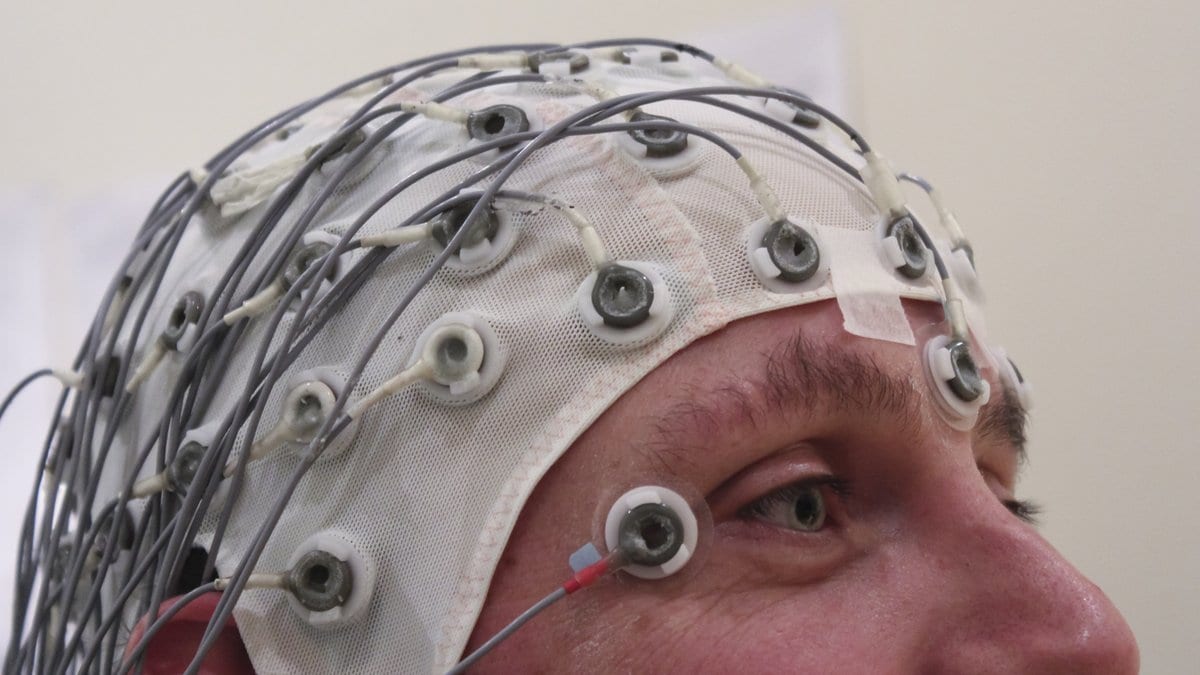
Researchers at the University of York report that patterns in brain activity recorded while people learned word-and-picture pairs differed depending on whether those pairs were still remembered after a nap or after an equal stretch of time awake. The study was published on August 27 in the open-access journal PLOS Biology.
Theoretical accounts have long held that some memories are "tagged" during learning for strengthening during later sleep. The authors write that "experimental evidence of such a tagging mechanism in the human brain is lacking."
Thirty-one adults, average age 20, took part in two sessions a week apart, according to the paper. Each session began with 160 word-object pairs and a memory test, followed by a two-hour daytime nap or two hours awake watching nature documentaries, then a second test. Recall held up better across the sleep delay than across the wake delay (t(30) = 2.49, p = .019).
Applying machine classifiers to the electroencephalography (EEG) recorded at learning, the team separated trials later recalled after sleep from those later recalled after wake. Theta rhythms, 3 to 8 Hz activity measured 0.3 to 1.05 seconds after each pair appeared, were stronger for items later recalled after sleep. The team puts the theta increase at 5.68% above baseline in the sleep condition and reports no significant change in the wake condition (a 2.73% decrease, p = .22).
The size of that theta response tracked the density of sleep spindles, brief bursts of activity, that were coupled to the roughly 1 Hz slow oscillations of deep sleep (r = .45 across five parieto-occipital electrodes). That coupling density was in turn associated with better retention (r = .43 across four fronto-central electrodes). Theta power on its own showed no direct relationship with retention (r = -.03, p = 0.88), and the authors write that their design cannot establish causal relationships between theta at encoding, coupling and consolidation.
Sixteen percent of the detected spindles were coupled to a slow oscillation, the paper reports. The data and analysis code are posted on the Open Science Framework.
Sources
- PLOS BiologyPeer-reviewed