Physicists Read a Magnetic Signal From Inside a Single Atom
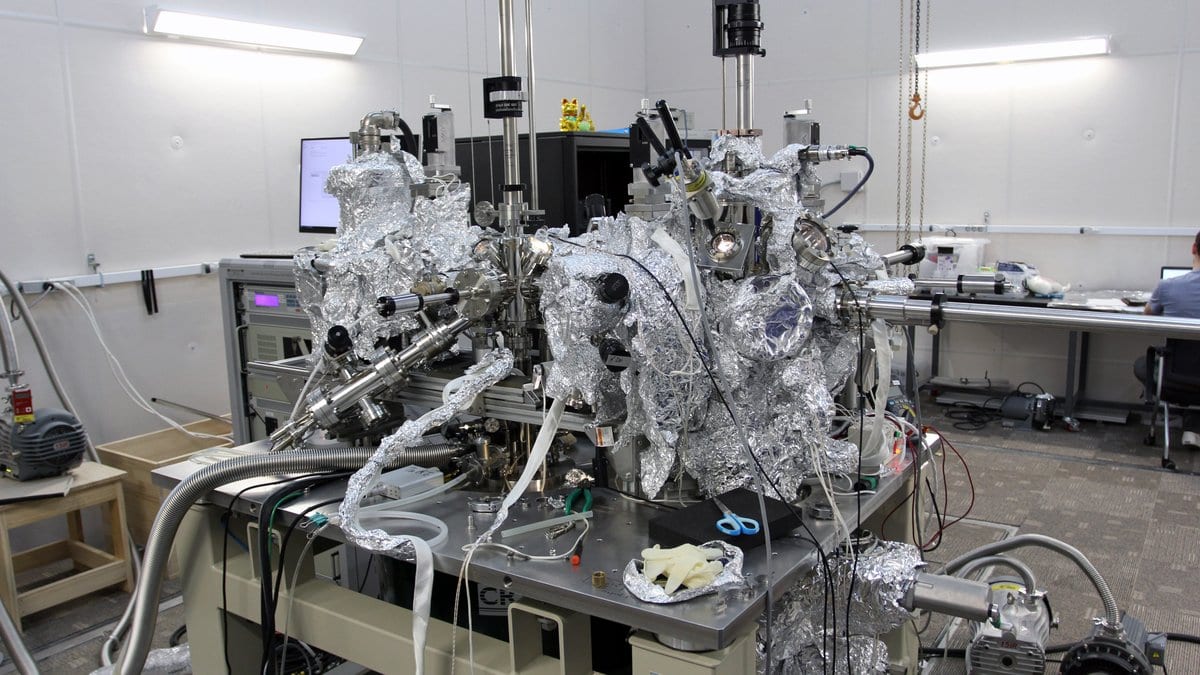
Physicists at Delft University of Technology have measured nuclear magnetic resonance on a single atom sitting on a surface, reading the signal out of the atom's own nucleus with the tip of a scanning tunneling microscope. Their paper appeared Oct. 24, 2026, in Nature Communications.
The authors describe atomic nuclear spins as promising candidates for quantum information technologies. A nuclear spin is well shielded from its surroundings, so it holds its state for a long time, and that same isolation makes it hard to control and hard to read. The group also reports that it could address the nuclear spin while that spin was only weakly mixed with the atom's electron spin. The paper calls that condition a requirement for controlling a nuclear spin directly in its long-lived state.
The measurement used an electron-nuclear double resonance scheme, which addresses the nucleus and the electron of the atom together, and resolved the nuclear spin transitions of a single titanium-47 isotope, whose nucleus has a spin of I = 5/2. Measurements and numerical analysis then characterized how that nucleus is coupled to the atom's electron spin and to the electric field around it.
Hester G. Vennema and Cristina Mier are the paper's first authors and contributed equally; Sander Otte is its senior author. All three work in the Department of Quantum Nanoscience at the Kavli Institute of Nanoscience in Delft. A co-author, Leonard Edens, is at CIC nanoGUNE-BRTA in Donostia-San Sebastián, Spain. The authors present the result as a valuable development for other platforms that work with nuclear spins.
Sources
- Nature CommunicationsPeer-reviewed