New Gene-Editing Method Adds Whole Genes Without Cutting Both Strands
Researchers at Boston Children's Hospital have reported a way to insert whole genes at a chosen point in the human genome without cutting both strands of the double helix and without waiting for the cell to divide. Sébastien Levesque, Daniel Bauer and colleagues published the method, which they call prime assembly, on Sept. 16 in Nature.
What it is meant to get around is a size limit. Prime assembly is built on prime editing, which rewrites short DNA sequences in place and currently supports changes of less than 250 base pairs, the paper states. The methods that install longer sequences generally depend either on breaking both DNA strands or on repair machinery that works only in dividing cells.
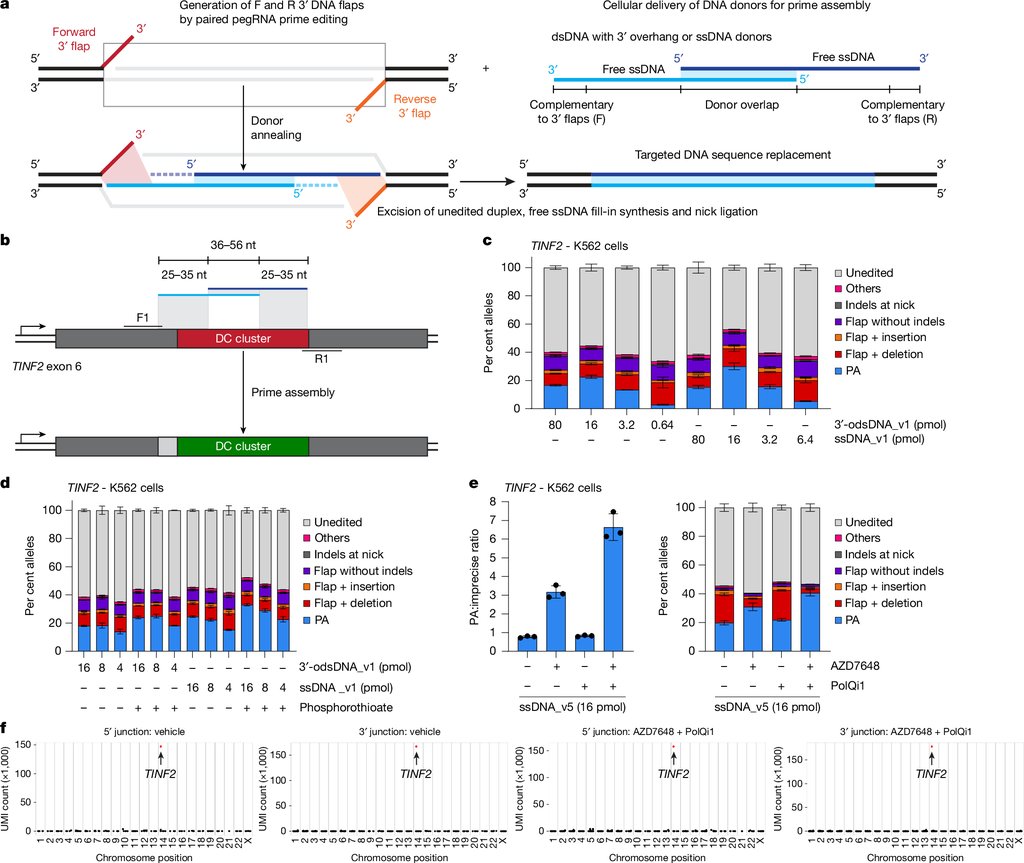
The group used prime assembly to rewrite a short stretch of one gene, to place gene-sized inserts as large as 12.1 kilobases, and to cut about a million bases out of one chromosome while inserting a marker used to select the edited cells. Efficiency fell as the inserts grew larger. All 48 single-cell clones tested after that deletion carried the intended change when the donor DNA was supplied as single strands.
In cells taken from healthy donors, the figures are much smaller. The authors reported editing an average of 3.3% of target sites in resting T cells and about 1.5% in blood stem cells. All of the work is in cultured cells, and the paper reports no animal or patient data.
The authors describe the large deletions as the first they know of to be made in human cells with a prime editor and no enzyme cutting both strands. They write that donors of this kind could provide universal strategies against many mutations that cause disease. That is a statement about what the approach might permit, not a result. The paper's own reference list carries three other 2026 reports of large insertions made with prime editing.
Sources
- NaturePeer-reviewed