NIST Built a Photon Detector 100 Times Wider, Not Smaller
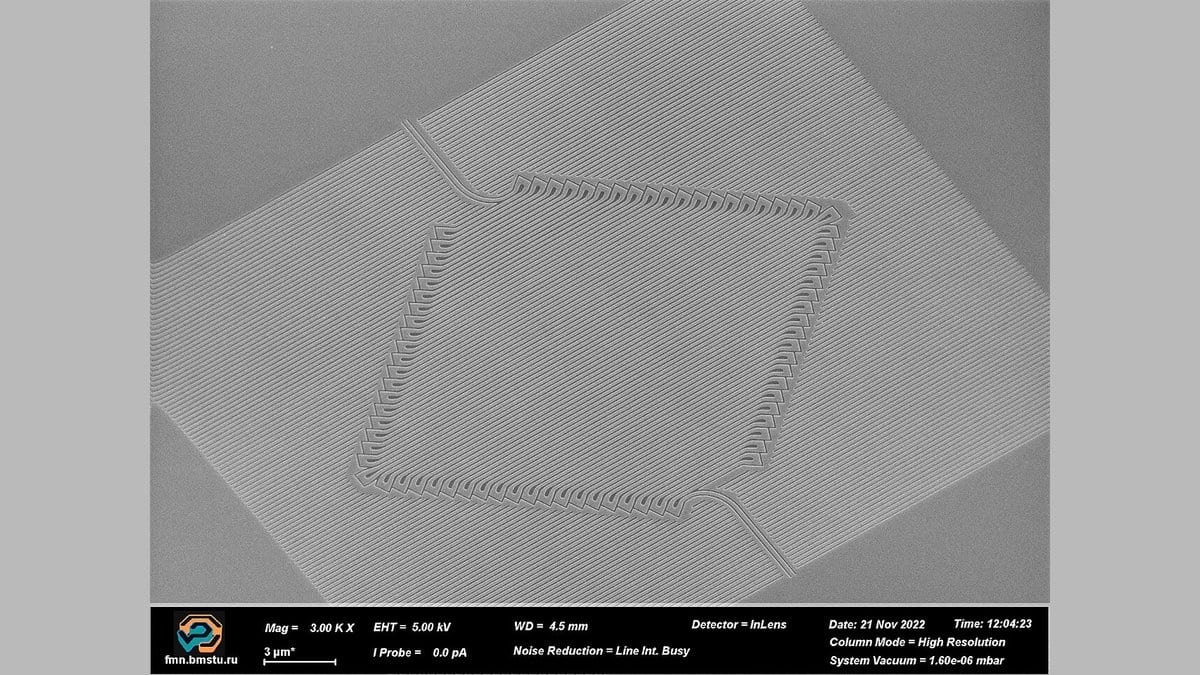
Physicists at the National Institute of Standards and Technology have run superconducting single-photon detectors whose sensing wire is a tenth of a millimeter wide, more than 100 times wider than the roughly 100-nanometer wires such detectors normally use, and report that false detections dropped by a factor of a billion. NIST announced the work Aug. 24; the paper appeared online Aug. 19 in Optica.
The devices, called superconducting nanowire single-photon detectors, carry an electric current with no resistance. A single photon striking the wire creates a hot spot that disrupts the current and produces a measurable voltage pulse. NIST says the field has kept shrinking the wires because that disruption has to reach across the wire's whole width. "Your photon energy needs to break superconductivity over the entire width of the wire," said Eli Mueller, a NIST postdoctoral researcher.
The team's change was to add superconducting rails alongside the central wire, carrying current in the same direction. According to NIST, the rails' magnetic field meets the wire's own and redistributes the current so it no longer piles up at the edges, where fabrication defects had been triggering the spurious signals known as dark counts.
NIST says its nanoscale detectors catch 98% of incoming photons. That figure belongs to those existing devices: the release states it is unclear whether the wide detectors can match it and that more testing is needed, attributing that to Marty Stevens, the group's leader. What the team did measure on the wide devices is the drop in dark counts, which NIST calls a record.
"For years, researchers have tried to get closer to the optimum performance of these detectors, but it was never clear how far you could push it," said Kristen M. Parzuchowski, the paper's lead author. "Now we've shown that you can actually reach the intrinsic performance limit."
NIST says the simpler design would make very large detector arrays easier to manufacture, and names blood-flow imaging through tissue and astronomy as uses. Stevens says the wires could go wider still.