A Narwhal Tusk's Spiral Comes From Two Opposite Twists
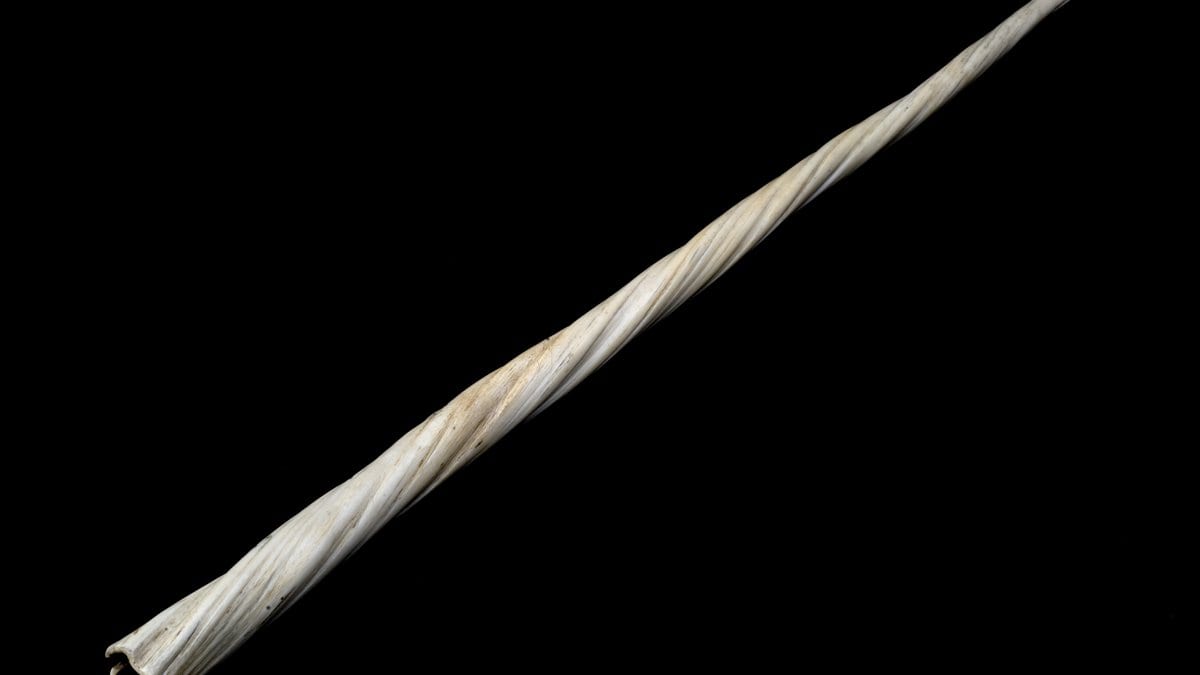
The narwhal's corkscrew tusk is built from mineral-hardened collagen wound into two helices that turn in opposite directions, a team led from Aarhus University in Denmark reports in a paper published Aug. 18 in Nature Communications.
Narwhal tusks, an overgrown tooth that grows throughout a male's life, "can exceed 2 m in length and consistently twist in a left-handed helix," the paper states. The angle of that surface helix, measured normal to the surface, "varies between 60° and 70°," according to the authors, and is inversely proportional to the tusk's diameter.
The team combined X-ray scattering and imaging at three synchrotrons (the DanMAX beamline at MAX IV in Sweden, cSAXS at the Swiss Light Source, and beamlines ID15A and ID13 at the European Synchrotron Radiation Facility in France) to follow the structure from individual mineralized collagen fibrils up to the whole tooth.
Their result, in the abstract's words: "the macroscopic helical structure is reproduced from the molecular-scale arrangement of mineralized collagen in a double helix with opposite chirality." Chirality is handedness. In the cementum, the tusk's outer layer, the collagen fibrils form a left-handed helix; in the dentine beneath it, the arrangement is right-handed and extends across the annual growth layers, which the paper reports differ in their mineral properties.
The mechanical reading is the authors': "The double helix configuration is generally more stable under bending and torsion than a single helix or a longitudinally aligned structure." They also suggest that the opposing internal helices "could be the forces driving the torsional deformations in cut tusk pieces."
The material came from Greenland. Two male narwhal specimens "were collected from Greenlandic Inuit subsistence hunters," the paper says, and six tusks from the Greenland Institute of Natural Resources collection, split lengthwise, supplied the morphological measurements. Mechanical testing used 10 samples cut along the tusk and 10 across it.
The first author is Adrian Rodriguez-Palomo and the senior author is Henrik Birkedal, both at Aarhus. Two of the co-authors, Eva Garde and Mads Peter Heide-Jørgensen, are at the Greenland Institute of Natural Resources.
Sources
- www.nature.comPeer-reviewed