Adding Titanium to Stainless Steel Does Not Remove the Specks Where Pitting Begins
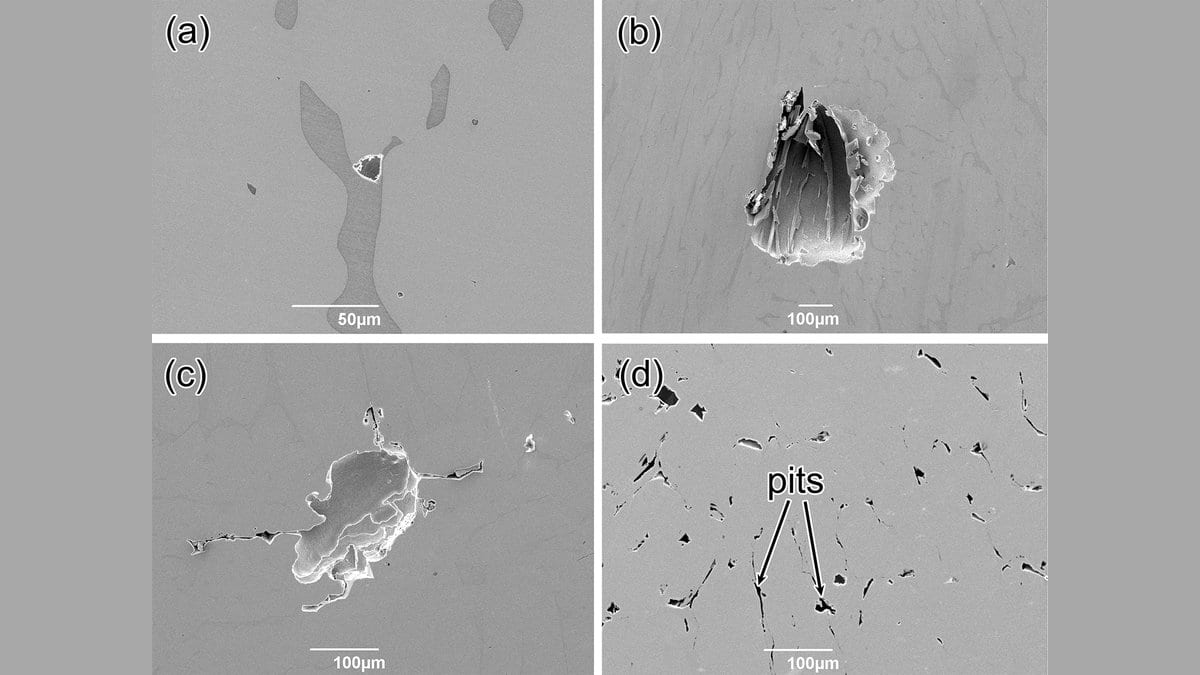
Researchers at Tohoku University report that a mixed manganese-titanium sulfide is where corrosion pits begin in stainless steel containing titanium, and that titanium raises the voltage at which pitting starts without removing the particle it starts from.
Pitting is a common way stainless steel fails in service. Chloride from seawater, road salt or process water breaks the metal's thin protective film at a single microscopic point and drills a hole there, while the rest of the surface stays bright. The weak points are generally inclusions, specks of other material left in steel when it is made. The study, published Oct. 22, 2026, in npj Materials Degradation, set out to establish which inclusion dissolves first in titanium-bearing steel, and therefore where a pit starts.
To settle it, Jiaqi Gao, Masashi Nishimoto and Izumi Muto grew the inclusions on purpose, mixing manganese sulfide or titanium disulfide powder into stainless-steel powder and pressing the mixtures into solid specimens with particles big enough to probe one at a time. The authors report that, with the voltage raised on individual particles in a laboratory sulfate solution, manganese sulfide began dissolving at 0.2 to 0.7 volts, the mixed manganese-titanium sulfide at 0.5 to 1.0 volts, and titanium disulfide only well above that. Titanium nitride, another particle that titanium forms, did not dissolve at all.
The same ordering appeared in bulk alloys. The average pitting potential, the voltage at which pits appear in a dilute chloride solution, was 0.38 volts for a commercial stainless steel containing about 16% chromium and 0.51 volts for an arc-melted version carrying 0.17% titanium. Electron microscopy and X-ray analysis did not find the mixed sulfide in the titanium alloy; the team infers it from the dissolution voltages and from the manganese and sulfur detected where pits had started. These are laboratory specimens in simple salt solutions, not steel in service.
The pits the team grew for inspection were a few micrometers across. The paper is open access, and the work was funded by the Japan Society for the Promotion of Science and the Iron and Steel Institute of Japan.
Sources
- npj Materials DegradationPeer-reviewed