Skip to content
See the World Through ScienceA project of ALLATRA
Source: Peer-reviewedPhysical Review Letters1 source

A Whirlpool in a Water Tank Gives Physicists a Way to Watch Wave Turbulence
Science

Republish this story

Our work is licensed under Creative Commons BY-NC 4.0. You may republish this piece for free — with credit to ALLATRA Media and a link to the original, unedited beyond length trims, and not for commercial use.

Read the full license

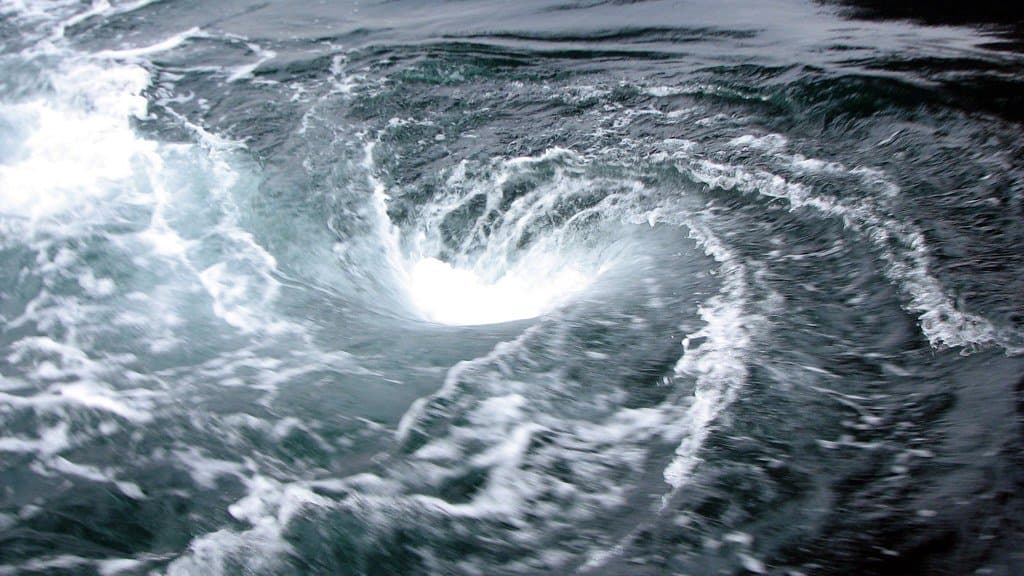
A whirlpool turning in dark green seawater, white foam spiraling into a bright center.
A tidal whirlpool in the Naruto Strait between Shikoku and Awaji Island, Japan (illustrative). The Paris team drove a single vortex of this kind in a laboratory tank and measured the waves running along its core."Naruto whirlpool" by MShades, via Flickr, CC BY 2.0 · CC BY 2.0

Physicists in Paris drove a single vortex in a tank of water, resolved the helical ripples that travel along its thin core, and watched energy pass from long waves to short ones in resonant groups of six.
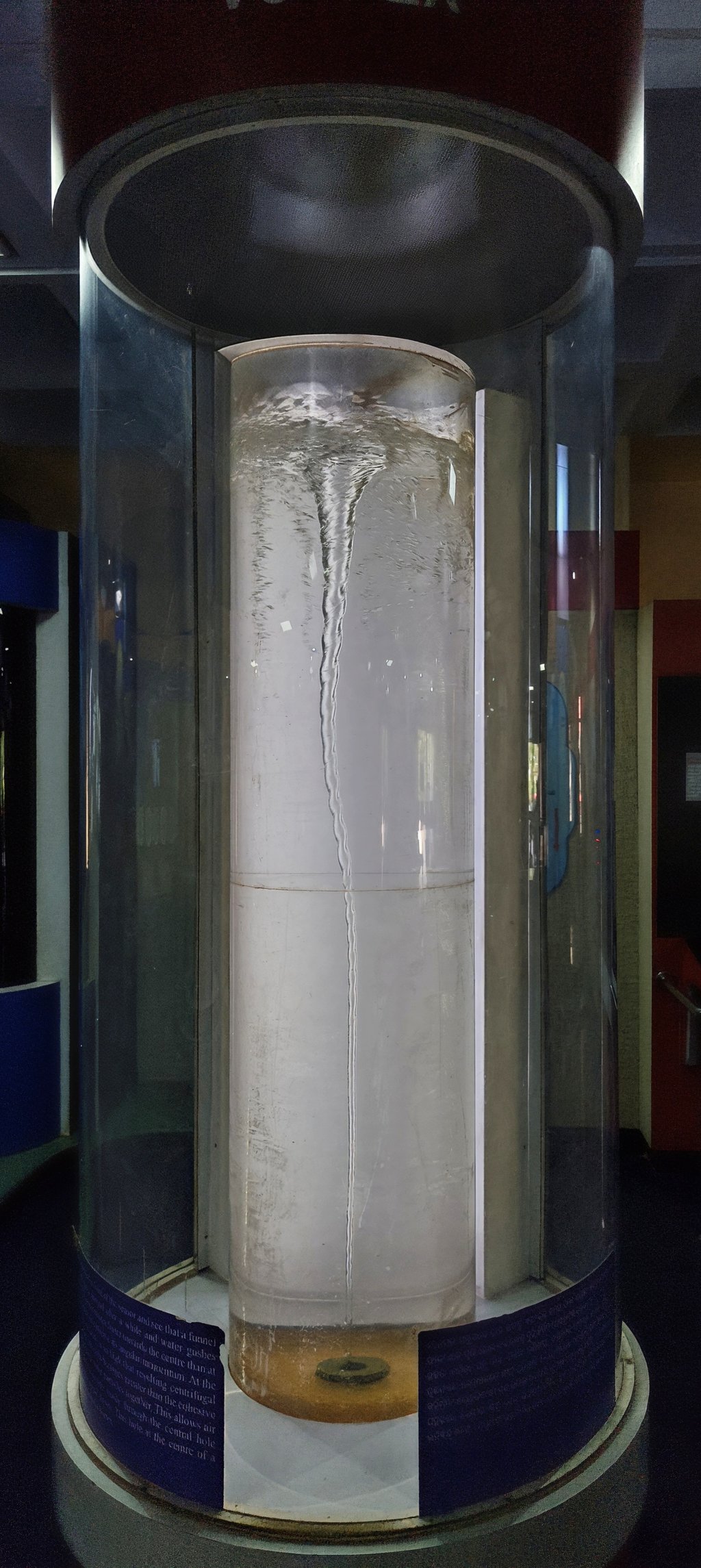
A tall glass cylinder of water in a science-center exhibit, with a thin twisting vortex running down its center.
A science-center exhibit holds a single vortex in a column of water, its thin core visibly twisting (illustrative). The experiment in Paris drove one vortex in a tank and resolved the helical waves running along a core like this. "Vortex 1" by Aliva Sahoo, via Wikimedia, CC BY 4.0

The work appeared in Physical Review Letters on September 21, 2026. Jason Barckicke and Eric Falcon of the MSC Laboratory at Université Paris Cité and CNRS, with Christophe Gissinger of the ENS laboratory LPENS, say the experiment establishes a platform for studying how energy moves along vortex cores in both classical and quantum turbulence.

The team tracked the waves over a broad range of scales in space and time. The authors report that the wave heights across those scales are consistent with the cascade predicted by weak turbulence theory (the mathematics of waves that interact only gently), and that resonant groups of six waves are what carries energy from large scales to small scales.

Kelvin waves are the name for those helical distortions. The paper says they are thought to matter from quantum turbulence up to atmospheric vortices, and that Kelvin-wave turbulence itself had stayed out of reach of direct experimental observation. The researchers describe their measurement as the first direct observation of it along a single vortex filament in a classical fluid under controlled conditions.

Physical Review Letters marked the paper an Editors' Suggestion and featured it in Physics, the American Physical Society's magazine, whose commentary on the work describes the tabletop water vortex as support for a decades-old account of how turbulence decays in quantum fluids.

Sources

Spot an error?

Spot an error?

Report an error

Spotted a mistake on this page? Tell us what's wrong and our editors will take a look.

What kind of problem?

Only if you'd like us to be able to follow up. We won't use it for anything else.

We correct mistakes openly. Select any text to flag it. Fixes are logged under our Corrections Policy.

Report an error

Reporting on

A Whirlpool in a Water Tank Gives Physicists a Way to Watch Wave Turbulence

What kind of problem?

Only if you'd like us to be able to follow up. We won't use it for anything else.

We read every report. Corrections are logged publicly.