Mice Need an Overlooked DNA Packaging Protein to Make Sperm Normally
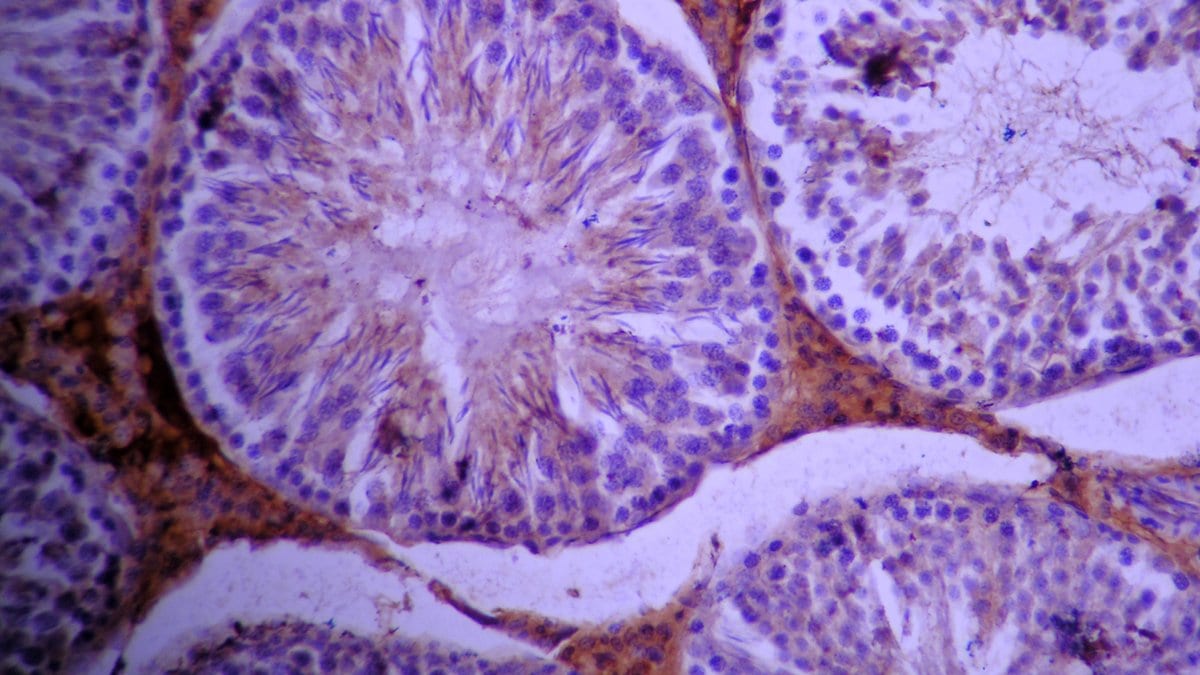
Mice that cannot make a little-studied form of a DNA-packaging protein do not produce sperm normally, a team led from Kyushu University reports. The protein, called H3mm15, is made predominantly in the testis, and mice that lose it develop disorganized seminiferous tubules, the coiled tubes where sperm are built, along with altered expression of genes tied to sperm production.
The paper, published Nov. 9, 2026, in Nucleic Acids Research, identifies H3mm15 as a subvariant of histone H3.3, one of the standard proteins that genomic DNA winds around to fit inside a cell. The authors write that histone H3 variants help regulate how DNA is packaged and contribute to which genes are expressed, and that the functional diversity of H3.3's own subvariants is largely unexplored. Their results, they write, suggest "an H3.3 sub-barcode mechanism," in which structurally different versions of H3.3 regulate the packaged state of DNA in different ways and so contribute to how genes are controlled during sperm production.
The paper’s authors, Qianmei Wu, Akihito Harada, and Yasuyuki Ohkawa (the senior author), worked with colleagues at the Division of Transcriptomics in Kyushu University’s Medical Institute of Bioregulation and at other Japanese institutions. They used RNA sequencing and a variant-specific PCR measurement to establish that H3mm15 is expressed predominantly in the testis, and then mapped where it sits on packaged DNA. It turned up closer to the points where genes start than H3.3 does, even though less of it is built into packaged DNA overall and the particle it forms around DNA is less stable.
The authors report that, in laboratory assays, H3mm15 had a more moderate effect than H3.3 on how strongly genes responded to stimulation. Lower stability did not translate into easier reading of the DNA: although H3mm15 forms a less stable particle than H3.3 does, the authors found no increase in transcription in a test-tube reaction by RNA polymerase II, the enzyme that copies genes into RNA.
Sources
- Nucleic Acids ResearchPeer-reviewed