Elephants' Overlapping Rumbles Match What the Group Is Doing

Researchers reported Oct. 1 in Scientific Reports that the situation a group of elephants is in can be worked out from the sound of several of them rumbling over one another, not only from calls made one at a time.
The authors write that most acoustic studies set overlapping calls aside, because individual voices cannot be pulled apart. Earlier work puts roughly 60% of elephant rumbles inside choruses of two or more voices, and they write that counting those in would give future studies far more material.
Louis Mahon of the Earth Species Project and colleagues analyzed 902 rumble recordings of adult female African savannah elephants, made by the Amboseli Elephant Research Project in Amboseli National Park, Kenya, over four separate periods between 1986 and 2022. Each carried a label assigned in the field for one of six situations, among them contact calls between separated animals, greetings, and the rumbles a family gives while settling where to go next. Models trained on measurements of the sound picked the right label more often than chance for single calls and for choruses alike, and models trained only on single rumbles could also label choruses above chance. The authors read that as evidence that calls inside a chorus share acoustic structure with single calls made in the same situation. Across the tests, more rumbles were labeled wrongly than correctly, and accuracy fell again when the models were given elephants whose voices they had never heard.
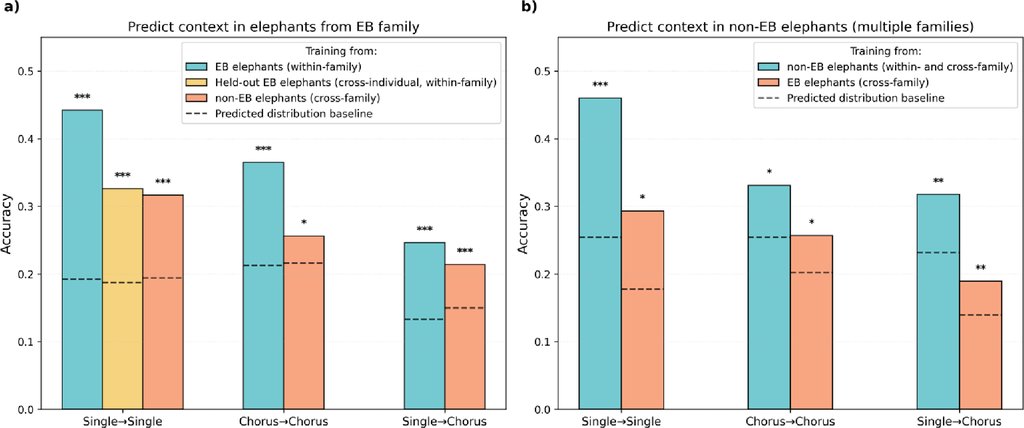
In three of the six situations the overlapping rumbles also grew more alike acoustically as an exchange went on: contact rumbles, greetings, and the cadenced rumbles a group gives while coordinating a move. The authors suggest the pattern points to convergence serving group coordination rather than social bonding. The study was observational, with no playback experiments to test whether elephants themselves respond to a converging exchange.
Sara C. Keen of the Earth Species Project and Joyce Poole of ElephantVoices jointly supervised the work. The acoustic features, metadata and analysis code are posted publicly on GitHub.
Sources
- Scientific ReportsPeer-reviewed