On a Chip, a Twist in Light Survives After Entanglement Is Gone
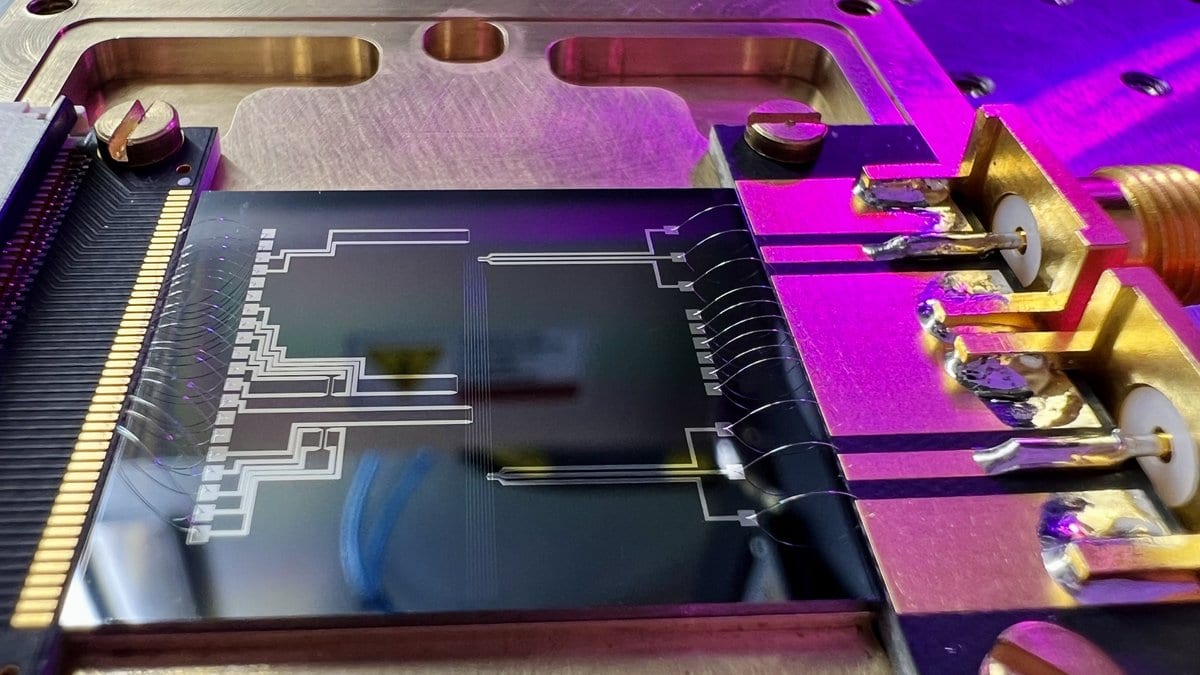
A research group led by the University of Pennsylvania has written a twisting pattern of polarized light onto a single photon on a silicon chip, then handed that pattern to a pair of entangled photons. The authors report that the pattern kept its shape under added noise even after the entanglement between those two photons had vanished.
The paper, published Oct. 12, 2026, in Nature Physics and open access, describes the work as a step toward quantum interconnects, the optical links that would let separate quantum machines work as one. In such links, information normally rides on entanglement and is lost with it. The paper also says the experiment does not establish an operational advantage for quantum state transfer.
The pattern is a skyrmion, a texture whose twist adds up to a whole number, and that number is what the group tracked. The chip was designed for a count of 2, and the measured value on single photons came out at 1.981, in agreement with the group's own theory. After the transfer, all four possible measurement outcomes came back near the same count, with an average match to the intended states of 89%.
The group then fed noise into the system. The count held steady past the point where concurrence, the standard measure of entanglement, had fallen to zero. It reached zero itself only when the noise nearly swamped the state. The authors attribute that to a weaker form of quantum correlation that outlasts entanglement.
Single-photon versions of these patterns had been made on chips before, and entangled versions in bulk crystals. The authors write that producing entangled skyrmions on a chip and linking them to single-photon ones had remained out of reach.
The circuit sits on a 310-nanometer layer of silicon nitride. A laser pulse pumps two coiled waveguides that produce the photon pairs, and heaters on the chip route one photon into ring-shaped generators. The data behind the paper are posted publicly on Figshare.
Sources
- Nature PhysicsPeer-reviewed