Physicists Use Entangled Particles to Check a Key Standard Model Number
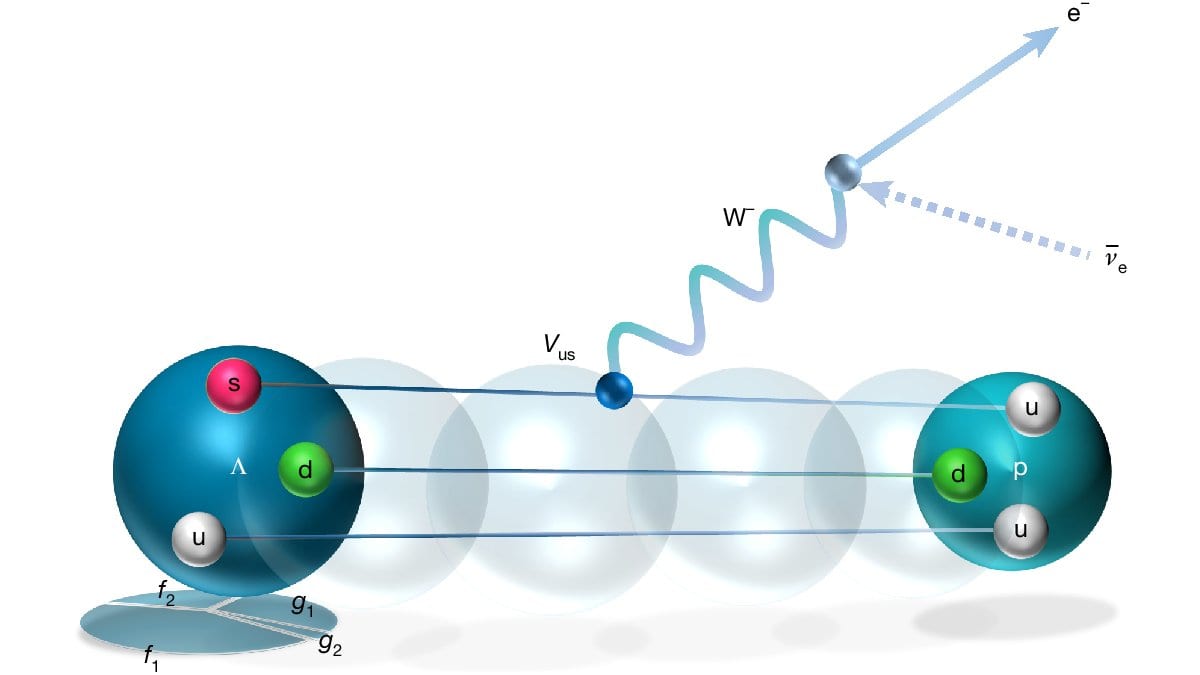
The BESIII collaboration has measured |Vus|, the number that sets how often a strange quark turns into an up quark, from the decay of a short-lived particle called the lambda. The value, published Sept. 2 in Nature, is 0.2339 ± 0.0041.
|Vus| belongs to a set of numbers the Standard Model requires to stay mutually consistent, a condition known as CKM unitarity, and physicists test the model by measuring each of them on its own. Current values from kaon and tau decays show tensions that may hint at physics beyond the Standard Model, the collaboration writes, and it presents decays of the kind it studied as an independent alternative. BESIII reports its own value as consistent with unitarity.
The decay BESIII used turns a lambda into a proton, an electron and an antineutrino. Decays of this kind have gone largely untapped, in the paper's account, because earlier experiments could not measure enough about where the products flew to pin down the quantities that describe the decay. BESIII made its lambdas in pairs with their antimatter counterparts at the J/ψ resonance, where the two come out polarized and quantum-entangled, so what is measured on one constrains the other.
That yielded two couplings describing the decay, plus what the collaboration calls the first determinations of the decay's absolute branching fraction, meaning how often it happens, and of its weak-electricity coupling. Combined with recent lattice quantum chromodynamics calculations, which compute the strong force numerically, they give the |Vus| figure.
The paper sets its result beside a Fermilab fixed-target measurement of the same decay from more than 30 years ago. That experiment's dataset was roughly 20 times larger, and BESIII reports comparable precision on one of the couplings from its own smaller sample. The collaboration argues the approach carries over to other baryon decays and establishes the foundation for a wider program.
Sources
- doi.orgPeer-reviewed