Soil Keeps Losing Carbon Long After a Wildfire, Global Review Finds
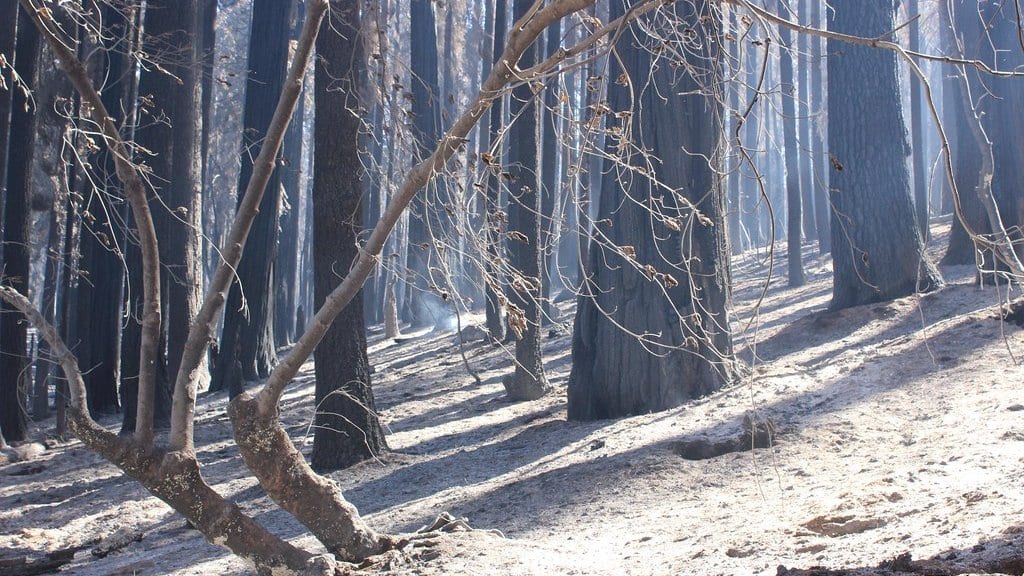
Wildfire strips the loosest part of soil carbon far faster than the carbon locked onto minerals, and the loss keeps deepening for about two decades after a fire, according to a synthesis of 210 published studies posted Aug. 29 in Communications Earth & Environment.
Tongxin Hu, Chun Wang, Zhenghu Zhou and Long Sun of Northeast Forestry University in Harbin, China, pooled 1,050 observations of burned surface soil down to 25 centimeters (about 10 inches). Wildfire cut particulate organic carbon, the loose and fast-cycling fraction, by 24.0%, against 9.5% for mineral-associated organic carbon, which is bound to soil minerals and far more stable, the authors report.
The losses do not peak right after a fire. In the pooled data they intensify over roughly the first 20 to 25 years before soils begin to recover, the paper states. Across sites, the authors report, the size of the loss is set mainly by how much carbon the soil held to begin with, the local climate and the time since the fire.
Scaling those responses globally, the team estimates cumulative wildfire-driven soil organic carbon losses of 885.92 plus or minus 12.75 teragrams, about 886 million metric tons, between 1997 and 2023. That figure is an extrapolation from the compiled observations rather than a measured total.
The work is a meta-analysis of already-published field results, not new fieldwork. The authors write that their findings underscore "the critical need" for global carbon-climate models to represent particulate and mineral-associated carbon separately.
Sources
- Communications Earth & EnvironmentPeer-reviewed