Skip to content
See the World Through ScienceA project of ALLATRA

Fossil Emissions Dip Slightly in 2026, but Carbon Dioxide in the Air Keeps Climbing
Environment

Republish this story

Our work is licensed under Creative Commons BY-NC 4.0. You may republish this piece for free — with credit to ALLATRA Media and a link to the original, unedited beyond length trims, and not for commercial use.

Read the full license

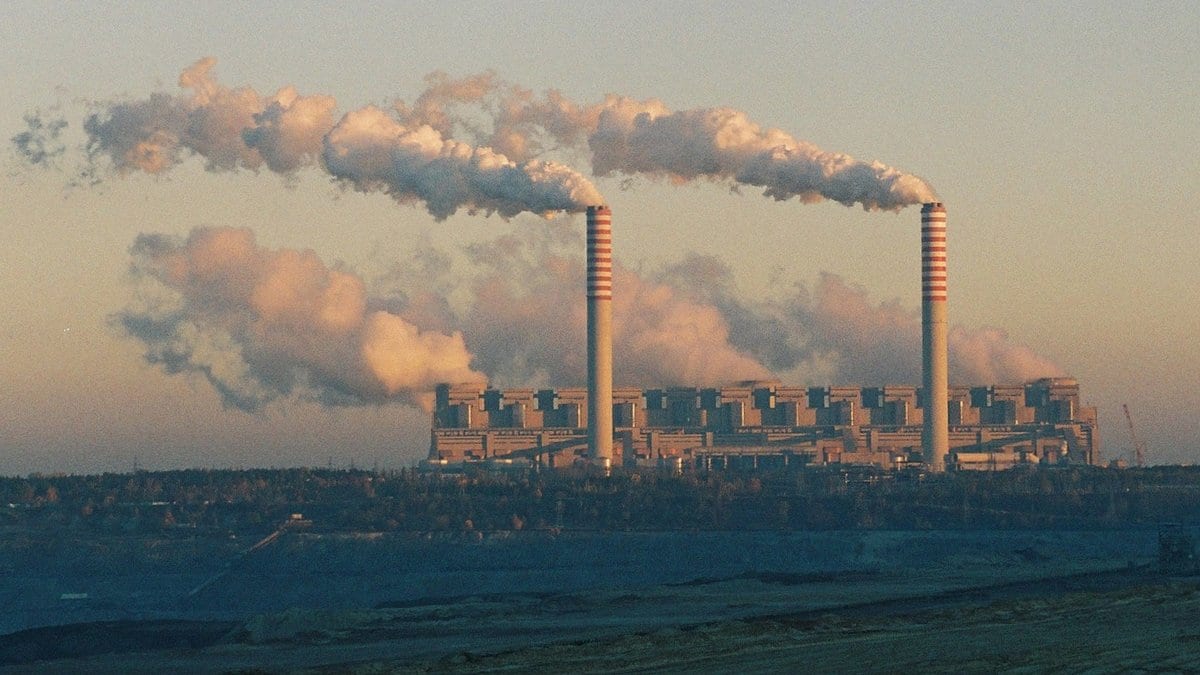
Two tall striped chimneys at a coal-fired power station send plumes across a hazy sky at dawn, with long generating halls below and bare, stripped ground in front.
The lignite-fired generating units at Belchatow in central Poland, photographed Oct. 29, 2005 (illustrative). Coal burning is one of the fossil sources the annual budget totals."20051029 Belchatow power station" by Petr Štefek, via wikimedia, CC-BY-2.5

Fossil fuel emissions of carbon dioxide look set to be 0.40% lower in 2026 than in 2025, according to preliminary figures in the Global Carbon Budget 2026, the annual carbon accounting submitted Nov. 10, 2026, by Pierre Friedlingstein of the University of Exeter and his co-authors. The range the authors put on that projection runs from 1.5% lower to 0.6% higher, so it spans no change at all.

The carbon dioxide already in the air keeps building up either way. The same preliminary figures have the concentration rising 2.2 parts per million to reach 427.7 parts per million, which is 54% above the pre-industrial level. The Global Carbon Budget is a yearly accounting of how much carbon dioxide human activity releases and where it goes, whether into the air, into the ocean or into plants and soils, and the authors write that quantifying it is needed to understand the global carbon cycle and to project future climate change.
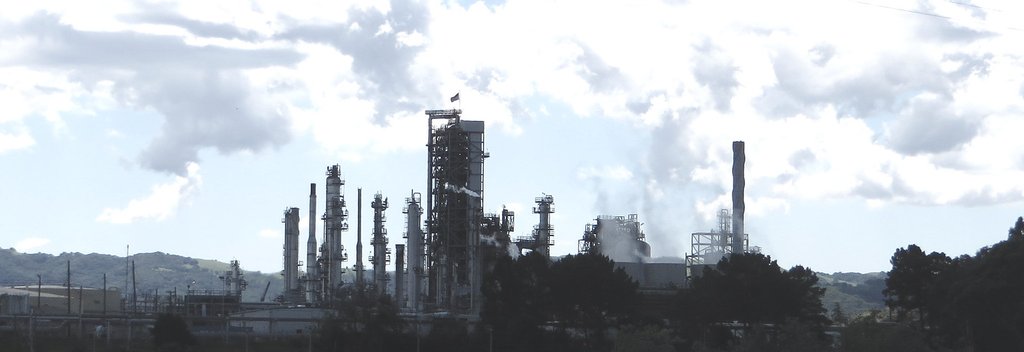
A refinery seen from a distance, its tall distillation columns and stacks silhouetted under a cloudy sky, with white vapor rising from several units and wooded hills behind.
Crude is turned into fuels here, at a plant in the San Francisco Bay Area, photographed March 29, 2016 (illustrative). Burning those fuels is counted in the budget's fossil total alongside coal and gas. "Oil Refinery, Martinez, California" by Ken Lund, via Flickr, CC BY-SA 2.0

For 2025, a completed year rather than a projection, the authors report fossil emissions 1.2% higher than in 2024 and total human-caused emissions of about 42.8 billion metric tons of carbon dioxide, a figure that includes emissions from land use such as clearing forest. They call the uncertainty on that land-use component persistently large, and say their comparison of methods still finds low agreement on how much carbon dioxide the land takes up.

The paper is a preprint under review at the journal Earth System Science Data and has not been peer-reviewed. Public comment on it is open until Dec. 17, 2026, with referee reports, community comments and the authors' replies posted on the same page.

The budget's component estimates run back to 1959, and the authors have posted the data behind this edition publicly.

Sources

Spot an error?

Spot an error?

Report an error

Spotted a mistake on this page? Tell us what's wrong and our editors will take a look.

What kind of problem?

Only if you'd like us to be able to follow up. We won't use it for anything else.

We correct mistakes openly. Select any text to flag it. Fixes are logged under our Corrections Policy.

Report an error

Reporting on

Fossil Emissions Dip Slightly in 2026, but Carbon Dioxide in the Air Keeps Climbing

What kind of problem?

Only if you'd like us to be able to follow up. We won't use it for anything else.

We read every report. Corrections are logged publicly.