Adding Plankton Detail to a Climate Model More Than Doubles Its Projected Ocean Carbon Loss
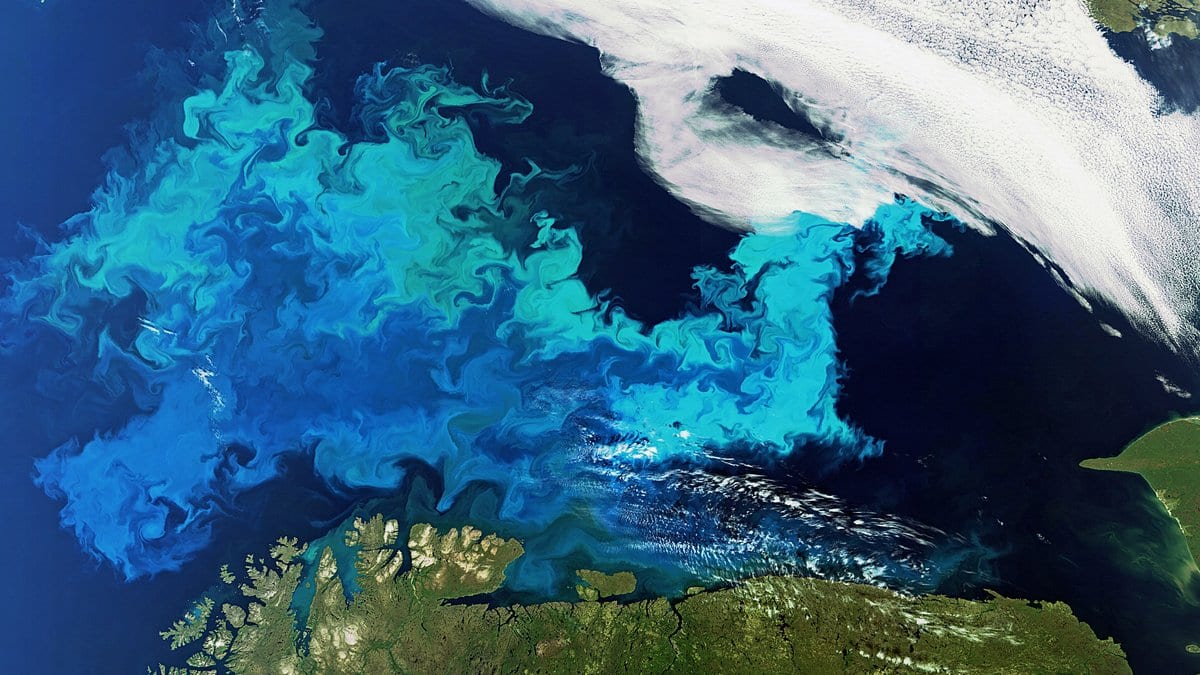
One Earth system model, run three times with progressively more plankton biology in it, projects a late-century fall in the carbon that ocean life sends out of surface waters, with the fall more than twice as large in its most detailed version as in its simplest. The study appeared Nov. 21, 2026, in Nature Communications.
The three runs differ only in how much plankton ecology the model carries, so the gap between them measures a modeling choice rather than anything observed at sea. The paper sets out why that choice matters: the ocean's biological pump, which carries carbon from sunlit surface water down into the deep sea, regulates how much carbon dioxide stays in the air, and Earth system projections may miss how the complexity of plankton food webs shapes the pump's response to warming.
The authors report that under SSP5-8.5, the highest-emissions scenario they ran, late-century global net community production falls 5.8% in the model's default configuration, against 8.8% and 12.8% in the two more complex ones. That quantity is what the plankton community fixes and does not respire away — the share that is actually available to sink. Warming and stronger layering of the upper ocean change total carbon fixation only modestly; the lasting declines are in net community production and in the carbon exported to depth. The amplification comes from a shift toward smaller phytoplankton and heavier grazing by zooplankton, which keeps more of the fixed carbon in the upper ocean.
The authors put their conclusion as a possibility: "Coarse plankton representations may therefore underestimate future biological-pump weakening and climate-carbon feedbacks."
Fanyu Lin of Zhejiang University is the first author and Stephanie Dutkiewicz of the Massachusetts Institute of Technology the senior author, with co-authors at NOAA's Geophysical Fluid Dynamics Laboratory, the National Oceanography Centre in Southampton and the China Meteorological Administration. The work is open access, and the journal's page for it carries the study's source data and the file of its peer review.
Sources
- Nature CommunicationsPeer-reviewed