Rain and Dripping Leaves Deliver Carbon That Global Carbon Budgets Leave Out
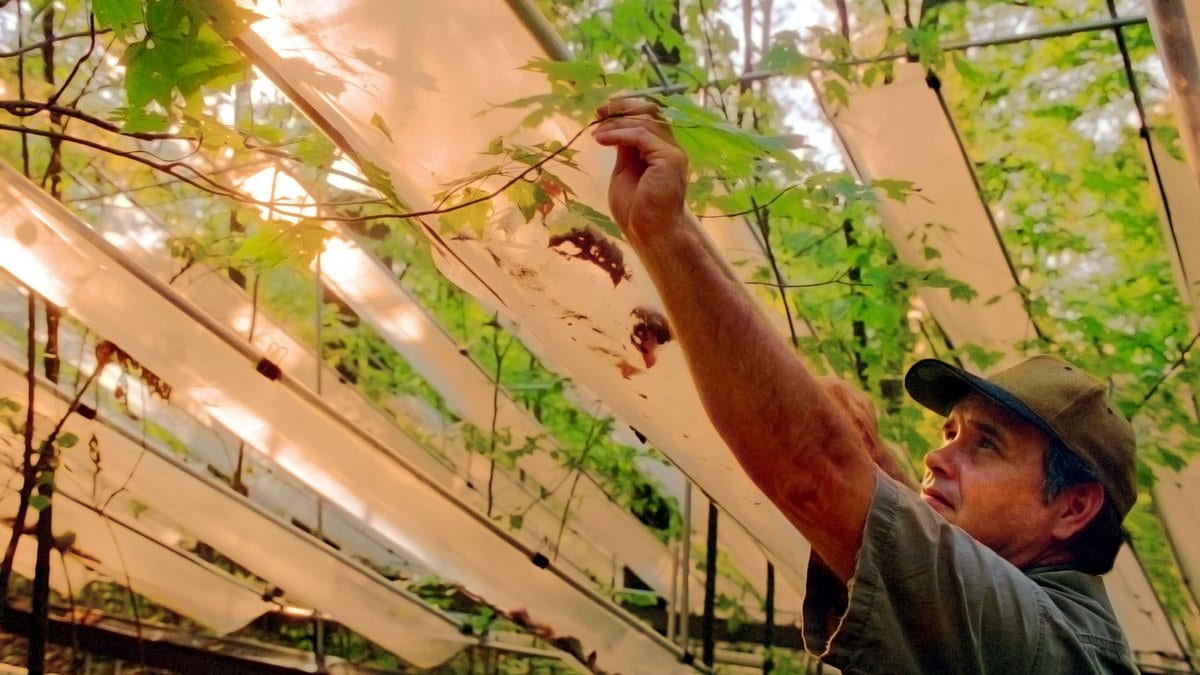
Rain and the water that drips off tree canopies carry about 612 teragrams of carbon to land each year, or 612 million metric tons, according to a reconstruction by Ningyu Jia, Yu Zhao and colleagues at Nanjing University. The authors report that this input is missing from current global carbon budgets, and that it rivals the carbon exported from land to the ocean.
The carbon they counted is dissolved organic carbon, meaning carbon dissolved in water rather than carried as soot or dust. In the paper, published Nov. 12, 2026, in Communications Earth & Environment, the team describes this deposition as doing two jobs at once: it is where a share of organic air pollution ends up, and a supply of nutrients to land ecosystems.
That estimate comes from a reconstruction of the years 1980 to 2020, not from a direct global measurement. The team built it by combining machine learning with constraints from measurements of carbon isotopes, the heavier and lighter forms of the carbon atom.
Canopy interception, water that reaches the ground only after running over leaves and branches, accounts for about 52% of the global flux, the authors report. They write that the chemical transport models used to follow pollutants through the atmosphere systematically underestimate that share.
The team also found that deposition has come loose from the rising emissions of the pollutants this carbon forms from, and is governed instead by shifting weather patterns.
The paper is open access, and Communications Earth & Environment has posted it as a peer-reviewed accepted manuscript that a final edited version will replace. Besides Nanjing University, the co-authors are based at Nankai University, Tsinghua University, the Shanghai Academy of Environmental Sciences and the Institute of Atmospheric Physics of the Chinese Academy of Sciences.
Sources
- Communications Earth & EnvironmentPeer-reviewed
