A Glacier Model Run Day by Day Instead of Month by Month Projects More Ice Loss
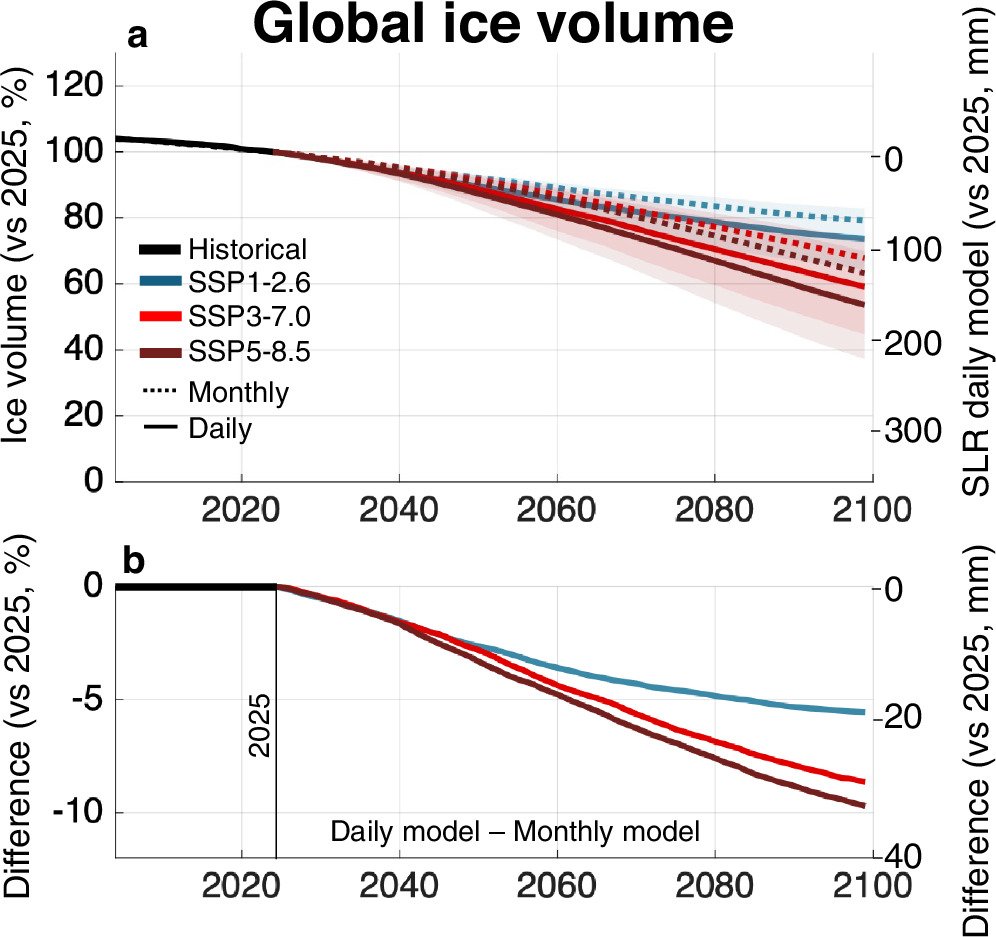
A daily-resolution version of a global glacier model projects 5–10% more ice loss by 2100 than the monthly version it was built from, an extra 20–33 mm of global mean sea-level rise. Lander Van Tricht, Daniel Farinotti and colleagues at ETH Zurich and the Swiss Federal Institute for Forest, Snow and Landscape Research (WSL) ran both settings of the Global Glacier Evolution Model for every glacier larger than 5 square kilometers, and published the comparison Oct. 19, 2026.
Such models normally run on monthly average temperature and precipitation. The team reports in Nature Communications that monthly averaging hides heat waves, the switch between rain and snow near freezing, and fast changes in a glacier's surface between snow and bare ice. Leaving that variability out may systematically underestimate future glacier loss, and the time step matters most where glacier projections feed water-supply and hydropower assessments.
Measured against 2025, the daily model projects global glacier losses of 26% by the end of the century under a low-emission scenario and 47% under a high-emission one, both with a wide spread across the climate models. That extra loss is a difference between two model setups, not an observed one.
The gap is widest in flat, ice-cap regions. For Svalbard, the Russian Arctic, and the Antarctic and sub-Antarctic islands, the daily model projects up to 25% more loss over the century, which the authors call upper-end estimates because those regions are unusually sensitive to calibration. Iceland goes the other way, at 4% less loss, because resolving single days sorts more of its warm, wet storms as rain rather than snow.
Against 4,037 annual field measurements of glacier mass balance, the daily version matched observations slightly better, an improvement the authors call modest. The gain was larger in extreme melt years, which monthly averaging flattens. In Western Canada and the United States, the daily model also puts the yearly runoff peak about 46 days earlier by 2100 than in the 2001 to 2020 baseline.
Daily runs cost substantially more computing time, and the authors expect monthly models to stay standard.
Sources
- Nature CommunicationsPeer-reviewed