Up to 140% More Ground Strikes Under High Emissions, a Lightning Model Projects
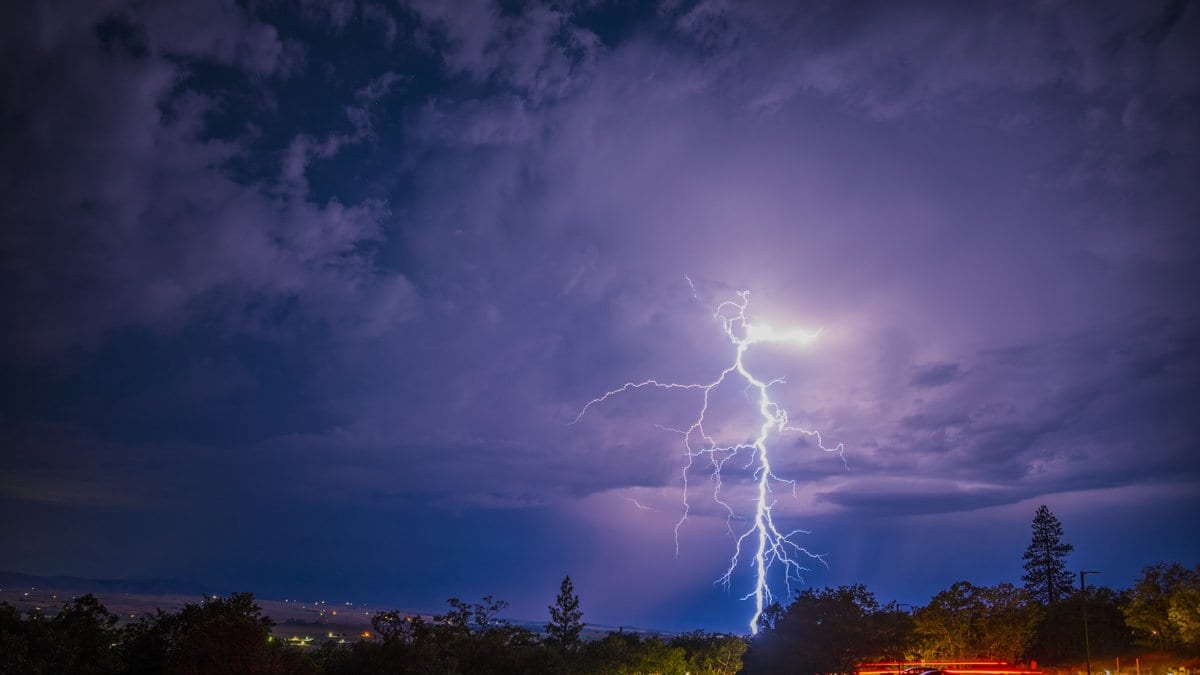
A machine-learning model trained on records of lightning that reaches the ground projects 76%–140% more of those strikes over land under a high-emissions path, a team at the Technical University of Munich, Vrije Universiteit Amsterdam and the University of East Anglia reports in Earth's Future. The paper was published Nov. 24, 2026.
Most projections of lightning under warming cover total flashes, including those that never leave the clouds. The study is about ground strikes alone. Andreas Krause and Anja Rammig of the Technical University of Munich and their colleagues write that these strikes pose significant risks to infrastructure, people and ecosystems, and that their future trends remain poorly constrained.
The range comes from running the model on output from two climate models under SSP3-7.0, a scenario of high emissions, and the authors convert it to roughly 30% more ground lightning for each degree of global warming. Applied instead to 20th-century climate, the model puts the global rise in ground-strike frequency across that century at about 11%. That figure is model output too, not a count of observed strikes.
The model uses a machine-learning method called XGBoost. It was trained on ground-based strike observations together with six daily weather variables, among them temperature, rainfall and wind speed, and it predicts strike density over land in grid squares half a degree across. The authors report that it reproduced present-day lightning patterns in space and time, and that it performed better than a linear statistical model and three existing schemes that infer lightning from convective rainfall or storm energy. By the paper's account, the increases the model projects run substantially higher than those from the linear model and from earlier studies.
The projections put the largest absolute increases in the tropics and the largest relative increases at high latitudes — where strike density often more than doubles. They diverge most in the tropics under one of the two climate models, particularly over the Amazon and New Guinea, where the projected climate departs furthest from present conditions.
The German Research Foundation and the Velux Stiftung funded the work.
Sources
- Earth's FuturePeer-reviewed