A Lost Ice Shelf Once Braced Three Ice Sheets in Baffin Bay
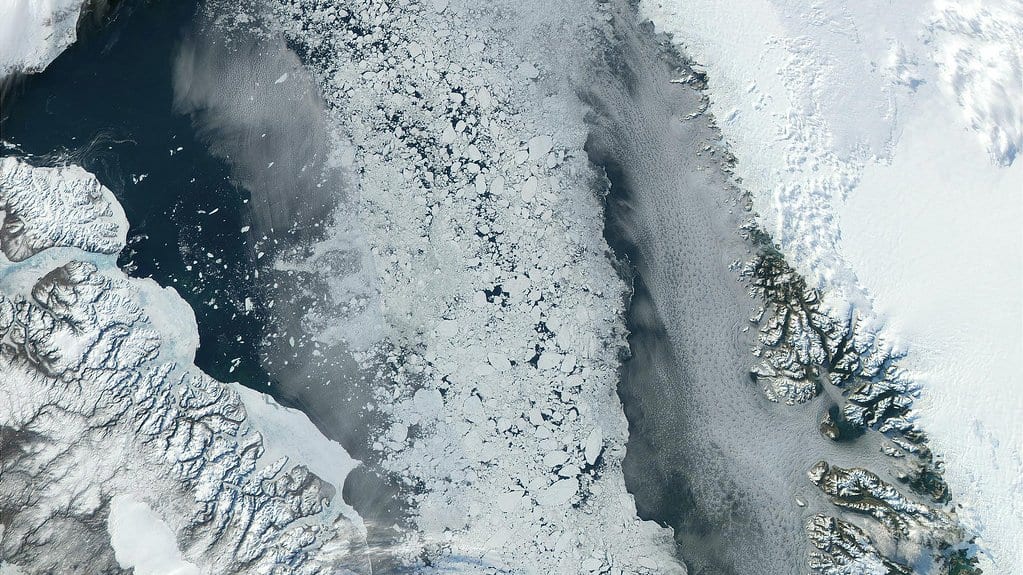
Researchers have mapped evidence that a single floating ice shelf once filled Baffin Bay, the basin between Greenland and Canada, and braced the three ice sheets that met there at the peak of the last ice age. The study was published Oct. 21, 2026, in Nature Geoscience.
How those ice margins were arranged sets the conditions that govern how an ice sheet retreats, and the authors present the Baffin Bay shelf as an analog for how a weakening brace may speed up the retreat of Antarctic ice streams in the future.
Shannon A. Klotsko of the University of North Carolina Wilmington and colleagues compiled seafloor depth measurements and studied the landforms of the Baffin Bay continental slope. They report evidence of ice that rested on the slope during the last glacial period, and they trace the deepest mark it left around most of the bay. Those marks are interpreted as the imprint of a basin-spanning ice shelf covering 150,000 square kilometers and standing about 1,400 to 2,100 meters thick, once corrected for the sea level of the time. The authors write that, held in place by the shape of the basin, the shelf braced the ice sheets around it, locked mechanically to them and helped them thicken.
Drawing on sediment cores, the team infers that the shelf's collapse set off rapid retreat of those ice sheets. That step is the authors' inference, not something the mapping measured.
Global ice volume peaked between roughly 26,500 and 19,000 years ago, when the Laurentide, Innuitian and Greenland ice sheets came together in Baffin Bay. A separate group reported evidence for an extensive ice shelf in northern Baffin Bay in 2022, in Communications Earth & Environment, and the new work traces the marks of grounded ice around most of the basin.
The mapping files and the processed depth grids from the research cruise are posted at the Marine Geoscience Data System.
Sources
- Nature GeosciencePeer-reviewed
