Warming Could Add Cloud Particles Over Arctic Ice and Cut Them Over Its Seas
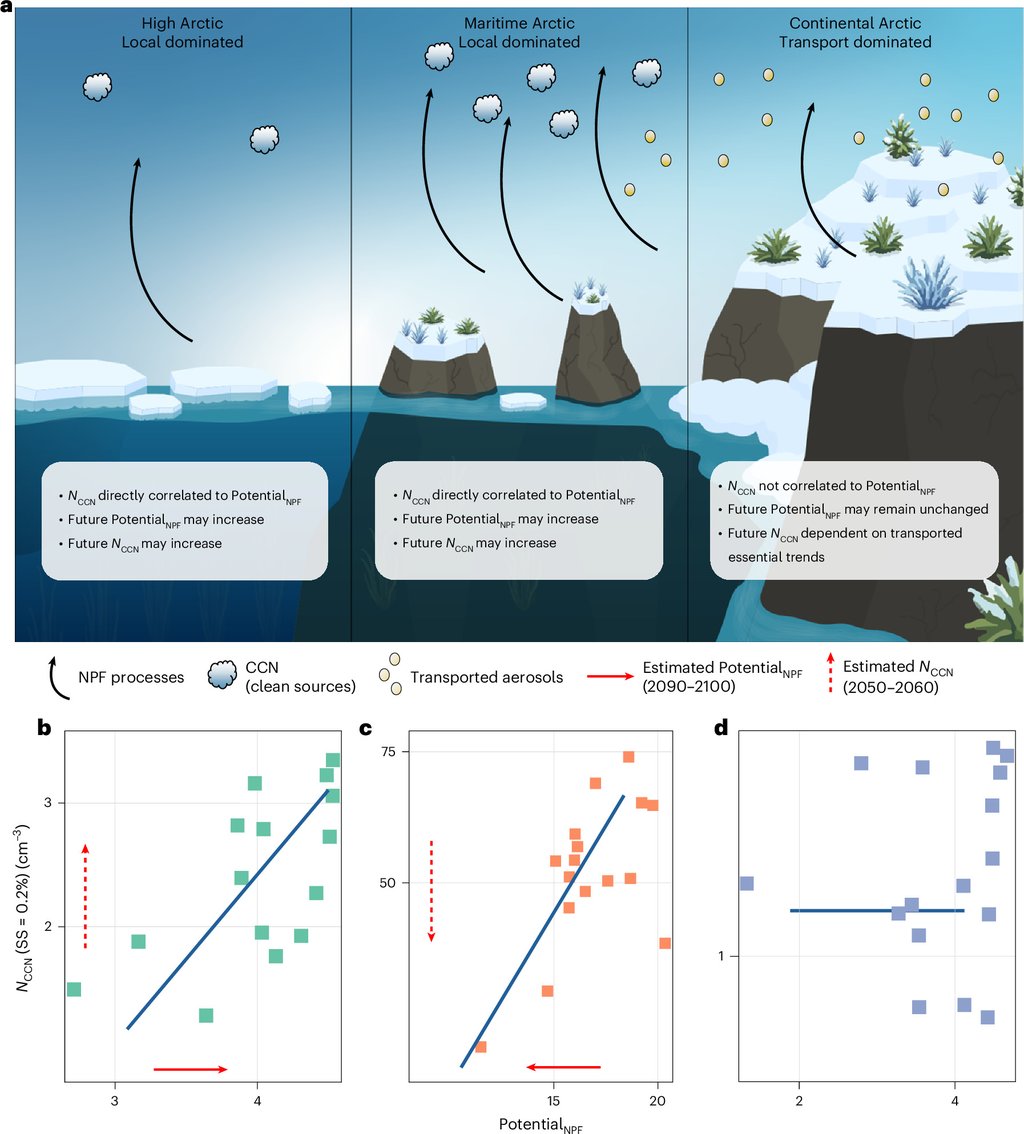
A team led by Samuel De Xun Chua and Katrianne Lehtipalo at the University of Helsinki has split the Arctic into three zones for the tiny airborne particles that cloud droplets form on and projects that warming will raise their numbers in one zone while cutting them in another. Reported Sept. 28, 2026, it rests on air measurements from eight Arctic monitoring locations covering 2003 to 2024, all reprocessed by one method so they could be compared.
Writing in Nature Geoscience, the authors say no single Arctic site can stand in for the region, and that a simple narrative in which warming raises particle numbers across the whole Arctic risks being misleading. They argue that the harmonized records give climate modelers a yardstick for testing how models handle Arctic aerosols.
The zones are the High Arctic, over the summer sea ice and Greenland; the Maritime Arctic, the open Barents and Norwegian seas; and the Continental Arctic, a land belt from Finland to Arctic Canada. Over the High Arctic and the Maritime Arctic, the particles assemble in the air out of gases, a process called new particle formation. Over the Continental Arctic, haze carried up from lower latitudes dominates.
The end-of-century figures are projection, not measurement. Extending the temperature response it measured under SSP2-4.5, an intermediate emissions scenario, the team estimated the number of cloud condensation nuclei, the particles a droplet forms around, in the 2090s. Those that owe their existence to new particle formation could rise 3–16% in the High Arctic and fall 15–31% in the Maritime Arctic. No estimate was attempted for the Continental Arctic, where future counts depend on emissions far to the south.
In the High Arctic the air is clean enough that a shortage of particles, not of moisture, limits cloud formation, so small changes in their number matter. The Maritime Arctic has no permanent monitoring station; its figures rest on short research cruises, and the authors say that limits how tightly they can be constrained.
The paper is open access, and its maps and code are posted on Zenodo.
Sources
- Nature GeosciencePeer-reviewed
