Sunlight May Be Changing the Ancient Air Trapped in Antarctic Ice
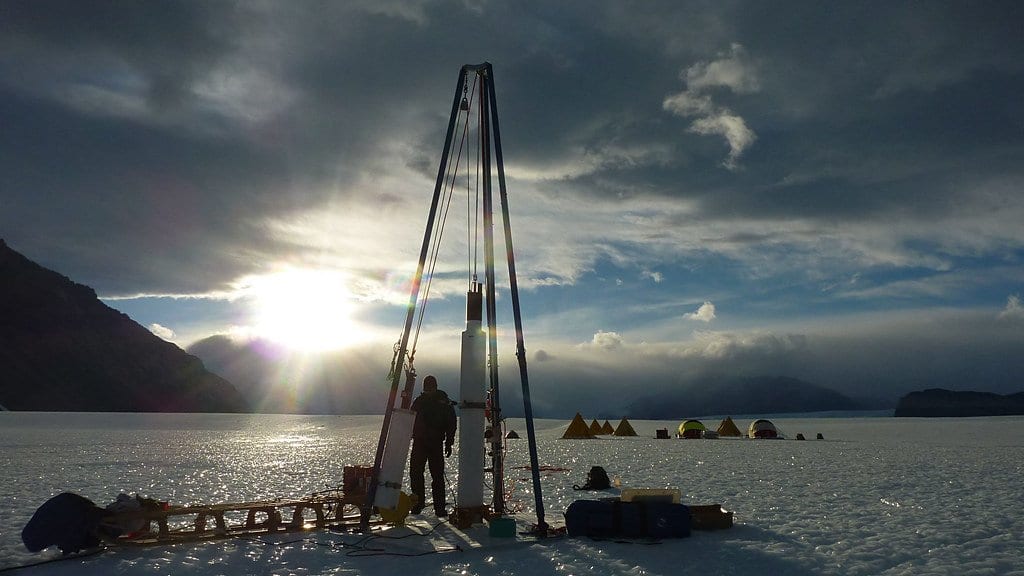
Sunlight-driven chemistry in the top few meters of exposed Antarctic ice appears to change the greenhouse gases trapped inside it, Giyoon Lee and Jinho Ahn of Seoul National University and colleagues reported Sept. 8 in Communications Earth & Environment.
That bears on a shortcut the field has come to rely on. In blue-ice areas, wind scours the snow away and ancient ice comes to the surface, so a shallow core can reach air that elsewhere lies deep inside the ice sheet. Sunlight-driven chemistry should be weighed when gas records from those areas are interpreted.
The study draws on 11 shallow cores from the Larsen blue-ice area in northern Victoria Land, East Antarctica. Carbon dioxide fell with depth and settled near 4.60 meters. Methane climbed through the first meter or so, then fell away to about the same depth.
In the upper 1 to 2 meters, the oxygen in the trapped air was short of its heavier form, a pattern the authors read as consistent with reactions driven by sunlight, though the specific pathways involved and their overall significance remain uncertain. Carbon isotopes point to a mix of organic and inorganic sources for the extra carbon dioxide, and to an organic source for the extra methane.
The team tested the more ordinary explanations first. The warmest daily average temperature logged at the site is −6 °C, and the cores carried none of the bubble-free bands that refreezing leaves behind. Nitrogen isotopes put modern air leaking in through cracks at about 5% of the trapped gas, far too little to account for the excess. Dust and sea-salt markers held steady with depth, and microbial activity was ruled out as a primary driver as well.
The authors also offer a practical recommendation for anyone who handles such ice: keep unnecessary light off samples during collection, transport and storage. The study is open access, and the measurements behind it are posted on Figshare.
Sources
- doi.orgPeer-reviewed