IonQ Reports a Quantum Link Four Times Faster Than the Record It Cites
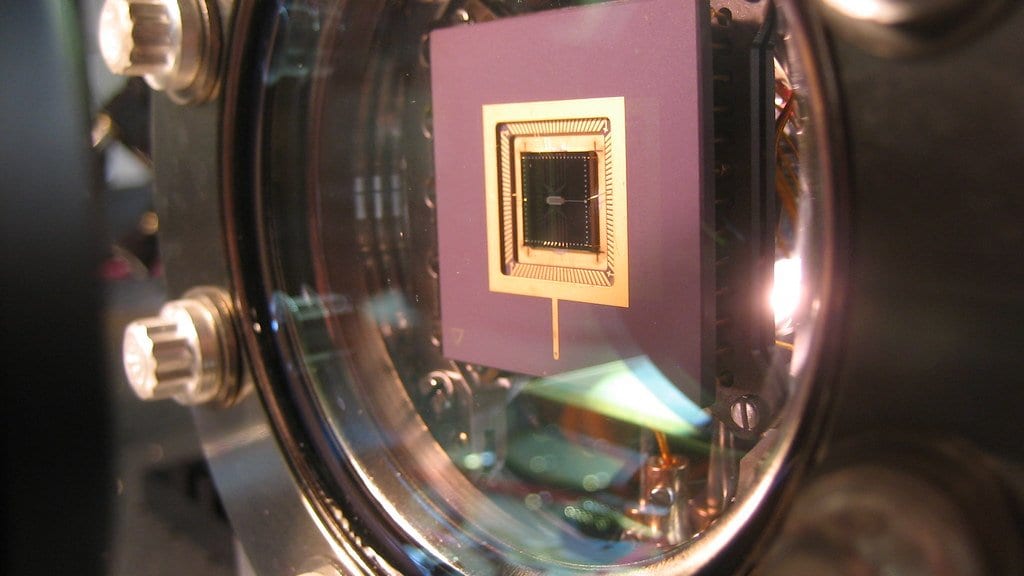
IonQ said on Oct. 9, 2026, that it had measured more than 1,000 entanglement events per second (1 kHz) between a trapped-ion qubit and a solid-state quantum memory linked by light. The rate is the company's own measurement, and no independent or peer-reviewed account of it has been published.
Entanglement is the connection that makes two separate quantum systems behave as one, and it is what networking quantum computers would run on. IonQ calls the speed of that connection a bottleneck and says the rate it reports is fast enough to support distributed quantum computing, meaning one calculation split across linked machines.
The two ends of the link are different kinds of hardware, and IonQ treats that as the point of the design: the trapped ion holds its quantum state unusually well, while the solid-state memory, which the company identifies as a silicon-vacancy device, couples more efficiently to light.
IonQ puts the new rate at more than four times the previous record for trapped ions, which it credits to the Duke University group of its co-founder and chief scientist Chris Monroe and cites as O'Reilly et al., Physical Review Letters 133, 090802 (2024). So the comparison is between a published, peer-reviewed result and an announcement: the new figure comes from a company release that names a technical paper and an arXiv preprint without printing an identifier for either, so the paper behind the claim is not identified.
IonQ says the same memory and interconnect approach feeds its work on HARQ, a program of the U.S. defense research agency DARPA that seeks interconnects able to work with more than one kind of qubit. The company expects the architecture to suit neutral atoms and superconducting systems as well, and says it has sold two of the systems, to the University of Maryland and to SDT in South Korea.