Middling Grazing Is a Sweet Spot for Steppe Plants, but Not for Soil Life
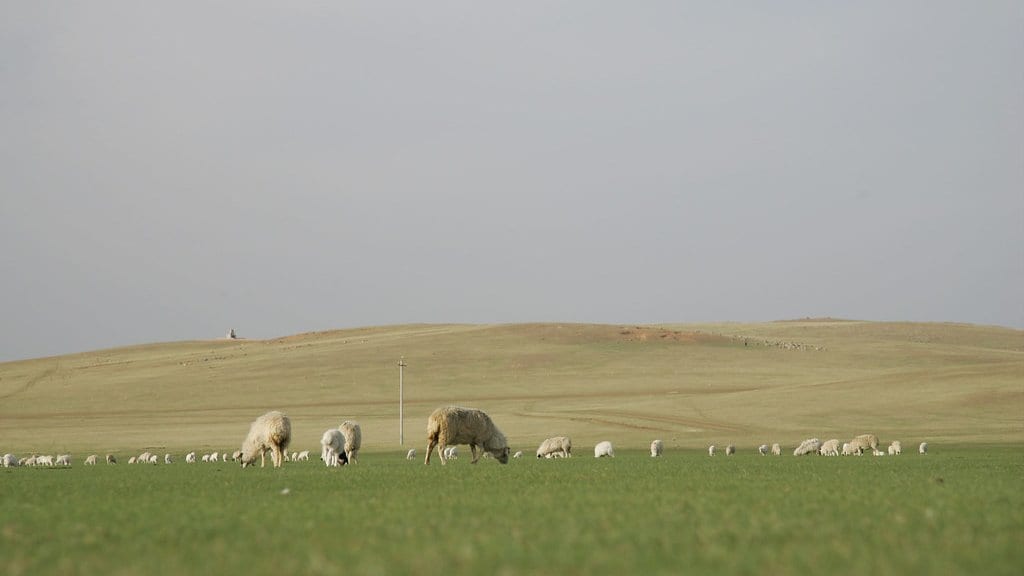
Plant diversity in a grazed Eurasian steppe peaked where grazing was neither heavy nor absent, as a long-standing idea in ecology predicts, while the community of organisms in the soil underneath did not follow that pattern. Jinlong Gao, Xuliang Zhuang and colleagues at the Chinese Academy of Sciences report the split in a study published Oct. 9, 2026, in Communications Earth & Environment.
The idea is known as the Intermediate Disturbance Hypothesis, and it has been tested mostly on plants. The paper reports that it does not carry across the layers of a food web, and the authors call for belowground communities to be built into the frameworks used to judge how grasslands hold up under global change.
Above ground, the authors report, diversity, plant mass and stability all rose and then fell again as grazing pressure increased, peaking in the middle of the gradient. Below ground, the number and mix of soil organisms at any one place barely responded. What changed was the difference between places, which peaked at moderate disturbance. The structure of the community changed too, as the network of associations among soil organisms grew simpler and shifted toward positive ones. The authors describe that as a reorganization rather than a loss of species, and say it is consistent with the stress-gradient hypothesis, in which organisms lean on each other more as conditions get harder.
The authors associate the two patterns with less carbon reaching the soil from the plants above. Along the gradient they measured lower dissolved organic carbon, the carbon carried in soil water, and a shift toward organic matter that soil organisms break down less easily. That connection is an association measured across the gradient, not an experiment that varied the carbon supply.
The study is open access, funded by the Chinese Academy of Sciences' Strategic Priority Research Program and the National Natural Science Foundation of China. The journal accepted it Sept. 17, 2026, and is sharing the accepted version ahead of the final published one.
Sources
- Communications Earth & EnvironmentPeer-reviewed