A Turbulence Model That Picks the Right Specialist for Each Patch of Flow

A team at the Chinese Academy of Sciences has replaced the single neural network that most machine-learned turbulence models rely on with a library of specialists, each trained on one kind of flow, and a lightweight rule that blends them point by point across a simulation. The work was published Oct. 8, 2026, in Communications Engineering.
Turbulence models stand in for the swirling motion a full simulation cannot afford to compute, and they set the limit on what engineers can predict about air over a wing, gas through a turbine or weather in the atmosphere. Hao-Chen Liu, Guowei He and colleagues at the Institute of Mechanics in Beijing say that predicting turbulent flows remains critically limited by the accuracy of those models, and that data-driven versions have so far leaned on single dense networks that struggle to generalize across different flow regimes, meaning physically different kinds of flow.
Their framework, factorized-gating mixture of experts, starts from an idea better known in large language models: split a model into parts and let a router decide how much each part contributes. The router is the hard piece. For turbulence it has to take in many flow quantities at once and return a weight for every expert. The change here is to break that one large decision into a short list of yes-or-no questions about the local flow, each tied to a physical attribute, and multiply the resulting probabilities together.
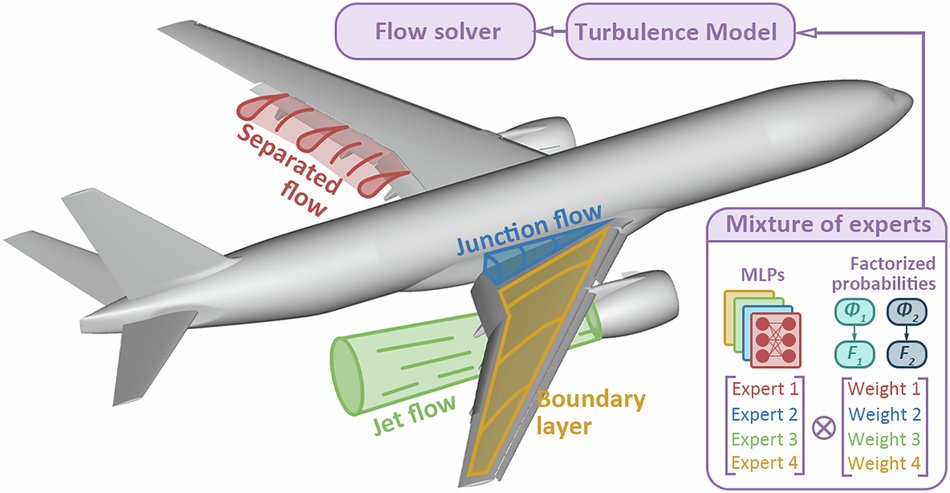
The authors report that this substantially reduces the complexity of the routing, makes it physically interpretable, and lets the expert library be expanded without retraining the entire model. The last of those is the practical one: adding a flow regime would not mean starting over.
How well it works is the authors' own measurement. They built the framework and ran the tests, which they describe as spanning standard benchmark flows through to real engineering applications, and report that accuracy held across the regimes they tried.
Sources
- Communications EngineeringPeer-reviewed