Your Phone Knew First: How Smartphone Quake Alerts Beat New Zealand's M5.9 Taumarunui Shake

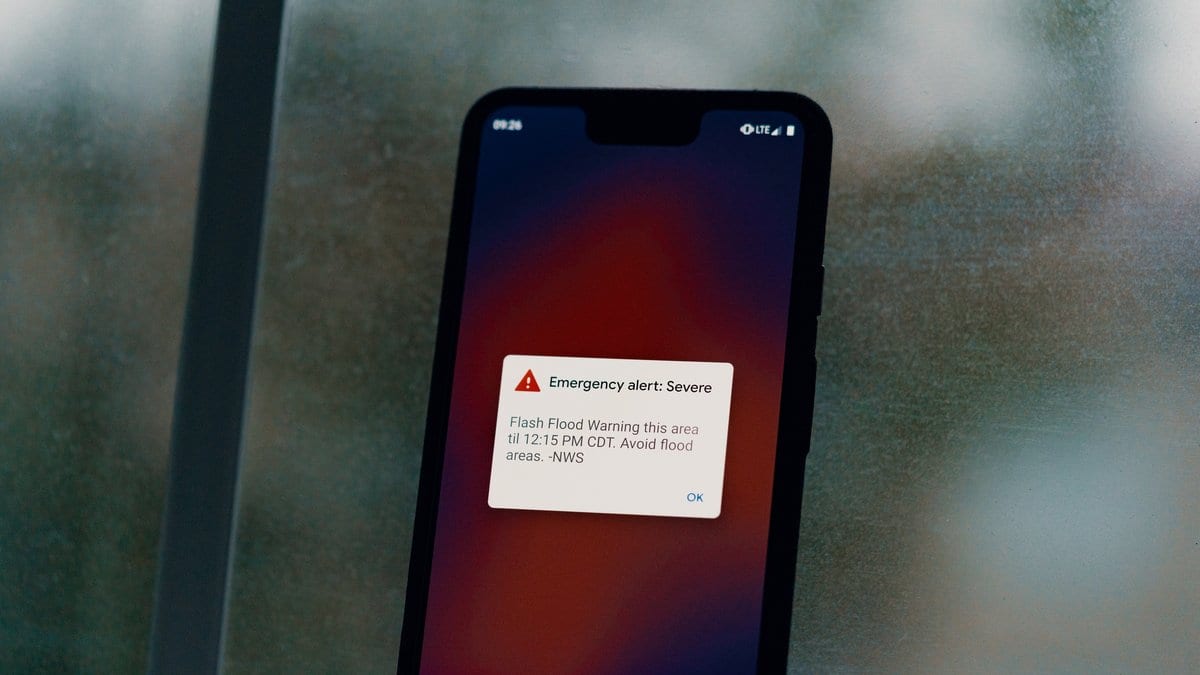
At 4:51 a.m. on Saturday, some North Islanders got a few seconds of notice that most earthquakes never give. Their phones buzzed loudly, overriding silent mode, a heartbeat before the ground began to move. New Zealand has no national earthquake early-warning system. Yet for a slice of the country, the warning came anyway, routed not through a government network but through the phone on the nightstand.
That warning rode a piece of physics as old as seismology and a sensing trick only a few years old. When a fault ruptures, it sends out two kinds of waves. The primary wave, the P-wave, is a fast compression pulse that arrives first but does little damage. Behind it comes the secondary wave, the S-wave, slower and far more destructive, the one that actually throws furniture and cracks plaster. The gap between them widens with distance. Near the epicenter, the two arrive almost together, so there is nothing to warn about. Farther out, that gap stretches into seconds, and seconds are enough to send a signal that outruns the shaking.
Google's Android Earthquake Alerts exploits exactly that head start. Every modern smartphone carries a tiny accelerometer, the chip that knows which way you are holding the screen. It is also, it turns out, a crude seismometer. When enough phones in one area feel the same sudden jolt at the same instant, Google's servers can tell a quake from a dropped handset or a passing truck, estimate its location and size, and push alerts outward faster than the S-waves can travel. The result is a sensing array made of ordinary hardware nobody bought for the purpose, spread across a country for free.
For the Taumarunui quake, the system behaved as designed. People close to the epicenter got little or no warning, because the damaging waves reached them almost at once. Farther away, the margin opened up. Some Auckland residents, more than 200 kilometers north, reported the alert landing just before the floor started to sway, according to 1News. Below magnitude 4.5, Android sends a quieter "Be Aware" notice; for a quake this size it fires the louder "Take Action" alert, engineered to punch through a phone left on silent overnight.
Why a phone network and not the government? New Zealand's Emergency Mobile Alert exists, but it was never built for this. It is meant for hazards that unfold over minutes or hours (tsunami, flooding, severe weather), where an official can log in, write a message, and decide who needs it. An earthquake gives no such runway. "By the time we would have logged into the system, written a message and decided where to send the alert, the quake would have been and gone," Civil Defence Manawatū-Whanganui told 1News. The math of the P/S-wave race leaves no room for a human in the loop. Automation is the only way the warning can win.
Beneath the alert story sits a geological one. GeoNet's rapid analysis traced the rupture to normal, or extensional, faulting in the upper crust: the ground pulling apart rather than being pushed together. Taumarunui lies at the western edge of the Taupō Volcanic Zone, a belt where the crust is being stretched thin as the Pacific Plate dives beneath the country farther east. No named fault takes the blame. The New Zealand Active Faults Database shows no mapped active trace at the epicenter, according to Newswire; the King Country is sparsely surveyed next to the plate-boundary zones, and this quake appears to have broken an unmapped structure hidden in that gap.
The volcanic zone also shaped how the shaking spread. The plateau's hot, fractured rock soaked up seismic energy, so the ground motion carried farther north and south than east, sparing the east coast much of the early jolt. GeoNet ranks it the strongest shallow earthquake (40 kilometers deep or less) recorded near Taumarunui in the modern instrumental record; the previous benchmarks were a magnitude-4.9 in 1957 and a magnitude-5.2 in 2020. A shallow source is exactly why a moderate magnitude felt so sharp: with only 9 kilometers of crust to travel through, the energy reached the surface with little to blunt it, and GeoNet logged severe shaking close to the epicenter and nearly 23,000 felt reports across both islands.
Aftershocks followed the usual pattern: more than 70 in the hours afterward, the largest a magnitude 3.7 about half an hour after the mainshock. GeoNet expects them to keep coming with decreasing frequency, while noting that a similar or larger event, though unlikely, can never be ruled out.
GeoNet's initial analysis will be refined as seismologists work through the aftershock data in the weeks ahead. But the earthquake also provided a real-world demonstration of what a crowdsourced warning system can do. In a country without a national earthquake early-warning network, phones already in people's hands gave some residents a few seconds of warning before the shaking reached them.