Kamchatka's Shiveluch Drew on Two Different Magmas a Year Apart

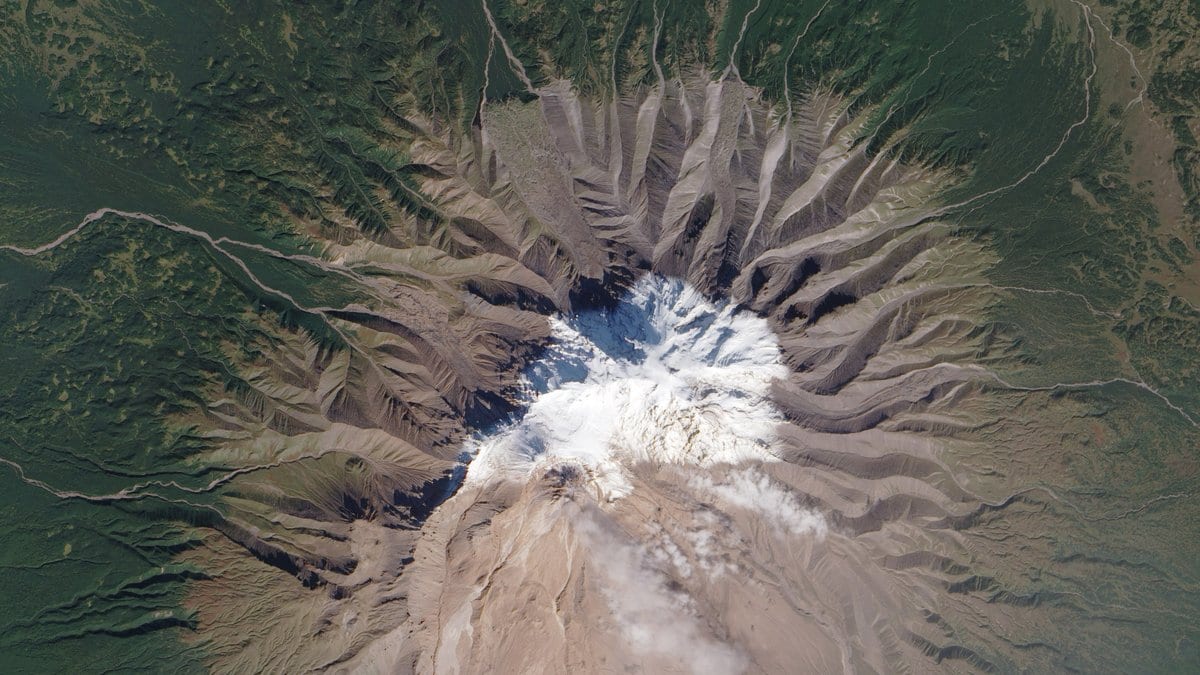
On April 10, 2023, Shiveluch blew up. The explosive eruption on Russia's Kamchatka Peninsula was about VEI 4 on the scale of eruption size, and the largest event at this volcanic center in six decades. About a year later, the volcano was building again, and not in the same place: a new dome, the New Karan Dome, rose about 5.5 kilometers southwest of the crater. The rock it was made of was not the rock of 2023.
That contrast is the starting point of a paper published Oct. 10, 2026, in Bulletin of Volcanology by Alexandra Shakirova and Andrey Chemarev of the Kamchatka Branch of the Geophysical Survey, with Natalia Gorbach of the Institute of Volcanology and Seismology. All three work in Petropavlovsk-Kamchatsky. They set the volcano's seismic record from 2021 to 2024 against the chemistry of what it erupted, and conclude that the two eruptions tapped magma bodies differing in composition and sitting at different depths.
A year is quick for this. The paper's own words for the sequence are "rapid reorganization" and "near-synchronous activation," and the comparison is close at hand: the last eruption of this size at Shiveluch was six decades earlier.
The evidence comes in two kinds, and neither would carry the argument alone. One is the continuous seismic record from the Kamchatkan network, sorted by a technique that groups earthquakes whose recordings look almost identical. A family of such look-alike events is read as one small patch of rock breaking over and over, so a family appearing in a new place marks where the system is working. The other is the erupted rock. The 2023 eruption produced andesite, with dark inclusions of a denser magma from deeper down scattered through it. The 2024 dome was basaltic andesite: poorer in silica, and unusually rich in the mineral amphibole, a composition reported at Shiveluch for the first time by Gorbach and colleagues in 2025.
Three depths run through the account, and they are three different kinds of number. The shallowest is a reservoir 4.5 to 6 kilometers down. The paper's reading of the 2023 eruption is that it was likely driven by deep magma recharging the system from below. On that reading, the rising magma pushed volatiles, the water and gas dissolved in it, into the shallow store. The support offered is the seismic data, plus the consistency of those dark inclusions. Nobody imaged the reservoir; its depth is a position the data fit.
The deepest number is 35 kilometers. After the eruption, seismic activity shifted toward the Karan domes and reached that far down, and because those earthquakes were located rather than inferred, it is the most nearly measured of the three figures. It is also a maximum, not a typical depth.
Between the two sits a deep storage zone at 16 to 25 kilometers, and this one is an inference about a magma body drawn from how earthquakes behaved near it. The families there record what the paper describes as magma or volatiles, or both, arriving from the base of the crust. They also record the pressurizing of that deep zone, the reactivation of an old weakness in the rock, and the slowly intensifying activity that ran up to the later eruptions.
That is the whole toolkit: earthquakes and rock chemistry, across 2021 to 2024. There is no scan of the crust to picture a magma body, no ground movement measured from orbit, no study of melt trapped inside crystals. So of the three depths, one is where earthquakes were located and two are where magma is inferred to sit.
As for why the two eruptions came so close together, the paper offers a pairing rather than a single cause. Deep recharge starts the sequence. Then the big explosive eruption empties enough of the shallow system to drop the pressure, and that decompression lets magma rise through the crust to feed what follows. In the paper's own wording, the short interval between the two reflects those coupled effects, and the paper puts that forward as the likely sequence rather than a demonstrated one.
Nothing was handed from one reservoir to the other. The 2024 magma is a separate batch, deeper and richer in iron and magnesium, and what the first eruption gave it was a drop in pressure.
Both halves of this were already on the record. The 2024 rock came from Gorbach and colleagues, and the new paper's tenth figure is adapted from their work; the seismicity had been published separately by Shakirova and Chemarev in 2025. What is new on Oct. 10, 2026, is the peer-reviewed join: the two records read against each other, and the coupled mechanism that comes out of it.
The new dome was also picked up independently from orbit: a separate team working continuous satellite monitoring logged its first heat signature in April 2024. On the day of the eruption, the literature is not quite unanimous: Girina and colleagues treat it as a multi-day event and Zharinov and Demyanchuk date it April 11, 2023.
The part of this likely to outlast the particular eruption is the pairing of the two records. Rock chemistry says what melted and roughly where it was stored. Earthquake families say when something moved. Neither, on its own, would have put the 2023 andesite and the 2024 basaltic andesite into the same story.