A Sky Survey Found Most Satellite Constellations Brighter Than Astronomers Recommend

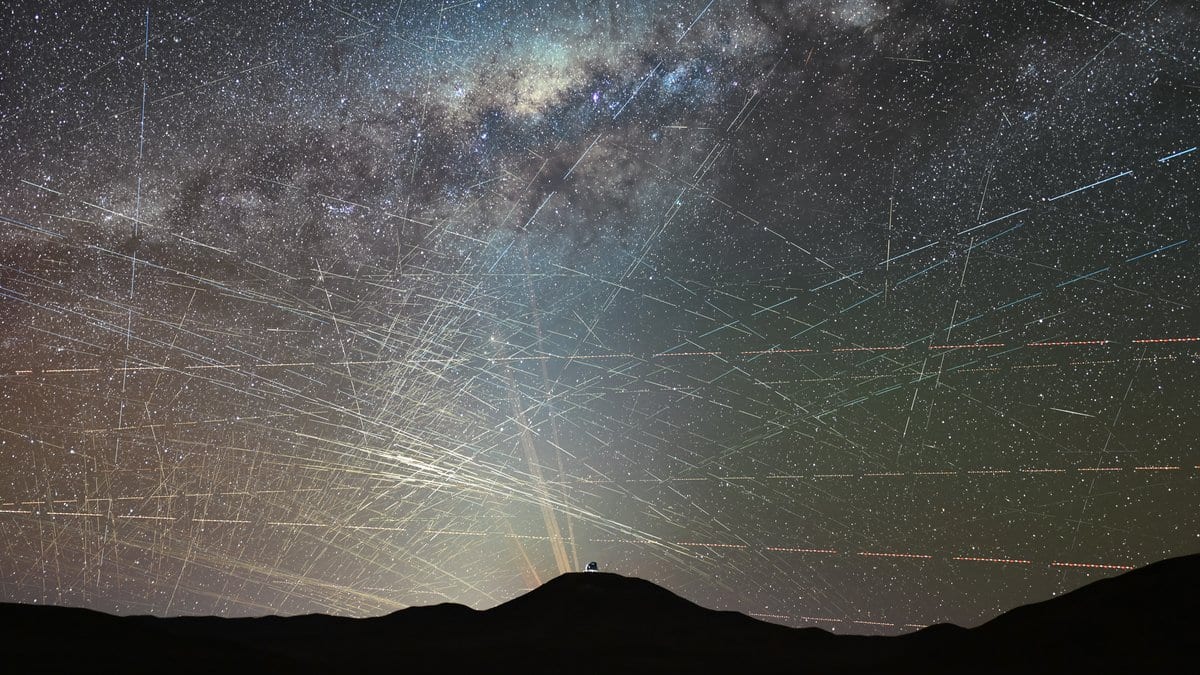
Six cameras in a field in southwestern Ontario spent 36 nights pointed at nothing in particular. None of them moved. Between Oct. 7 and Nov. 11, 2024, whatever crossed those patches of sky was measured, and almost everything that crossed them was a satellite. The tally from Elginfield Observatory was 24,812 satellite tracks from 5,118 individual spacecraft, recorded during 230 clear hours out of 407 possible.
The staring is the point. Satellite brightness has mostly been measured by tracking spacecraft chosen in advance, which says little about what fraction of the whole population is too bright. The Ontario array, Project Luciole, uses 14 off-the-shelf low-light video cameras running at 25 frames a second. It was adapted from the Global Meteor Network, the meteor-camera project that co-author Denis Vida runs at Western. Jack Rayworth and nine colleagues, eight of them at the University of Western Ontario and one at Defence R&D Canada, posted the results as a preprint on Oct. 7, 2026. The paper is under revision at a journal and has not been accepted.
The line the survey measures against is not a law. A 2020 report from the SATCON1 workshop recommended that a satellite in reflected sunlight stay fainter than magnitude 7, just below naked-eye visibility, at altitudes up to 550 kilometers. Above that altitude, the recommended limit gets fainter still, because a satellite in a higher orbit crosses the sky more slowly and leaves a denser trail on a telescope image. The International Astronomical Union's Centre for the Protection of the Dark and Quiet Sky endorsed the recommendation. No regulator limits how much sunlight a satellite may reflect, and operators are not required to meet the recommendation. The Centre signed a cooperation agreement with the European Space Agency on Oct. 8, 2026, but that agreement does not change the recommendation's voluntary status.
For one operator, the figure is more than a suggestion. When the US National Science Foundation and SpaceX announced a coordination agreement on Jan. 10, 2023, NSF's NOIRLab described the company as working toward recommendations that included reducing the optical brightness of its satellites to magnitude 7 or fainter, keeping orbital altitudes around 700 kilometers or lower, and publishing orbital information. Starlink, then, has a publicly stated commitment to work toward a brightness target, though that is not the same as being required to meet it.
Who sits above the line, and how often
The survey's central result is a rate rather than a count, and the denominator is the crucial detail. Rayworth and colleagues counted only those passes that public orbital data predicted would cross a working camera's field of view, accounting for cloud cover, camera downtime and atmospheric losses. On that measure, Starlink exceeded the recommended brightness limit on about 25% of possible passes, spent rocket bodies did so on about 21%, while the newer Guowang/Hulianwang constellation and the Fengyun group exceeded it on more than half. OneWeb was the exception, at about 6%. Because the rate is expressed as a proportion of eligible passes rather than a raw count, it can help compare constellations of different sizes. Guowang's planned expansion is to 13,000 satellites.
Starlink still accounted for roughly two-thirds of all the over-limit passes the cameras recorded, by sheer number. The faint end of the survey carries a caveat that qualifies its most quotable result: the narrow-field cameras can detect satellites as faint as magnitude 9, but the sample is complete only to magnitude 6.15. As a result, satellites fainter than that threshold are underrepresented, and the fraction of passes exceeding the brightness limit may be underestimated for constellations dominated by fainter satellites. The authors acknowledge this limitation and state that the reported percentages for those classes, including OneWeb, are lower limits.
OneWeb is where the paper makes its main interpretive claim. Its 6% result, the authors write, "shows that effective brightness mitigation is achievable with current technology." They do not attribute the result to orbital altitude alone. OneWeb operates at 1,200 kilometers, but Gonets and Globalstar orbit at comparable or greater altitudes and were measured as substantially brighter.
The most critical hours are when satellites are visible
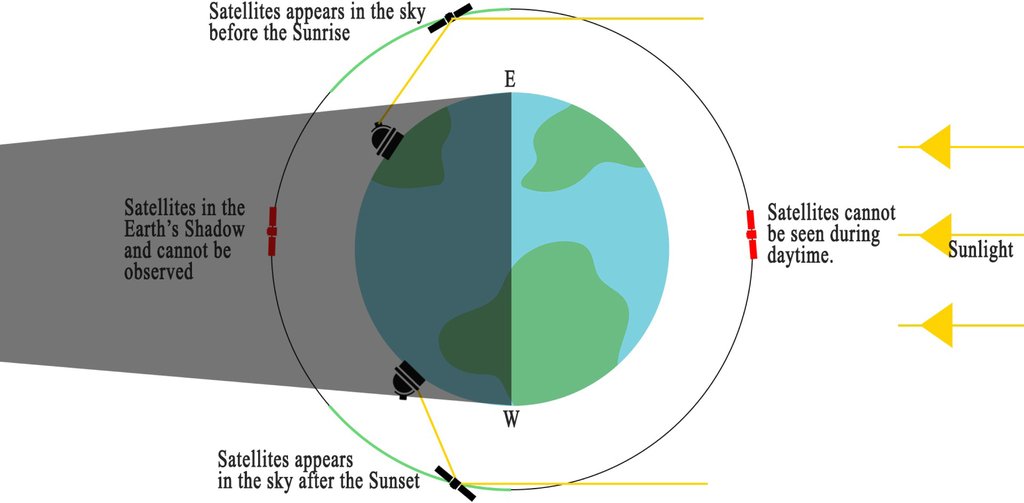
Timing is the other half of the paper. Almost every track landed in the two hours after sunset or the two hours before sunrise; through the middle of the night, most low-orbit satellites sit in Earth's shadow and go dark. A geometric model the team built to generalize beyond Ontario estimates about 3.3 hours of satellite visibility per night, with little variation through the year, at latitudes between 35 degrees south and 35 degrees north. Those are also the hours observatories use to take calibration images on which the rest of a night's data depend, and when searches for asteroids closer to the Sun than Earth have to run. The authors describe the cost as "not a statistical loss of observing time so much as a targeted threat to particular scientific goals."
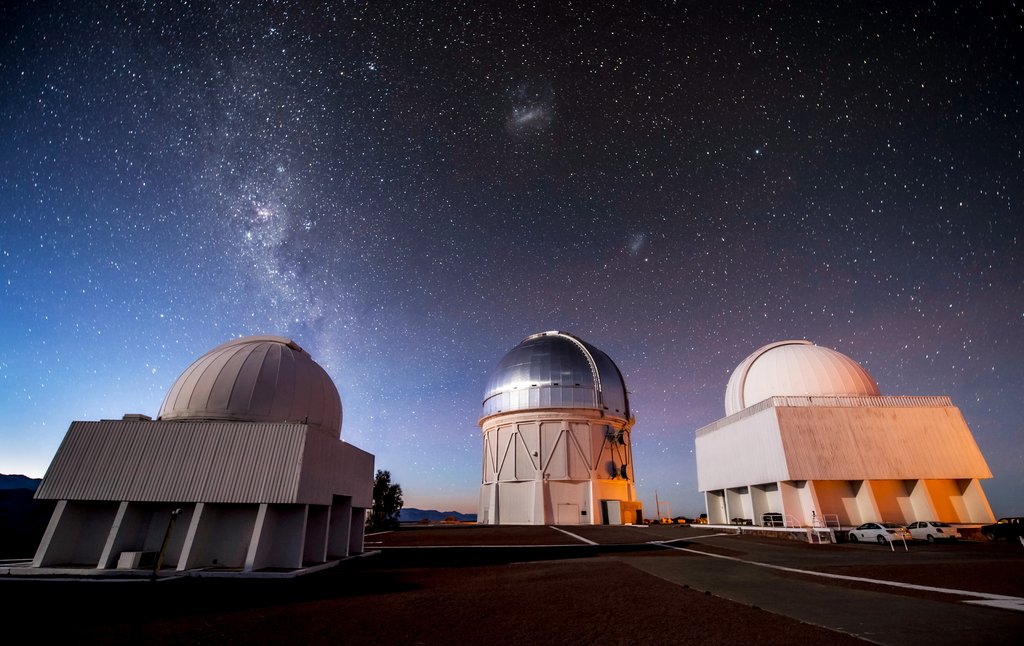
Using the measured density of satellite trails, expressed as satellites per square degree per minute, the team predicts that about one in three 30-second exposures at the Vera C. Rubin Observatory will contain a trail. The estimate has three important limitations. It is based on the Ontario measurements, not observations by Rubin; it applies only within the roughly 3.6-hour window of intense satellite visibility at Rubin's latitude, not across the entire night; and the underlying density has an uncertainty of more than 40%. The one-in-three figure should therefore be treated as an approximate estimate, not a precise rate.
The survey also has a systematic gap. It misses satellites in the weeks after launch, while they raise their orbits, because public orbital elements are often unavailable during that period. These passes can be especially bright because the spacecraft are at lower altitudes and may be held at unusual orientations. The authors therefore treat their estimates as lower limits on the frequency of the most disruptive events.
What the operators have put on the record
No operator has publicly responded to this survey, which was posted online on Oct. 7, 2026. SpaceX's position is on the record elsewhere: alongside its commitment to work toward magnitude 7 or fainter, it publishes a brightness-mitigation guide for satellite operators. The effectiveness of those measures has also been assessed by outside researchers. Anthony Mallama, Richard E. Cole, Jay Respler and Scott Harrington found that Starlink's Mini Direct-to-Cell satellites had an average apparent magnitude of 5.16 in brightness-mitigation mode, still brighter than magnitude 7. They also reported that the satellites grew fainter through 2024 after SpaceX adjusted their orientations. The Ontario data point in the same direction: the Version 2.0 Mini Direct-to-Cell satellites detected by the survey appear to reverse the dimming trend Starlink had established between 2020 and early 2024.
The broad conclusion is not new. Mallama and Cole reached a similar conclusion using a different dataset in Monthly Notices of the Royal Astronomical Society: Letters on Sept. 11, 2025. Both are affiliated with the IAU Centre that endorsed the recommendation, and the IAU and the Centre funded their paper. The closest independent confirmation of the headline therefore comes from researchers affiliated with the body that endorsed the recommendation. A separate survey from Steward Observatory is independent of both, and none of the 10 authors of the Ontario study is affiliated with the IAU Centre.
What the measurement changes is where mitigation needs to happen. For most of the large constellations, typical satellite brightness exceeded the recommended limit at their operating altitudes. This suggests that the problem lies in the ordinary reflectivity of the spacecraft bus, antennas and solar arrays, rather than only in occasional glints. Those characteristics are largely determined during spacecraft design and manufacturing, not once the satellites are in orbit.
Sources
- arXivPreprint
- Monthly Notices of the Royal Astronomical Society: Letters
- arXivPreprint
- arXivPreprint
- noirlab.edu